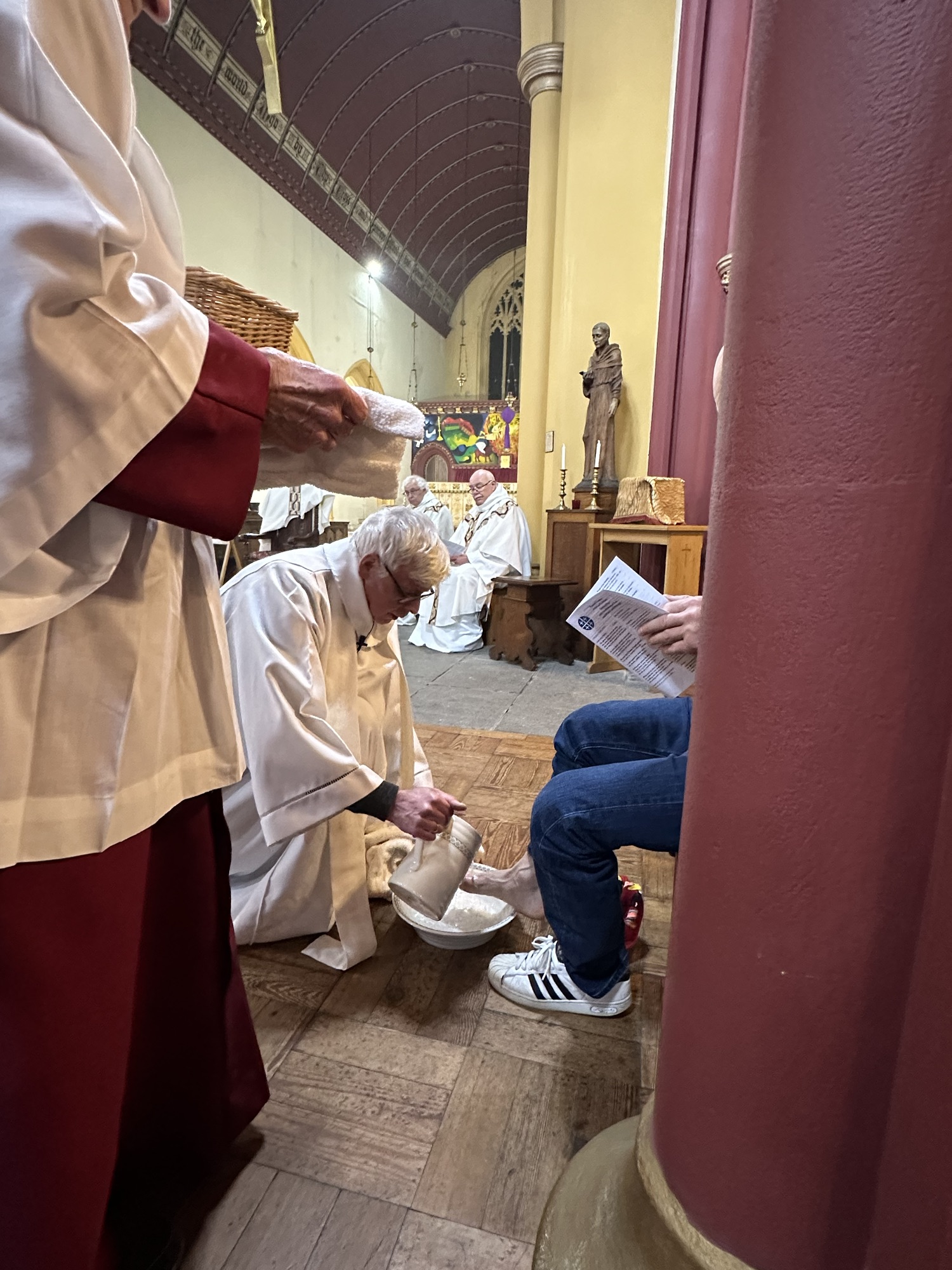
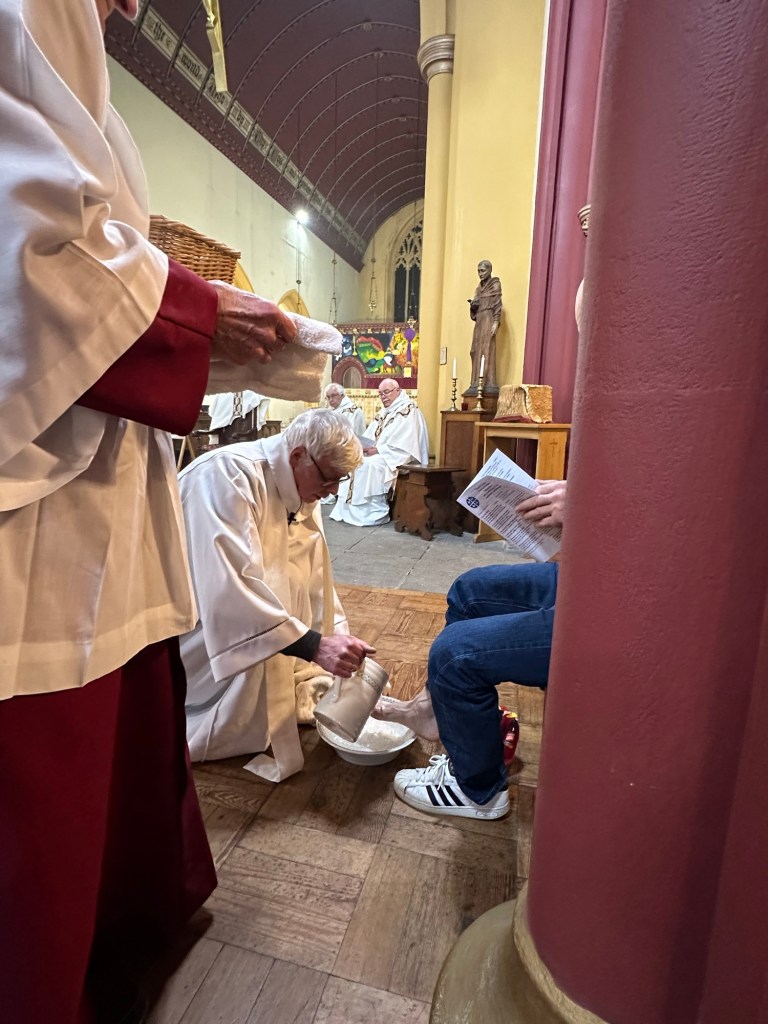
In the homily at the Evening Mass of the Lord’s Supper, Fr Dean explores the connection between the Eucharist, the crucifixion and our life of service.
Darren McGarvey, also known by the stage name Loki, grew up in Pollock on the south side of Glasgow. Today, he is a writer, columnist and Rap artist. He became the first ever Rapper in residence at Police Scotland’s Violence Reduction Unit.
In his book “Poverty Safari: understanding the anger of Britain’s underclass” he provides moving insights into his own experience of growing up in poverty, a life surrounded by anger and violence, drugs and crime, inequality and difficulties.
In one passage, he shares a moment when he was five years old. His mother was partying downstairs with friends, and so he decided to join them with the plan of being able to stay up a little later and join in the fun. But his plan turned into a distressing moment of anger and violence. His mother ran to the kitchen, grabbed a knife, and chased him as he stumbled up the stairs to his bedroom.
“If only I had the sense to run out of the front door instead,” he writes. “Seconds before, she had appeared to be having so much fun that it had felt safe to wind her up in front of people. Now I was trapped in my room, pinned against the wall, with a knife to my throat. I don’t remember what she said to me but I do remember the hate in her eyes. I remember thinking that I was about to be cut open and that I would probably die. Just as she lifted the knife to my face, she was pulled from behind and thrown to the other side of the room by my dad, who then restrained her while one of the guests picked me up and bundled me into the back of a car.
“I don’t remember my mother, or anyone else, ever talking about that night again. Truth be told, I forgot about it myself until many years later, when it came back to me in the form of a flashback.”
Our memories play tricks on us. Sometimes, for those who have experienced great trauma, their brain tries to protect them from harm, pushes away, into the deep recess of their mind, some painful memory too much to take, too much to process but which somehow emerges later in life. Sometimes, in other extreme cases, humans are even able to create false memories, construct events and experiences that never happened but which seem as clear as day.
Our minds and memories are complex.
For Darren McGarvey, it was only later, as he began to put his life together and address his own power to bring change, that the pain of the past could be seen more clearly.
This evening, we begin to enter sacramentally into the Mystery of Christ’s pain, death and resurrection. We do so with a sense of hindsight. The past is made present, the memories are made clear right in our midst.
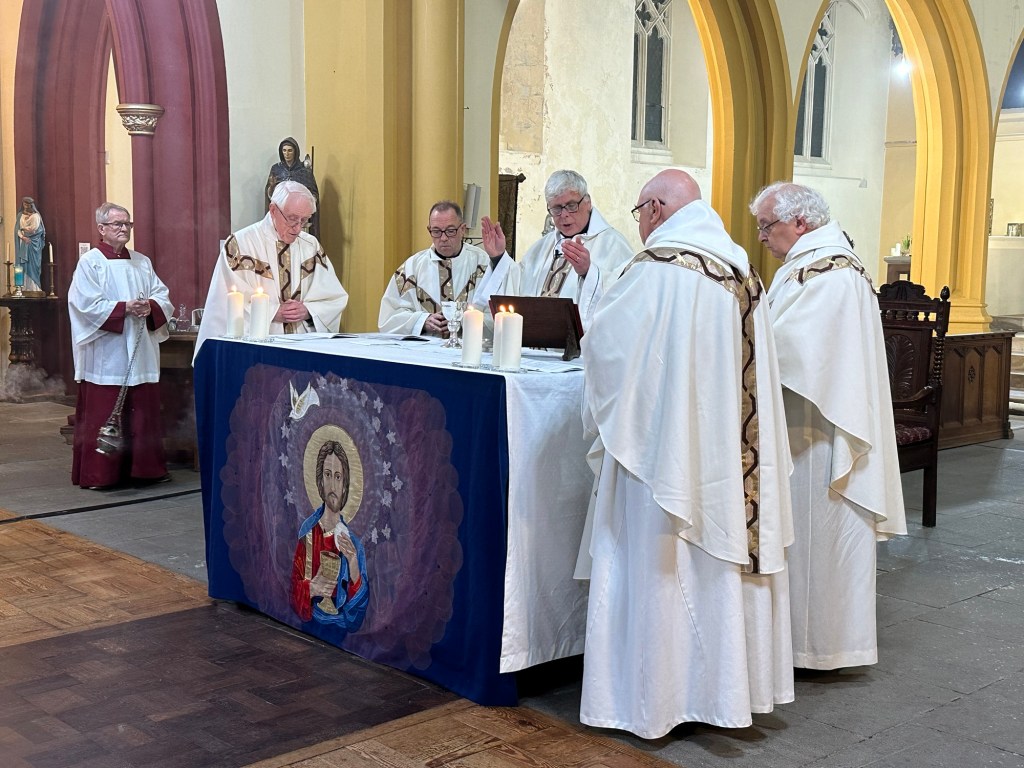
In some ritual, liturgical and shared way, we draw closer to the cross of Jesus – to his love, to his life, to his power to save, to the way in which he makes sense of our lives.
This is the night on which Jesus broke bread, the night on which he gave us a new way of remembering and recalling, of sharing in his life, in his death, and in his resurrection.
St Teresa of Calcutta said, “The Eucharist is connected to the Passion (of Jesus). If Jesus had not established the Eucharist we would have forgotten the crucifixion. It would have faded into the past and we would have forgotten that Jesus loved us. To make sure that we do not forget, Jesus gave us the Eucharist, as a memorial of his love.”
This is such a simple thing. The Eucharist recalls, reminds us of the cross. It’s what St Paul meant when he wrote, “Every time we eat this bread and drink this cup, we proclaim the Lord’s death until he comes again.”
Back to Darren McGarvey, whose words we began with. “In ‘deprived’ areas, where resources are scarce, gossip is a form of currency, and if you’re unlucky enough to hail from a visibly troubled family, you are presented with a choice: you can let others people talk about it or you can become the author of your own story – which is exactly what I did.”
Now and over the coming days, through word and action, we tell the story of God’s love for the world. We move through the moments of this Mass tonight until it stands froze, locked in that Gethsemane moment of struggle and prayer.
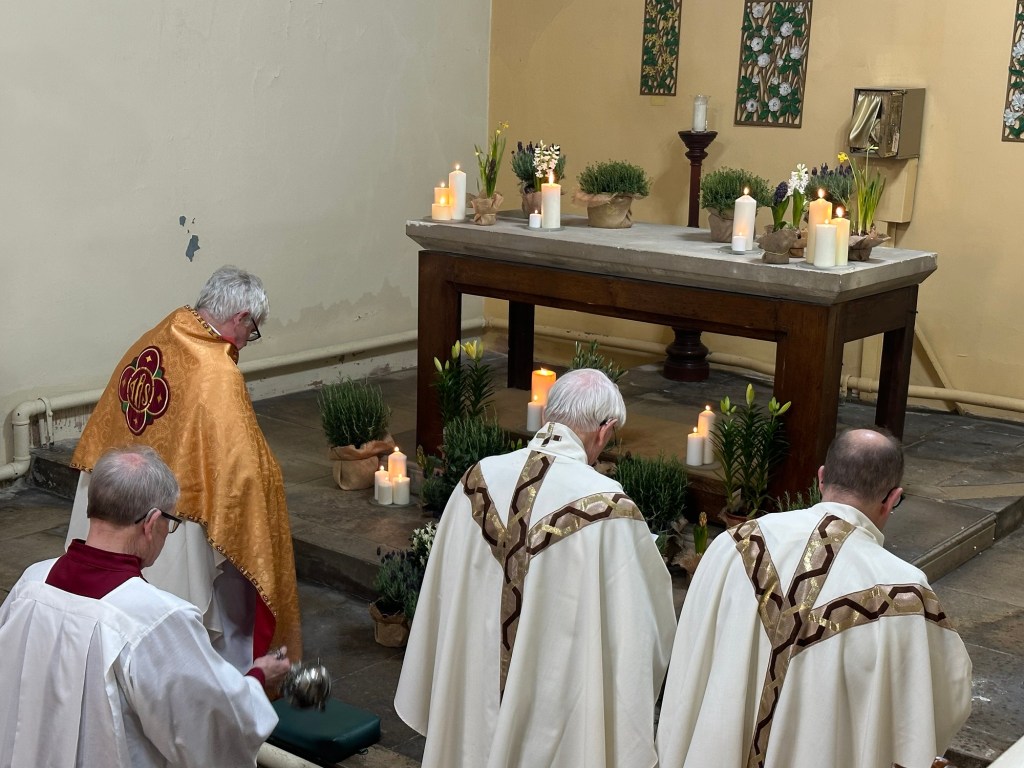
Tomorrow, we will lean closer to the cross of Christ as we bring our pain to his, and wonder at “Love so amazing, so divine.”
We will wait and watch and gather in darkness on Saturday evening to celebrate the unfolding of God’s Love story which elaborates into a life that doesn’t end, into the remarkable, redeeming presence of Jesus for ever.
In tonight’s gospel story, we hear how the reality of the Eucharist can be expressed and told in our own day, in our own way. As he leaves the table, clothed with a towel, Jesus acts out that life of service. It’s a role-play of divine proportions, a scene filled with love. And the only stage direction is to do for others as he has done for us.
As the Eucharist is connected to the Passion of Jesus, so it’s connected to the pains of everyone. Flowing from the Eucharist is our service of those who are in need. The clean pristine cloth of the altar is never far away from the grime of our feet. The trimmed candles and polished silver are not separate from the dirt of the street.
Everything we do throughout these days is underwritten by the story of God in Christ. We don’t change the story of God’s love for the world. We allow it to change us, and so through changed lives, take part in changing the world and transforming the lives of others.
Much of the world and our society, despite growing in secularism, still know some of the story of Jesus. They are free to take what they want from it. They can place it alongside all the other stories they know or think they know. They can file the stories away as fables or store them alongside other sacred stories.
It’s our calling to share the gospel truth, the story of Jesus’ love with its grim and great reality, with all its outtakes and spin offs, with its sequels and extended material, as we become part of the story, live it out, pass it on.
We are invited to allow God, the author of life, to draw us deeper into the story which is his. To be, as St Teresa said, “a little pencil in the hand of God, who is writing a love letter to the world.”
We can allow others to distort and try to hide the story of God in Christ, or we can take that story, and live it out in our own lives, beginning here at the place where God calls us back to the cross of Jesus, to the love of Jesus.
Without the Eucharist we would forget the cross. Let us never forget the cross. Let us never forget the Eucharist. And let us never forget our calling to be that light in the world, the salt of the earth, the yeast, the leaven, the pencil in the hand of God.
From here, as Christ fulfils our hunger, may we go out and fulfil the hunger of others.
The story is out there.
It’s our calling to fill in the gaps, to stand in those places, to stoop to those feet, to let the memory live, to be faithful to the Eucharist, to be faithful to the Cross, to be faithful to God’s love in action.
“Lord, make me an instrument of Your peace;
where there is hatred, let me sow love;
where there is injury, pardon;
where there is doubt, faith;
where there is despair, hope;
where there is darkness, light;
and where there is sadness, joy.
O Divine Master,
grant that I may not so much seek
to be consoled as to console;
to be understood, as to understand;
to be loved, as to love;
for it is in giving that we receive,
it is in pardoning that we are pardoned,
and it is in dying that we are born to Eternal Life.”
(Prayer of St Francis of Assisi)
 South Cardiff Ministry Area