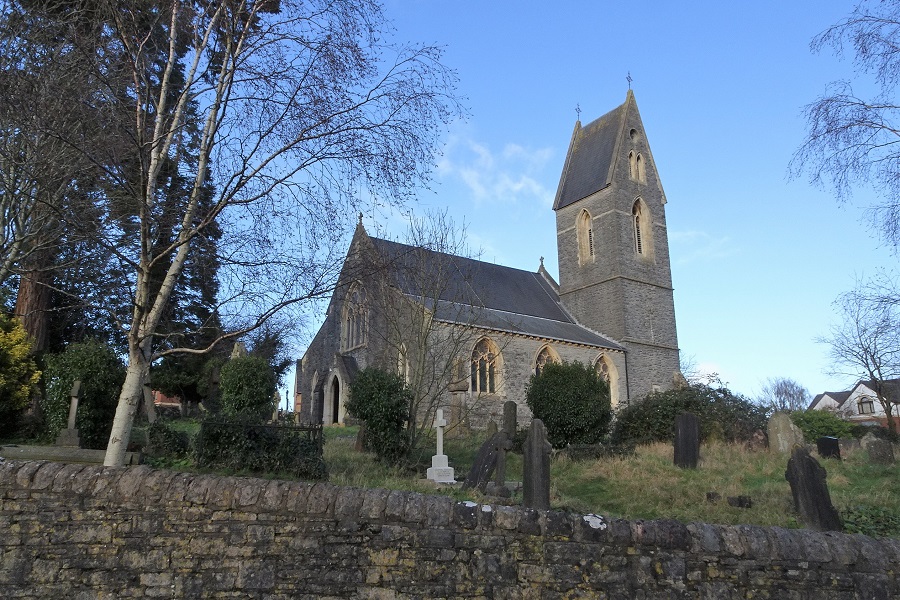
Llandough, so easily seen in its hill top location from Cardiff Bay, derives its name from St Dochdwy whose monastic settlement existed here from perhaps the fifth century.
In all likelihood, the Roman villa which stood here was transferred to him. It soon stood out amongst one of the three leading communities of its day, along with the greater Llantwit Major and Llancarfan which is why, perhaps, St Eudogwy appealed to the abbots of those three Llans to act collectively against a local corrupt chieftain.
Known as Bangor Dochau, the first permanent church here was built in the twelfth century. The present church is one of two successive churches built since then, the final stones stacked in 1820. However, the tall Irbic Cross in Sutton Stone which stands in the graveyard dates back to the tenth or eleventh century. Some suggest the monument may be a memory to Dochdwy’s grandfather. At one time, before its dismemberment, it would have stood over ten feet tall.
Meanwhile, excavations in a neighbouring field (to make way for a housing development) discovered over a thousand bodies. They dated from the fifth to the tenth or eleventh century at which point the monastery was possibly disbanded.



Hwyl
The hilltop Llan
of Dochdwy's dwelling
looks over a city
which sprawls from the sea
to the feet of the valleys.

Buildings come and go
across a crane filled landscape.

Was Dochdwy laid to rest here
in the graveyard discovered
a few decades ago,
a thousand bodies buried
in a site now buried by homes?

White quartz pebbles
pressed onto their brow and their bodies,
for the dead to throw at the devil,
or as a token of admission
to a new world
each with a new name
scratched in white.

Here, on this hilltop Llan
with a sight of the city
stood Dochdwy's monastic home.

Here, the Irbic Cross
of Sutton stone
stands tall,
ten feet high.
It stands the test of time
as the city we see
still builds up,
builds higher,
sprawls further
beyond the hilltop Llan
of Dochdwy's dwelling
as we seek a new city,
the heavenly Jerusalem.
Bible Reading
From Revelation 21:1-6

Then I saw a new heaven and a new earth; for the first heaven and the first earth had passed away, and the sea was no more. And I saw the holy city, the new Jerusalem, coming down out of heaven from God, prepared as a bride adorned for her husband. And I heard a loud voice from the throne saying, ‘See, the home of God is among mortals. He will dwell with them; they will be his peoples, and God himself will be with them; he will wipe every tear from their eyes. Death will be no more; mourning and crying and pain will be no more, for the first things have passed away.’
Prayer
Lord God,
here I stand
in the Llan of Dochdwy,
his history lost in time
but his name still clings
to this landscape.

Most of us will be forgotten
in generations to come,
no monument,
no memory,
but you have always known us
and will know us still
as citizens of Heaven,
and a new world.

Help us to know that we are loved,
and to love in return,
to treat each person
with dignity and respect,
for all are loved by you.
Through Jesus Christ our Lord. Amen.
Stay Awhile
Stay awhile, be still, and be at peace.
Enjoy the ground
on which you sit or stand.
Hear the life of the village,
the sound of the birds.

Savour the stillness of the church,
admire the weathered beauty
of the Cross in Sutton stone
rooted here
for a thousand years.

Let this be a moment for you,
in the heart of this village,
on this sacred ground,
to know God’s love
in Christ.
Pray for
Pray for the city and people of Llandough,
for the church community of St Dochdwy
and the Penarth Ministry Area,
and for the staff and patients
of the hospital nearby.

Pray for the city of Cardiff,
and all involved in its governance.
Hwyl Fawr
May God guard us and keep us,
move with us and for us,
before us and around us,
that we may give him glory. Amen.

St Dochdwy, pray for us.
All the Saints of God, pray for us.
LINKS & INFO
Website: www.parishofpenarthandllandough.co.uk
Where next?
Plan your journey to the next part of the Llanscape of Wales using our Google Maps Trail:
 South Cardiff Ministry Area