Why is Sunday important to Christians? Why does the date of Easter change? What is Ash Wednesday?
Here you’ll find answers to these and many other questions about the times and seasons of the Church’s year

Introduction
‘Time passes. Listen. Time passes. Come closer now. Only you can hear the houses sleeping in the streets in the slow deep salt and silent black, bandaged night.’
So goes the beauty of Dylan Thomas’ words from ‘Under Milk Wood’ as we are invited closer, through the passing of time, into the life of the sleeping town.
The passing of time – the seconds and minutes, the hours and days and months, and the changing seasons of the year – provide a pattern and rhythm to life which frame how we live and move.
As we move to the heartbeat of nature, there is also a rhythm to the church’s year and our own passing of time, which takes us beyond time – to things eternal.
This series of two-minute reads offers an insight into how we pass our time. So, if you care to give them the time of day, we offer you quick connections to the times and seasons of the Church’s year.
To understand any of it, we need to begin with one particular day of the week, from which everything else will fall into place – Sunday!
QUICK LINKS
SUNDAY | EASTER | ASH WEDNESDAY & LENT | PALM SUNDAY | MAUNDY THURSDAY |GOOD FRIDAY |HOLY SATURDAY | ASCENSION AND PENTECOST | CHRISTMAS

SUNDAY
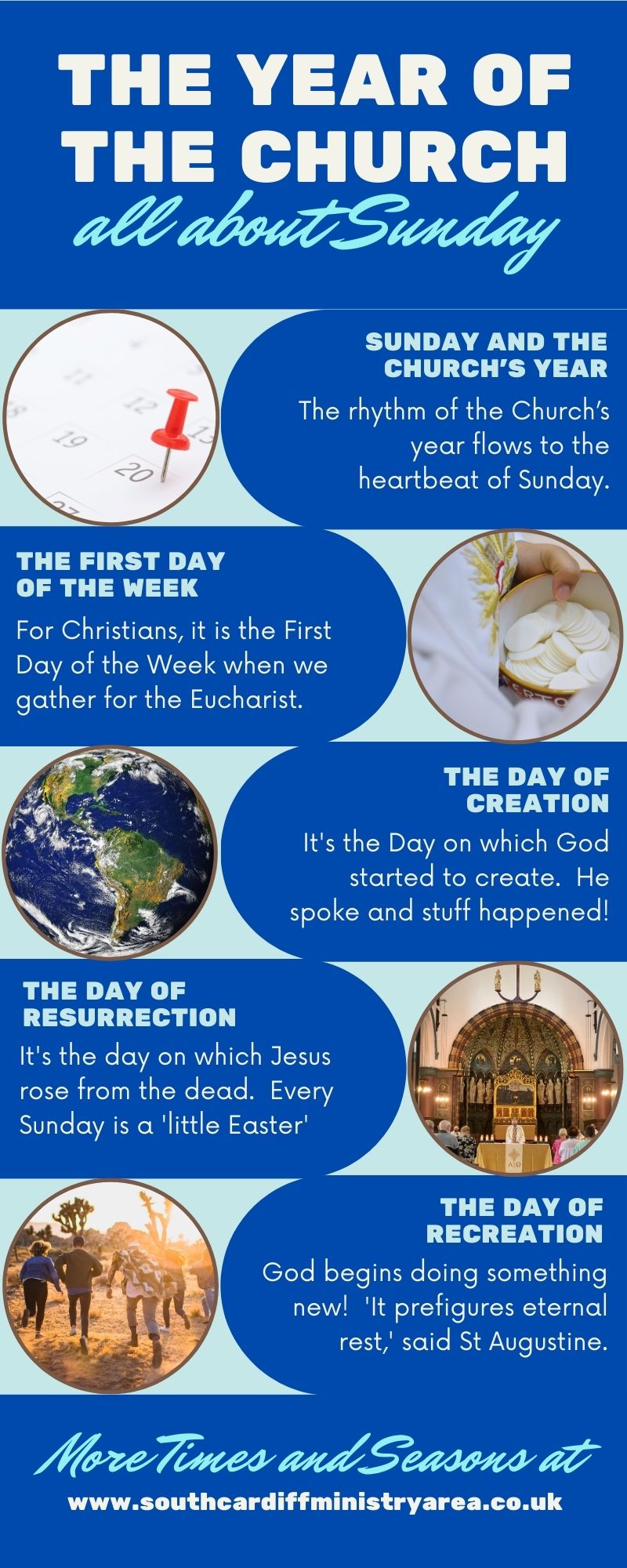
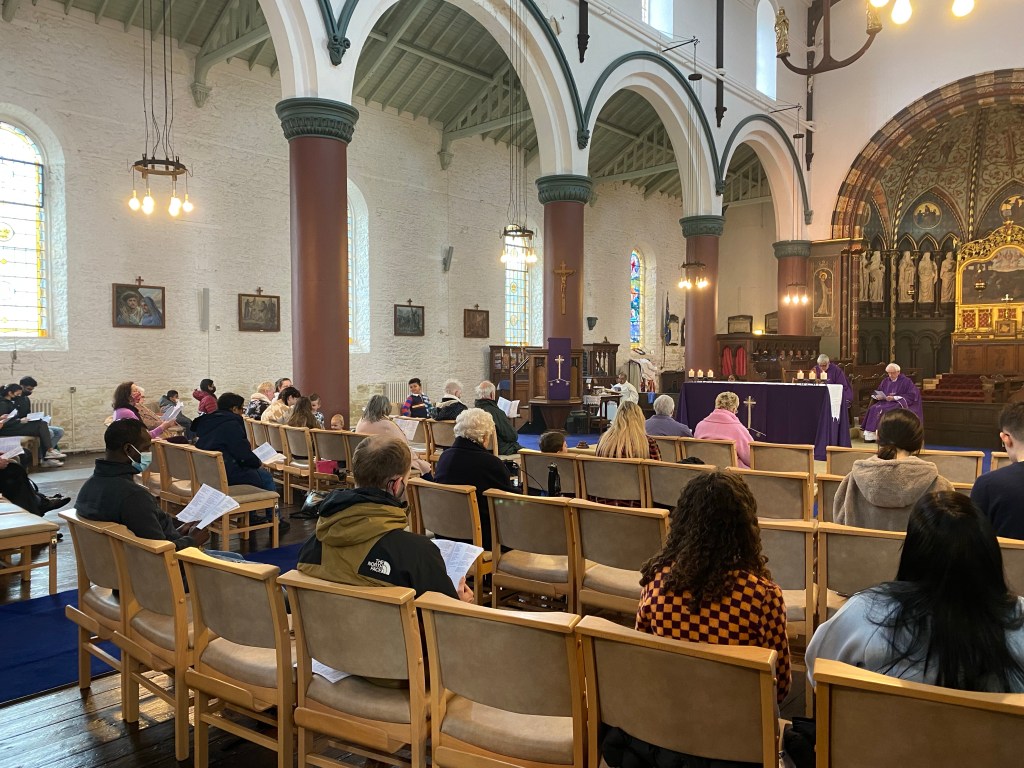
The rhythm of the Church’s year flows to the heartbeat of Sunday.
From very early on, Christians met on Sunday to celebrate the Eucharist. St John Chrysostom (in the 4th century) said,
“To abstain from this meal is to separate oneself from the Lord: the Sunday meal is that which we take in common with the Lord and with the brethren.’
But why Sunday?
Sunday is the Day of Creation.
Justin Martyr (writing in the second century) said it is the day “on which God transformed the darkness and matter to create the world.” (You can read all about it in the Book of Genesis!)
But then he goes on to say “and also because Jesus Christ our Saviour rose from the dead on the same day.”
Sunday is the Day of Resurrection.
It was on “the first day of the week” that Jesus rose from the dead. Both St Paul and the Acts of the Apostles mentions this gathering on the first day of the week (1 Corinthians 16:2 and eg Acts 20:7) and, in the gospels, the apostles are gathered on the first day of the week when the risen Jesus appears to them.
Justin Martyr wrote, “On the day of the sun, all who live in towns and in the country gather together in one place.”
In the early years of the fourth century, the martyrs of Abitinae said, “We have to celebrate the Lord’s Day. It is our rule. We could not live without celebrating the Lord’s Day.”
Sunday is the Day of Recreation
As well as being “the first day” Sunday is also described as the “eighth day.” Something new is happening. Time has been broken. There’s no endless cycle but an openness to a new world, a new time, and the final things.
To use a theological phrase: it’s “eschatological.”
The Epistle of Barnabas (AD 70 – 132) said, it is “the eighth day on which God inaugurated a new world.” St Basil (4th century) calls it “the image of the age to come.”
St Augustine said it “prefigures eternal rest.” It’s the Day of Recreation.
So, that’s Sunday, and the beginning of a pattern of worship which helps us understand the rest of the week and the whole year, beginning with Easter.
EASTER
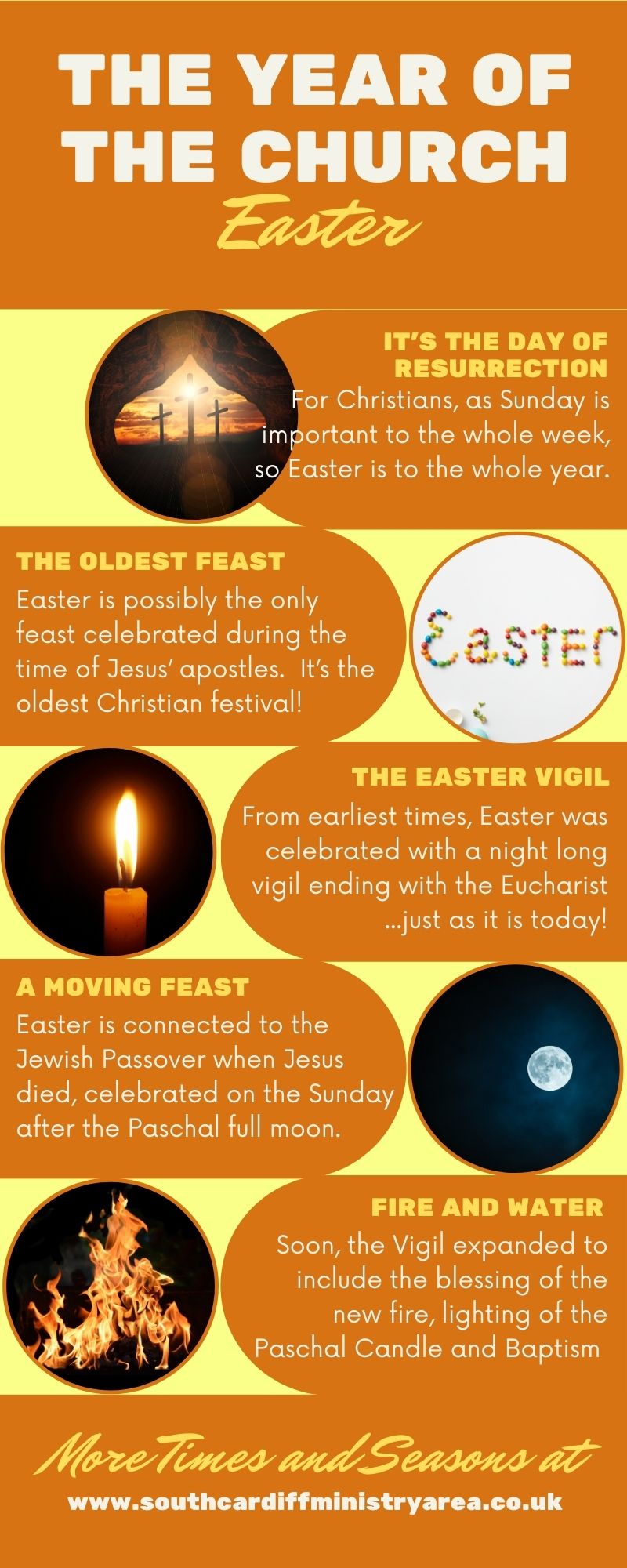
In the same way that Sunday is important to the week, so Easter is to the whole year.
Easter is possibly the only feast that was celebrated during the time of Jesus’ apostles, and so it’s the oldest festival of the Church’s year.
How do we know this?
First, because the date of Easter depended on the lunar calendar and the movements of the moon. This shows there was still much Jewish influence as experienced in the early church and the time of Apostles.
Second, Easter was celebrated on different dates in different parts of the world. It’s thought this was allowed because it rested on the authority that came from the Apostles.
Why does the date of Easter change?
Christians associate the date of Easter with the Jewish Passover when Jesus was crucified.
So Easter is the Sunday after the Paschal full moon, which is the first full moon on or after March 21.
Early Easter
Easter was certainly being celebrated by the end of the first century as a commemoration of the Death and Resurrection of Jesus.
At first, there was a long, night-time vigil preceded by a day’s fast. This fast, over time, was extended to two days and then six days. After a while it became even longer, eventually leading to the development of Lent. (But that’s for another time!)
The Easter Vigil was lengthy with many readings and songs telling the story of salvation from Creation to the Resurrection. It culminated in a celebration of the Eucharist at Midnight.
By the fourth century, we know of a distinct Good Friday commemoration. Both St Ambrose and St Augustine (4th and 5th centuries) refer to “the three most sacred days – the Triduum.” (Maundy Thursday to Easter)
In addition to the fast and the vigil, three new features arose.

Easter became the time for Baptism
St Paul wrote that “all of us who have been baptized into Christ Jesus were baptized into his death’ and that “we have been buried with him by baptism into death, so that, just as Christ was raised from the dead by the glory of the Father, so we too might walk in newness of life. (Romans 6: 3-4)
So the imagery of Baptism and the meaning of Easter made it the ideal time to celebrate it – which is what happened from early days.
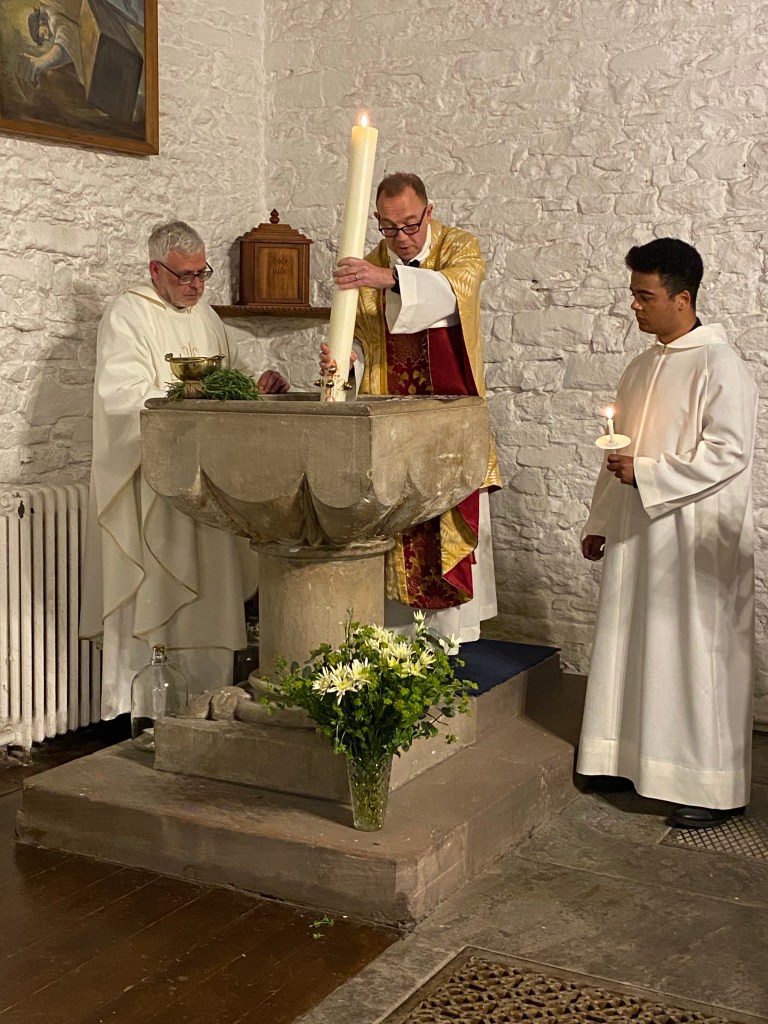
The Lighting and Blessing of the Paschal Candle
The Blessing of Light comes from the Jewish Blessing of the Lamp on the eve of the Sabbath.
However, in time, during the Easter Vigil, more honour was paid to the single candle which illuminated the lectern from which the Scriptures were read.
More and more elaborate praises gave rise to the Exsultet (The Easter Proclamation) as we know it today.
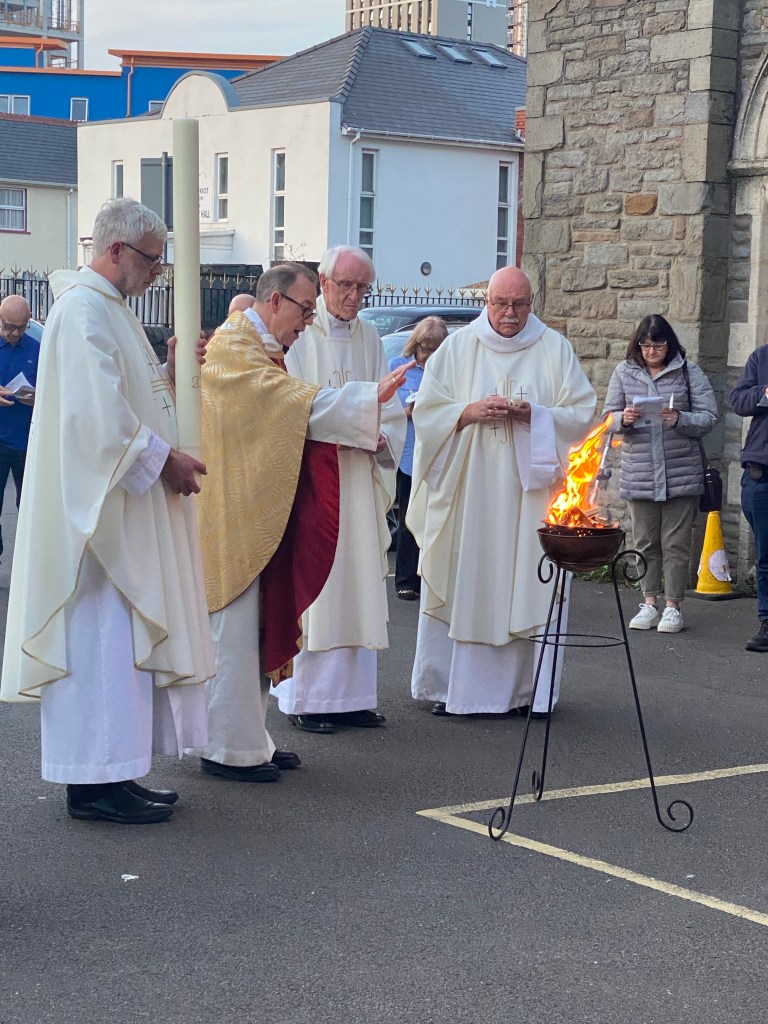
The Blessing of a New Fire
The ceremonial blessing of a new fire on Easter Eve may have arisen in Northern Europe.
Some believe it was introduced by St Patrick, although something similar also occurred in Jerusalem in the late fourth century.
There, at the beginning of a weekly Saturday Vigil, the fire was carried from the Holy Sepulchre (the tomb of Jesus) into the church.
And that’s Easter in two minutes!
Ash Wednesday and Lent
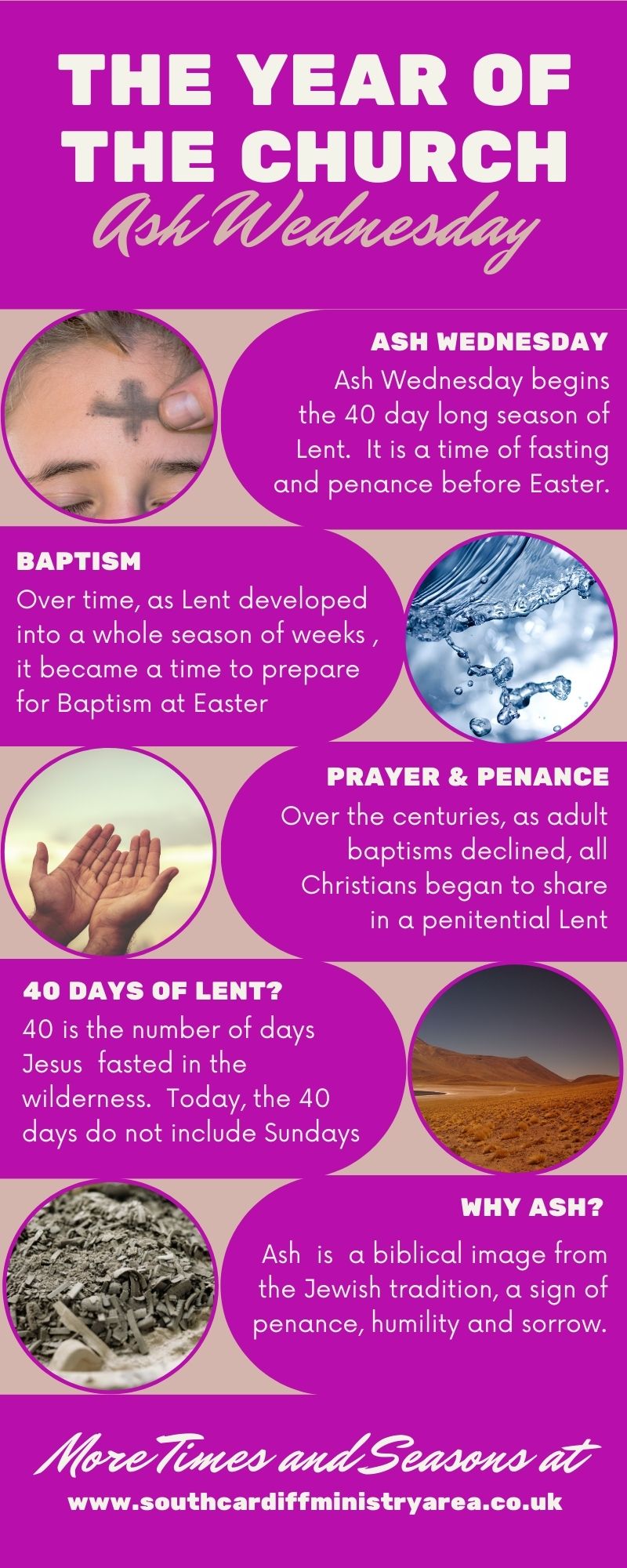
Lent is the 40 days before Easter. The number of days is based upon the days that Jesus spent fasting in the wilderness. So, Lent is a time of fasting.
It actually grew from the original day of fasting on the Saturday before Easter Day. But, since Easter was the ideal time for Baptism, Lent became a time for those being baptised to prepare. Although, our first written witness to ‘Lent’ is in the year 325 (The Council of Nicaea) we know it existed as a ‘season’ before then.
Forty Days of Lent?
So there are 40 days of Lent, but it’s not that simple! The actual length of Lent has varied – depending on how the 40 day period was calculated!
Whether it included or excluded the Sundays or the Saturdays and Sundays, or whether it excluded Good Friday and Holy Saturday or even the whole of Holy Week.
St Athanasius (4th century) said Lent was six weeks long, beginning on a Monday and included Holy week. Egeria, fifty years later, said that Lent in Jerusalem lasted 8 weeks and included Holy Week but excluded both Saturdays and Sundays because they were regarded as non-fast days.
Today in the West, the 40 days of Lent are counted from Ash Wednesday and include Holy Week but not the Sundays!
A Time of Penance
In time, as the number of adult baptisms declined so did the baptismal prominence of Lent which gave way to a more penitential season for all.
So it became common for all the faithful – not just those preparing for baptism – to take part in penitential exercises such as the Ash Wednesday fast, although it’s not until the eighth century that the beginning of Lent is called ‘Ash Wednesday’
Ash Wednesday
Why a Wednesday? Possibly because Wednesday was already a day of fasting adopted by early Christians during the week, alongside Friday. This followed the Jewish tradition which observed Monday and Thursday. Soon, historical reasons were given for these ‘Fast’ days. Wednesday was the day of Jesus’ betrayal, and Friday the day of his crucifixion.
Why ash? Well, this is a biblical image drawn from the Jewish tradition. It’s a sign of penance and sorrow. Having the sign of the cross pressed onto our heads developed in time, although in some parts of the world, Christians may be sprinkled with ash.
So, Ash Wednesday is a Day of Fasting and Penance and the first day of Lent which is a season for penance and preparation for Baptism at the Easter Vigil, which St Augustine described as ‘the mother of all vigils.’
Palm Sunday

The most prominent part of the Palm Sunday celebrations is the Palm Procession, and this was certainly the case in Jerusalem when Egeria made her pilgrimage there in the fourth century. The procession took place from the Mount of Olives into the city.
Over the centuries, the practice grew to Spain and Gaul and England and, by the 13th century, to Rome itself.
Today on Palm Sunday, we do the same. We gather in a place away from where the Eucharist will be celebrated. The faithful are encouraged by the priest to participate in the celebrations of Holy Week, the gospel account of Jesus entering Jerusalem is read, palm leaves are blessed, and then the procession is made to the church, signing songs filled with ‘Hosannas.’
Like all our rituals and celebrations, the procession is not a restaging, or an acting of parts played out like a stage drama. Something deeper is happening.
When Jesus rode into Jerusalem he was heading towards the Temple which, for the People of Israel, was the assured place of God’s closeness. Jesus’ ultimate destination was to the heights of God himself and to which he wanted to lift every human being.
And so, yes, when we participate in the Palm Sunday procession, something deeper is happening. Together with Jesus we set out on a pilgrimage along the road that leads to God.
Maundy Thursday
Maundy Thursday, the day when Jesus gave us the Eucharist, washed his disiciples’ feet, and was arrested in the Garden of Gethsemane, is a day rich with activity and symbolism. As the rite developed over the years, it combined three elements:
- The Commemoration of the Last Supper
- The Reconciliation of Penitents
- Various Preparatory Rites for the Baptism on Easter Eve especially the consecration of oils.
Historically, Maundy Thursday was the first weekday in Holy Week to have a Eucharist. Certainly this is what the pilgrim, Egeria, witnessed in Jerusalem in the 4th century where she witnessed two celebrations. The same occurred in Africa during the time of St Augustine. In other traditions there is only one, in others as many as three.
Today, there are two celebrations.
The Chrism Mass
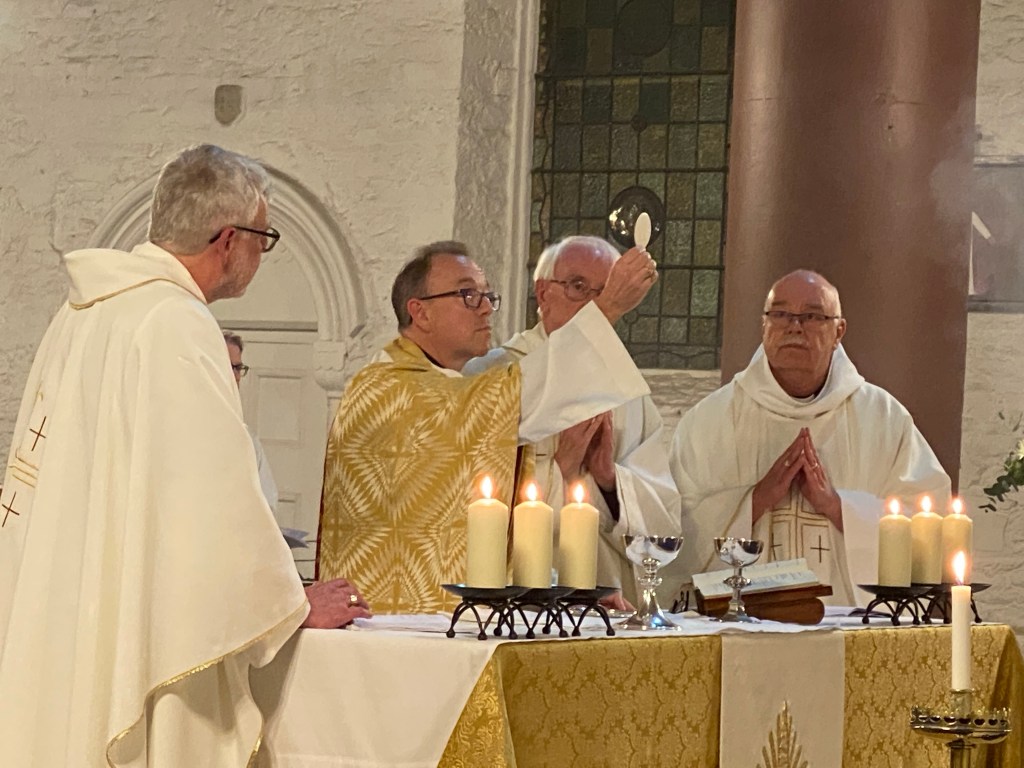
The Chrism Mass takes place in the morning when the oils are blessed and consecrated in preparation for the Rites of Initiation at Easter. Also, priests renew their vows in readiness of the Paschal feasts to come.
Evening Mass of the Lord’s Supper
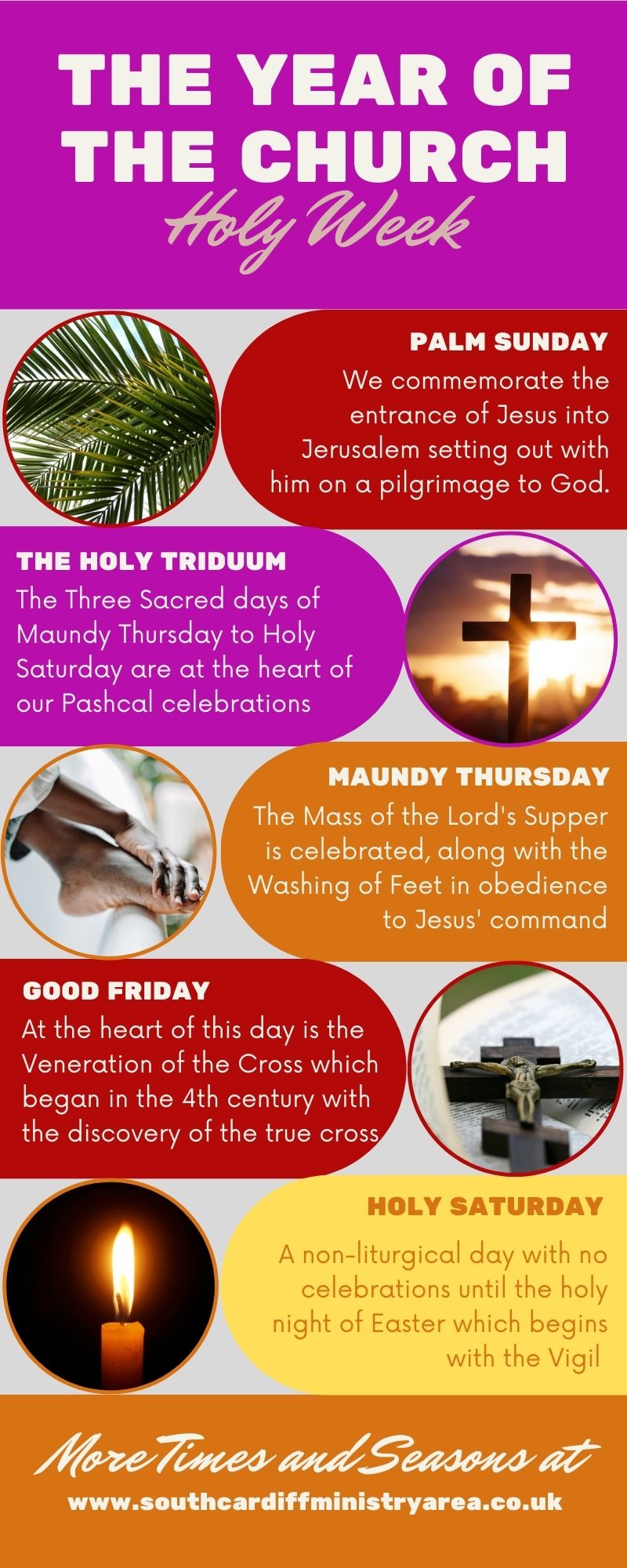
This is the beginning of the Paschal Fast, and the three most sacred days of Maundy Thursday, Good Friday and Holy Saturday / Easter Eve (collectively known as The Triduum).
During the Last Supper, when Jesus gave us the Eucharist, he also washed his disciples’ feet. It was a lived-out expression of his command to love one another. It’s from this ‘mandatum’ that we get the name of this day – Maundy Thursday).
So, during this celebration, we incorporate the washing of feet. We also offer our the gifts for the poor, the fruits of our Lenten sacrifices and charity. (Interestingly, in Milan, at the time of St Ambrose, the foot washing took place on Holy Saturday, perhaps its original position).
Stripping of the Altars
After Mass, the altars in the church are stripped and and crosses and other ornamentation removed. This is both a practical rite to prepare the space for Good Friday, and also one that is symbolic of the humiliation of Jesus who on this night was arrested in the Garden of Gethsemane.
It is customary to continue the Paschal fast in vigil until midnight at the an ‘altar of repose’ where the Blessed Sacrament is reserved for Communion on Good Friday (when no Eucharist is celebrated).
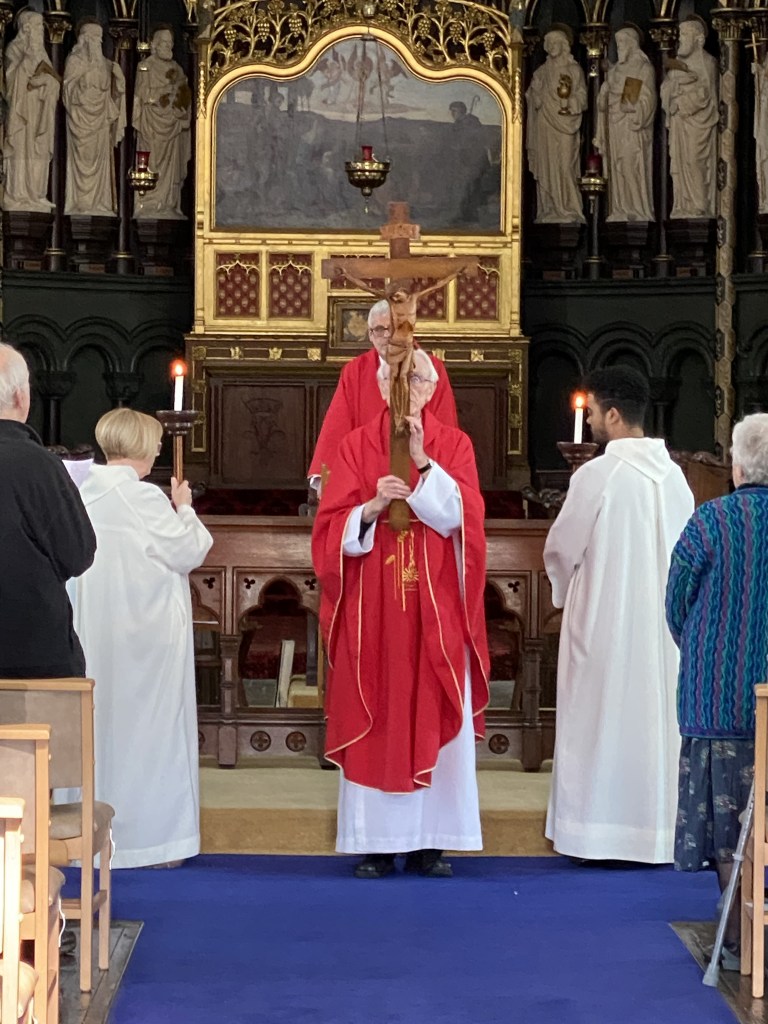
Good Friday
It’s not surprising that many of our Holy Week traditions find their roots in Jerusalem. After all, it’s where the historic events associated with the death and resurrection of Jesus took place, and so the geography of the city created particular opportunities for devotion.
Veneration of the Cross
This is one of the most significant features of Good Friday with its root in the Jerusalem celebrations. When St Helen discovered the cross of Jesus in the fourth century, it was obviously an item to be venerated. This soon worked its way into a public celebration on Good Friday, perhaps thanks to the liturgical gifts of S Cyril of Jerusalem, the bishop at the time.
As relics of the true cross were distributed far and wide, so did the Veneration of the Cross, and which finally reached Rome in the 8th century.
Today, in churches around the world, this veneration continues. In churches temporarily stripped of crosses and ornamentation, a cross is unveiled. ‘This is the wood of the cross on which hung the salvation of the world’ is chanted, and all respond, “Come, let us adore.’ If possible, the faithful are then invited to venerate the cross with a genuflection a bow, a kiss, or simply reaching out to touch the cross.
Communion
The second feature on Good Friday is Communion from the Reserved Sacrament. The practicing of receiving Communion outside of the Eucharist was common from the second century onwards. During an ordinary week, people would receive communion from the Blessed Sacrament in their homes.
Stations of the Cross
Another popular tradition on Good Friday is Stations of the Cross. As Jerusalem’s pilgrims walk the Via Dolorosa, so in our own churches around the world, we follow the way of the cross, pausing to reflect and pray at various occasions along that painful journey from Jesus’ condemnation to his death and being aid in the tomb.
Holy Saturday
The oldest feature of Holy Saturday, the day before Easter Sunday, is the total fast that was kept on this day. It was a day where there were no liturgical celebrations. The Easter Vigil which began on the evening of this day is explored above. Today, until the beginning of the vigil, there is no Mass or celebration.
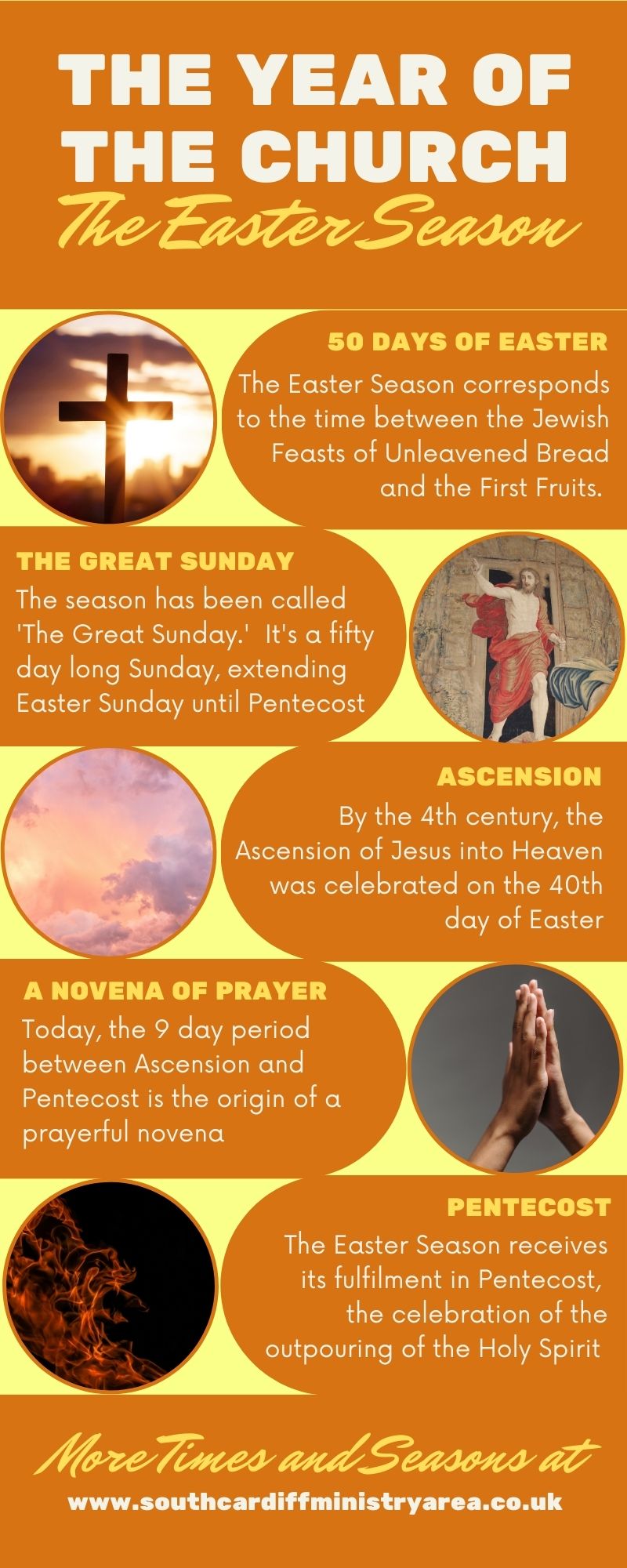
The Fifty Days of Easter
Rooted in Judaism, the fifty days of Easter is the oldest season of the Church’s year. It corresponds in part to the Jewish period between the Feast of Unleavened Bread and the Feast of First Fruits (also known as the Feast of Weeks or Pentecost).
The fifty days of Easter has been described as ‘The Great Sunday.’ It is, if you like, a fifty day long Sunday, as the celebrations of Easter Sunday are stretched out in time!
It wasn’t until the fourth century that the Ascension of the Lord was celebrated as an historical event on the fortieth day after Easter and Pentecost celebrated on the fiftieth day. This was based partly on the timeline of the Acts of the Apostles, a deepening of theology of the Holy Spirit, and the influence of the holy and historical places of Jerusalem.
Today, the nine day period between the Ascension and Pentecost is the origin for a prayerful novena. Nine days dedicated to prayer and waiting, just as Mary and the Apostles stayed and prayed for the gift of the Holy Spirit promised by Jesus. The Acts of the Apostles tells us that on the Day of Pentecost, “they were all gathered together in one place.”
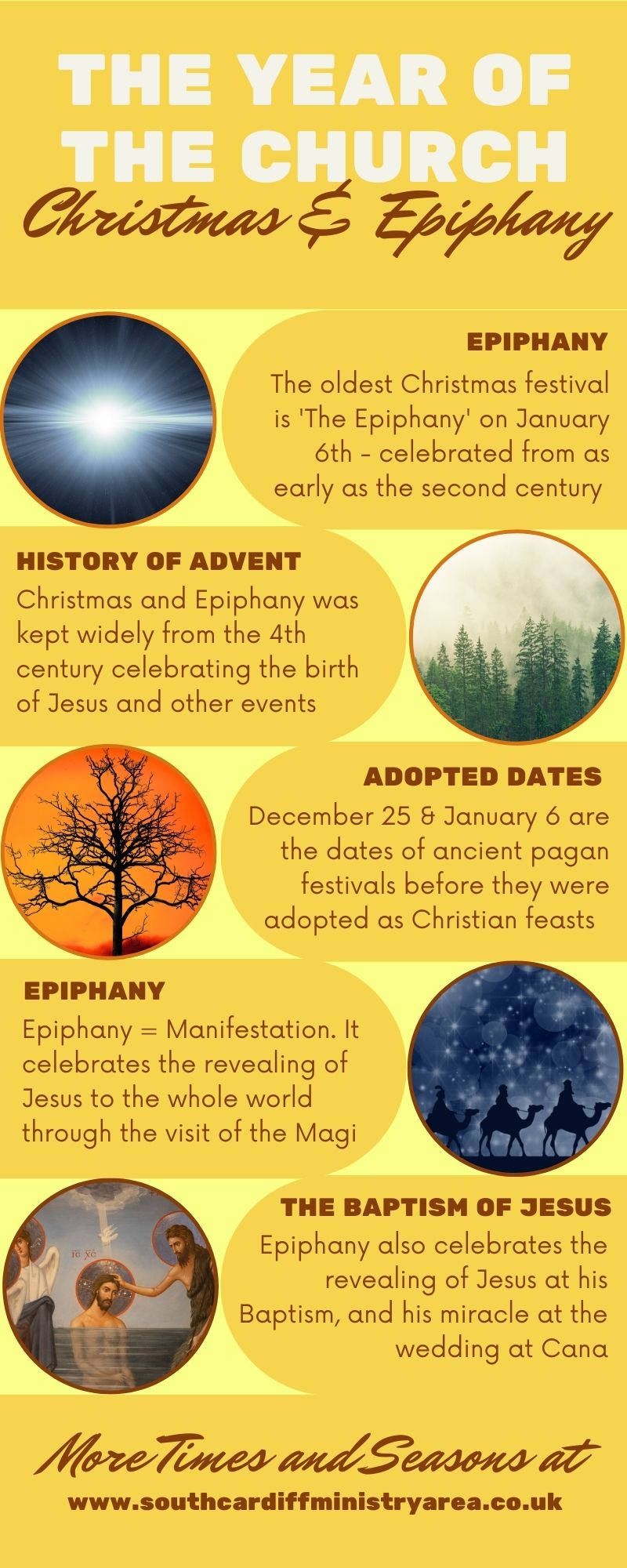
Christmas

In the Bleak Mid-winter
There are two important Christian festivals in the Winter. Christmas (December 25) and Epiphany (January 6) . The Epiphany is the oldest although both were only widely celebrated from the fourth century.
There is evidence that some kind of ‘Christmas and Epiphany’ festival existed as early as the end of the second century and was probably a celebration of Jesus’ birth and the events associated with it, such as the visit of the Magi.
Although the word ‘Epiphany’ is Greek, the first indisputable reference to its celebration is in Gaul in 261, although we have no idea as to how it was celebrated.
Egeria, a pilgrim to Jerusalem in the fourth century, says that, there, the Epiphany was a celebration of the birth of Christ. In the fifth century, St Jerome says that in Bethlehem, it was the Baptism of Jesus which was its main Epiphany theme. However, not long after this, Epiphany celebrations were introduced in Antioch, Cappadocia and Constantinople.
Christmas, as a feast, possibly began in Rome probably after the firs few decades of the fourth century.
Adopted Dates
The dates of Christmas and Epiphany do not claim to be historically rooted, unlike the celebration of Easter and Ascension, for example. Both dates were pagan festivals, the birth of the sun and the virgin-birth of Dionysius as well as legends of the epiphanies of gods. So, as a counter to pagan festivities, Christians adopted these dates to celebrate the birth of Christ and his manifestation of the light of the world.
Today, in the West, the birth of Jesus is celebrated on December 25th and the visit of the Magi on January 6th, along with other associated manifestations of Jesus at his baptism and his first sign or miracle at the wedding in Cana, both of which are revelations of the identity of Jesus.
 South Cardiff Ministry Area