Monday 17 April, 2023 | Monday of the Second Week of Easter |Readings: Acts 4:23-31; Psalm 2:1-9; John 3:1-8 (You can find these in full on the Universalis website – Click here)
During these days of Easter, each day at Mass we have moved through the Acts of the Apostles and witnessed the growth of the Church in those early days after Pentecost. The disciples are transformed, changed. They speak boldly and with conviction. They face authority without fear and spread the message that Jesus is risen from the dead. The outpouring of the Holy Spirit has enlivened and transformed them. They are a new Creation.
This New Creation is at the heart of that secret conversation between Nicodemus and Jesus under cover of darkness when Jesus talks of the need to be born again through water and the Spirit. As the Spirit of God hovered over the waters of Creation bringing order from chaos so too he fills the hearts of believers, gives them a new birth. The Spirit of God shows us who Jesus is and leads us closer to him. The Spirit fills our hearts and lives, praying in and through us, like a deep sigh too deep for words.
The disciples have moved out from beyond the closed doors of that upper room into the streets of Jerusalem, but their journey has only just begun. Soon they will leave the confines of the city walls, move out into the country and beyond. Today, as Peter and John return to their brothers and sisters, we hear them pray, and join our prayer to theirs, as they raise their voices to say, ‘Master it is you who made heaven and earth and sea, and everything in them.’ Soon, they will cross boundaries and venture into other countries, to take the message far and wide around the world, and witness to a New Creation.
MAKING CONNECTIONS
These posts are part of our endeavour each day to provide a short homily or reflection from the celebration of the Mass of the day. Links are posted on Twitter and Facebook, and you can also sign up for daily emails in your inbox by registering your email below:
MINISTRY AREA MASS
Mass today (Monday 17 April, 2023) is celebrated at St Mary’s Church Butetown at 6pm and Ss Dyfrig and Samson, Grangetown at 7pm. If you would like to send a prayer request then click on the ‘REQUEST PRAYER’ Button
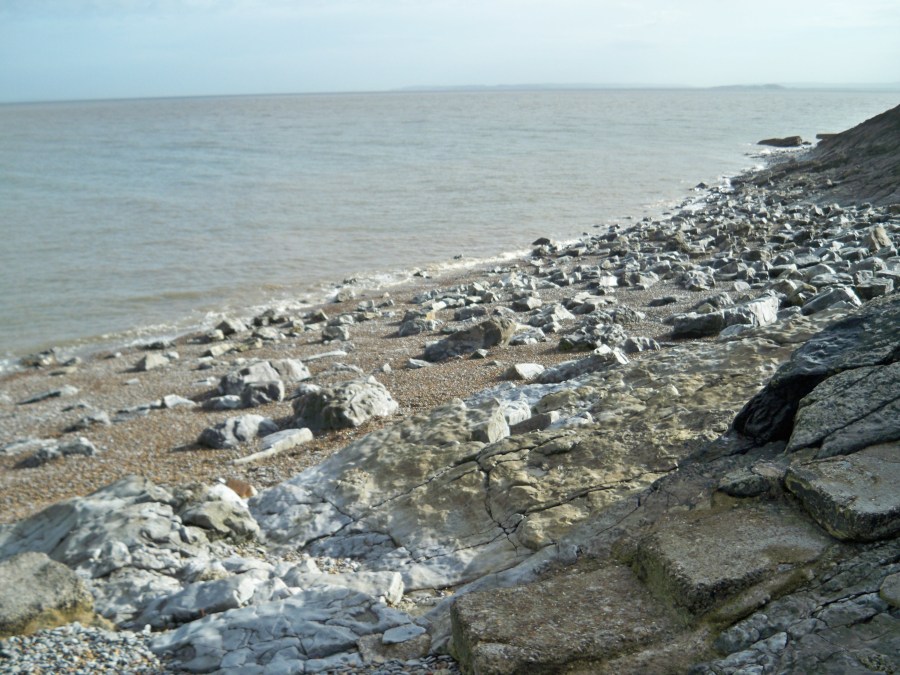
A journey from Cardiff by boat across the Bristol Channel to the island of Flat Holm raises the question, ‘What do we want here?’ Fr Dean reflects on a pilgrimage with Matt Batten
“There’s an easterly wind from Newport,” said the skipper as I enquired about the weather. I didn’t blame Newport. I don’t think they were responsible for the wind or the waves or the sickness that overcame Matt as his face became a pallid green half-way through the journey from Penarth to Flat Holm.
I had noticed a break in the excited chatter we’d exchanged since we met that morning for Mass at St Mary’s. The weather didn’t look good, but we were on an adventure, a personal pilgrimage, just the two of us, with the weather against us.
As we made our way across the waves of the Bristol Channel on board the Lewis Alexander, Matt had stopped moving around from taking videos of every moment and matter. He’s a ‘Comms Guy’ through and through, always looking for the angle, a new way of sharing something in a fresh way. For now, he had stopped. There was silence, apart from the chug of the boat, the sound of the sea.
As I turned away from my own view of the horizon and the grey sea which rose and fell and crashed against the boat, I saw him, sat there, looking, well, rather unwell, as grey as the sea. He rushed to the side of the boat and stayed there for some time. There, he had his own ‘private’ moment.
Afterwards, we chatted about the journey of St Cadoc all those years ago, back in the fifth century, and how his coracle must have crashed on the waves which made the journey difficult and dangerous. We marvelled at the faith and adventurousness of the Celtic Saints who pushed out from the familiar in search of something more. We always want more.
No wonder that when St Cadoc, after his own Flat Holm pilgrimage, sent his fellow pilgrim, Baruc, back to collect a forgotten prayer book, that Baruc succumbed to the waves. His body was washed up on the mainland, his name given to another island which welcomed his body.
That island, Barry Island, is now a playground for day trippers and holiday makers, armed with candy floss and popcorn, and whose fingers smell of the metal of money dropped into the slots of the arcade games. There, the only sickness comes not from the sea but by the fall and rise of Fairground rides as they look for excitement. We always want more.
We arrived at Flat Holm, and were greeted by a battalion of birds, gulls who gathered in great numbers as the boat chugged onto the shingled shore. I misinterpreted their cry as a welcome, a wing-flapped applause, an avian benediction. Instead, they said ‘Go home, stay away, leave us alone, this is our home. What do you want here?’
What do we want here?
At the water’s edge, we were welcomed by the new Warden of Flat Holm who began his job just four weeks earlier, and we spent much time with him.
We talked about the island and nature and the environment and the beauty of the island, the harshness of life here. But we also had conversations about the street and urban issues and young people. We talked about our backgrounds and our experiences. There, in seclusion and beauty, we talked about poverty and the lack of aspiration and opportunity, about politics and refugees and communities, about the direction of the country and how we all fitted in. A pilgrimage is never an escape from life. It’s an embracing of life, offers a new perspective.
From Flat Holm, we could see the city of Cardiff, from afar, across the rising grey waves. Even though there were the grim, grey clouds, pushed across by the easterly wind from Newport, we could see the tips of buildings, the eclectic gathering of steel and glass, the shape of the city.
What do we want here?
That’s the question, waiting for an answer. Whoever comes here is just dropping by as a visitor, a passer-by. Each of us needs to be respectful of the home into which we step, and those who live here – the wildlife – allowed a time, a place, to be at home, and thrive beyond the steel and glass of the city’s staggered life.
Here, on Flat Holm, nature takes priority. This is nature’s home, and we need to tread carefully with respect, with love, and to discover what it means to be at home in the world.
On the way back, as we gazed over the boat’s edge, I asked Matt what colour is the sea? He thought it brown. Yes, at times, it seemed brown, but then grey, and then the froth of broken waves which gave it a hope, an ambition to be a different colour, something new. We always want more.
The journey back was smoother. Perhaps Newport was kinder to us as we were homeward bound. It held back its wind, and we washed in through the Barrage from the flat tops of Flat Holm with a relative ease.
It had rained that day, across the island. We hadn’t noticed the rain, just the easterly wind along the journey. And the memory of the flat-topped island which welcomed us for a while, and asked us ‘What do you want here?’
Readings: Acts 4:13-21; Psalm 117(118):1,14-21; Mark 16:9-15 (You can find these in full on the Universalis website – Click here)
Homilies often begin with an illustration from everyday life. But today, let’s get straight to the point, which is what St Mark does in the gospel reading today. In typical succinct tone, he sums up the resurrection appearances of Jesus. He begins with Mary of Magdala and how her message was met with unbelief. After this, he speaks of two other disciples who were travelling to the country and who also did not believe. At last, he showed himself to the Eleven while they were at table. Jesus ticks them off for not believing the witness of those who had seen him, and then gave them the commissions to ‘Go out to the whole world; proclaim the good news to all creation.’
Our faith in the Risen Lord is not operated by some imaginary switch, like a light bulb which immediately brings light to a room. Rather, it is often gradual, like the rising of the sun at dawn, when one is not quite sure if we are in light or darkness, but we soon sense that the darkness is gradually giving way to the brightness of the sun. Doubt is part of the pilgrimage of faith, as we grapple with the reality of God.
It is like Jacob wrestling with the angel at the River Jabbok. Or like Peter stumbling his way from the fire of denial in the courtyard when Jesus is on trial to the sands of Galilee’s shore and the fire that the Rosen Lord had kindled for them to ‘Come and have breakfast.’ At the end of the gospel reading today, the disciples are sent out. We see them doing this in the reading from the Acts of the Apostles. Filled with post Pentecost fire and with a firm faith in the Resurrection of Jesus from the dead, Peter says, ‘We cannot promise to stop proclaiming what we have seen and heard.’ Peter and the others have been on quite a journey. It is a journey in which we share, and to which we can perhaps relate, as our faith grows and is enlightened like the rising of the sun at dawn.
MAKING CONNECTIONS
These posts are part of our endeavour each day to provide a short homily or reflection from the celebration of the Mass of the day. Links are posted on Twitter and Facebook, and you can also sign up for daily emails in your inbox by registering your email below:
MINISTRY AREA MASS
Mass today (Saturday 15 April) is celebrated at St Mary’s Church Butetown at 11.30am, preceded by Morning Prayer and Rosary at 11am. If you would like to send a prayer request then click on the ‘REQUEST PRAYER’ Button
Readings: Acts 4:1-12; Psalm 117(118):1-2,4,22-27; John 21:1-14 (You can find these in full on the Universalis website – Click here)
Perhaps one of the many comforting things for us which come from the resurrection appearances of Jesus is the number of times those who had been closest to him, failed to recognise him. How does this resonate with us? How many times do we fail to recognise Jesus, have we not been aware of him or alert to him? How often have we allowed other things to get in the way? Perhaps, at times, both the highs and lows of life distract us.
In the gospel reading, after the catch of fish, the Apostles begin to recognise Jesus. He calls them to sit and eat with him. The invitation to do the same is always before us. The invitation to the Eucharist is free and open to all and yet so many people prefer not to accept this loving invitation. They may find other things to do that, for them, are more important and worthwhile. Perhaps at times our enthusiasm wanes, we get tired and disconnected, worn and weary, and we disconnect from the Mass.
‘Come and have breakfast,’ said Jesus to the Apostles. They bring some of the fish they have caught, fruits of their labours, gifts for the banquet. Jesus, in return, accepts these fruits, transforms them into a meal of which he is the host, and where he nourishes them with his Risen presence. At the Eucharist, we present the gifts of bread and wine, fruits of the earth and work of human hands, and they become for us the bread of life and the chalice of salvation. It is a banquet of Divine proportions.
MAKING CONNECTIONS
These posts are part of our endeavour each day to provide a short homily or reflection from the celebration of the Mass of the day. Links are posted on Twitter and Facebook, and you can also sign up for daily emails in your inbox by registering your email below:
MINISTRY AREA MASS
Mass today (Friday 14 April) is celebrated at St Mary’s Church Butetown at 9.30am
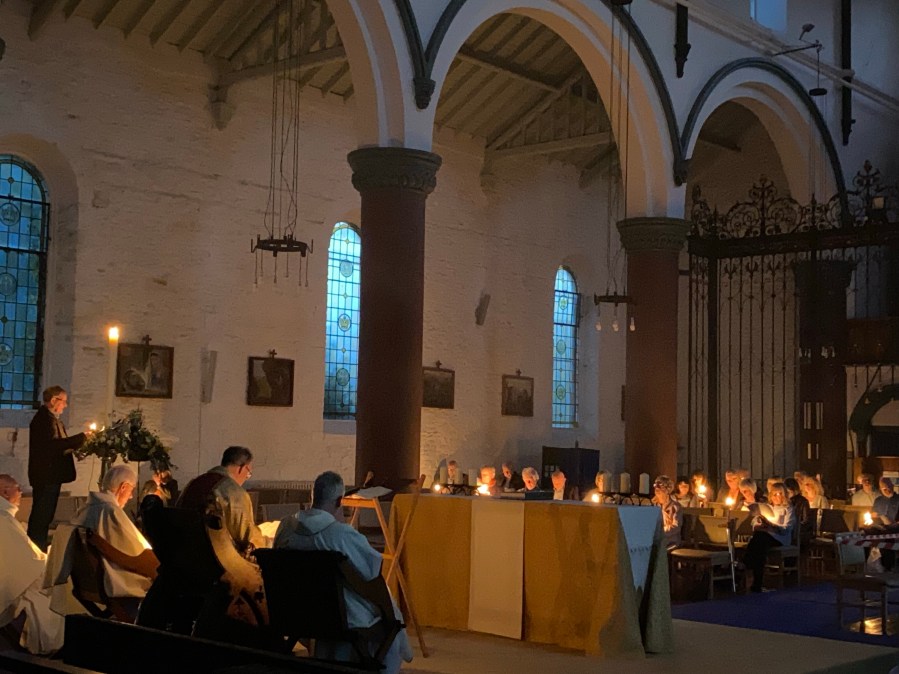
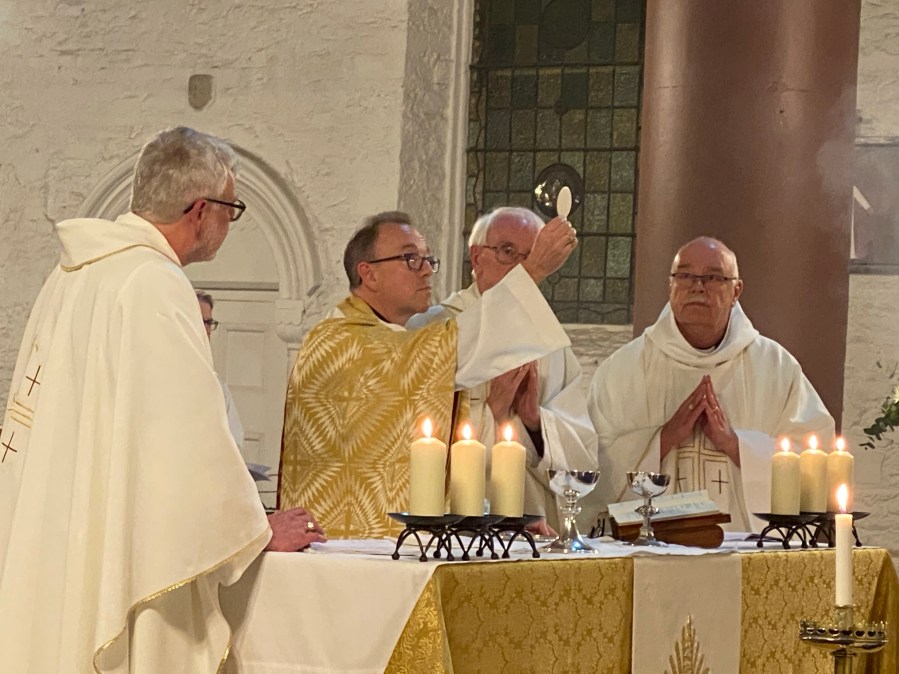
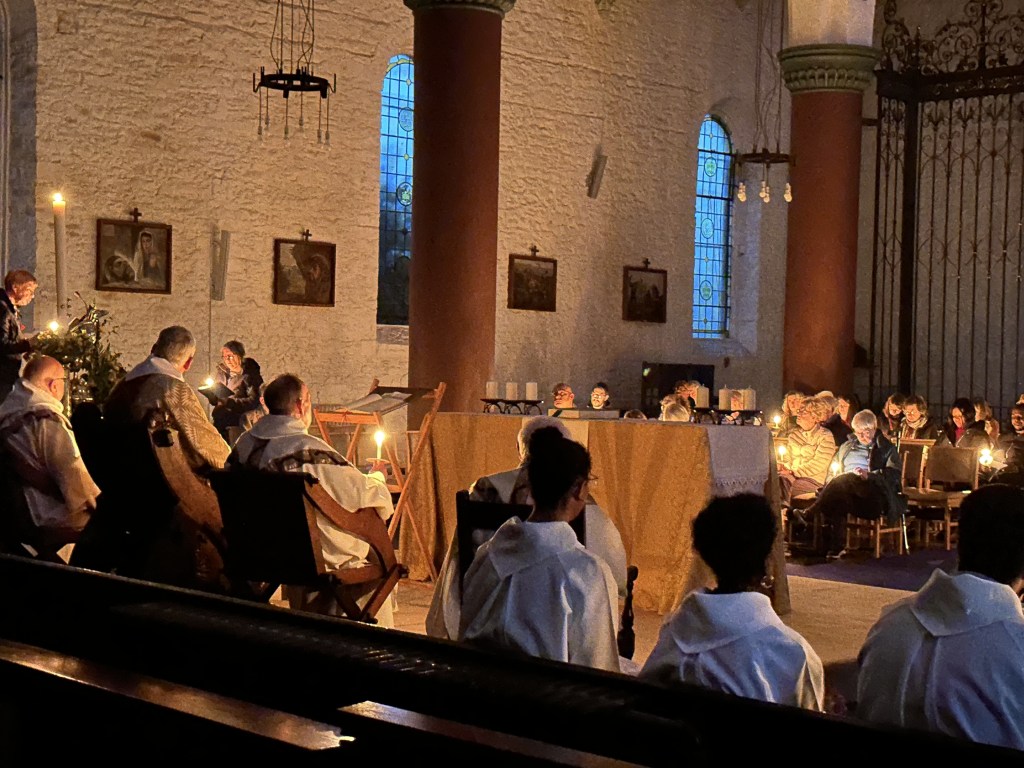
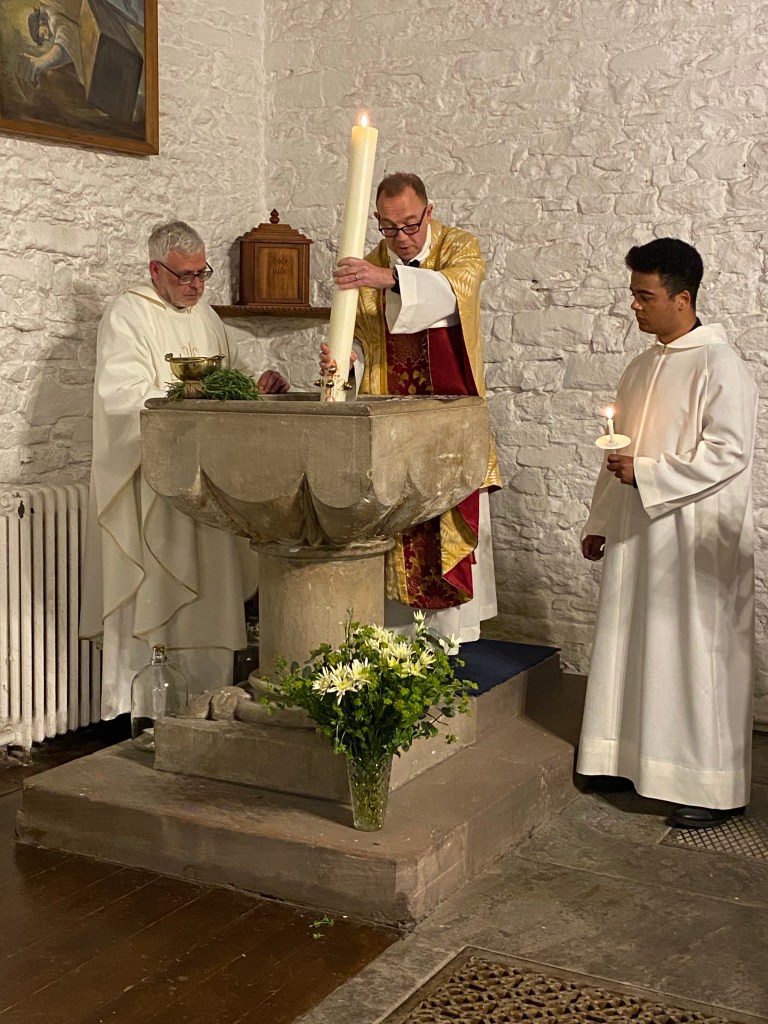
South Cardiff Ministry Area’s Easter Mass 2023 at St Mary’s Church
Readings: Acts 3:11-26; Psalm 8:2,5-9; Luke 24:35-48 (You can find these in full on the Universalis website – Click here)
As the two disciples from yesterday’s gospel share their Emmaus story with the other disciples, Jesus stands among them. They have been witnessing to his risen life with a personal testimony, speaking from their own experience, sharing their joy, telling their own story and, there, Jesus stands among them.
All that had happened had caused so much confusion, stirred up so many emotions, created so many tensions that it took some time to assimilate everything. Words such as ‘alarm’ and ‘fright’ enter the narrative. Jesus senses their agitation, discerns their doubts, and invites them closer to see and to touch him. He shows them his wounded hands and feet, the marks of love.. Jesus will for ever be associated with the sacrifice of the cross. He carries his wounds for ever.
Each of us has our own story of faith to tell. We may not think that our story is significant when compared to others, or we may find it difficult to put it into words or be confident to tell it. But we can be assured that when we share the good news of Jesus risen from the dead and reveal how his grace has moved our lives, he will be standing there with us. For our story of faith is not to draw attention to us but to reveal Jesus to others. He wants others to see the wounds that have come from his love. He desires others to draw near to him, to experience the peace he brings to the world.
MAKING CONNECTIONS
These posts are part of our endeavour each day to provide a short homily or reflection from the celebration of the Mass of the day. Links are posted on Twitter and Facebook, and you can also sign up for daily emails in your inbox.
MINISTRY AREA MASS
Mass today (Tuesday 13 April) is celebrated at Ss Dyfrig and Samson, Grangetown at 9.30am | St Mary’s Church Butetown at 10am | St Saviour’s Church, Splott at 5.45pm
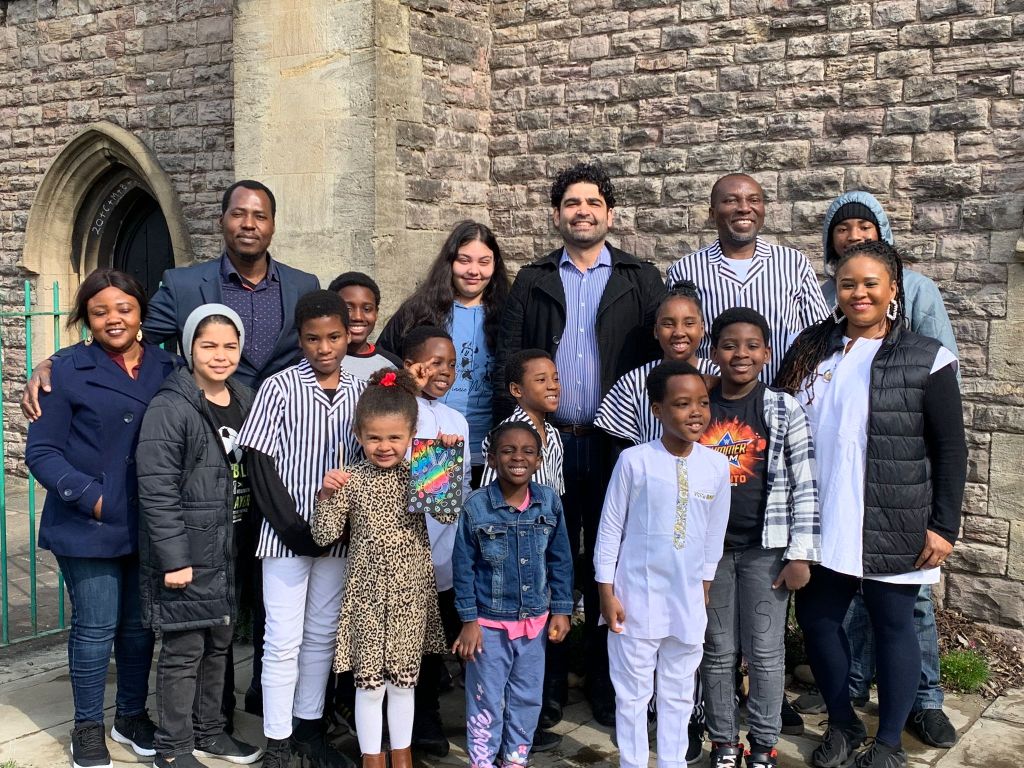
A pic from Easter Sunday at St Saviour’s, 2023 featuring our newly baptised with friends and family
Readings: Acts 3:1-10; Psalm 104 (105):1-4,6-9; Luke 24:13-35
Martin Buber, the Austrian Jewish and Israeli philosopher said, “All journeys have secret destinations of which the traveller is unaware.” This is certainly the case for those two disciples of Jesus who made their way from Jerusalem to Emmaus. Perhaps they wished to make the journey as quickly as possible – after all, most of us are very keen indeed to get to our destination and we may view the journey as something to be achieved quickly, efficiently, and as a simple means to an end.
Whilst the destination of Emmaus is always before them, on arriving they will look back on their journey and realise the significance of what they had experienced along the way. After spending a short time in Emmaus, they return to Jerusalem as quickly as possible, retracing their steps. They are now deeply aware for themselves that Jesus had risen from the dead for they had recognised him in the Breaking of Bread. Even though he had shared in their journey, walked and talked with them, been invited to stay with them at the end of the day, they failed to recognise him. When they arrive in Jerusalem, their own experience is confirmed by that of the disciples. ‘Yes, it is true,’ they said. ‘The Lord has risen and has appeared to Simon.’ Those two travellers then share the story of what happened to them on the road and how they had recognised Jesus at the breaking of bread.
Whenever we gather at the Eucharist, we are called to recognise the Risen Lord. But we also bring to him all that we have experienced along the path of life. Being attentive to the presence of Jesus in the Eucharist can help us to be more alert to his presence in our daily lives, and in all the little journeys we make, whether we are at work or rest or play, whether we are moving on or standing still. Sometimes, our journey may take us to a different destination, or new possibilities are opened to us. We may even go back to where we started but with a fresh perspective on life. So, may our time spent with Jesus in the Breaking of Bread, and the precious gift he gives us, help us to be more attentive to his presence in our daily lives.
MAKING CONNECTIONS
These posts are part of our endeavour each day to provide a short homily or reflection from the celebration of the Mass of the day. Links are posted on Twitter and Facebook, and you can also sign up for daily emails in your inbox.
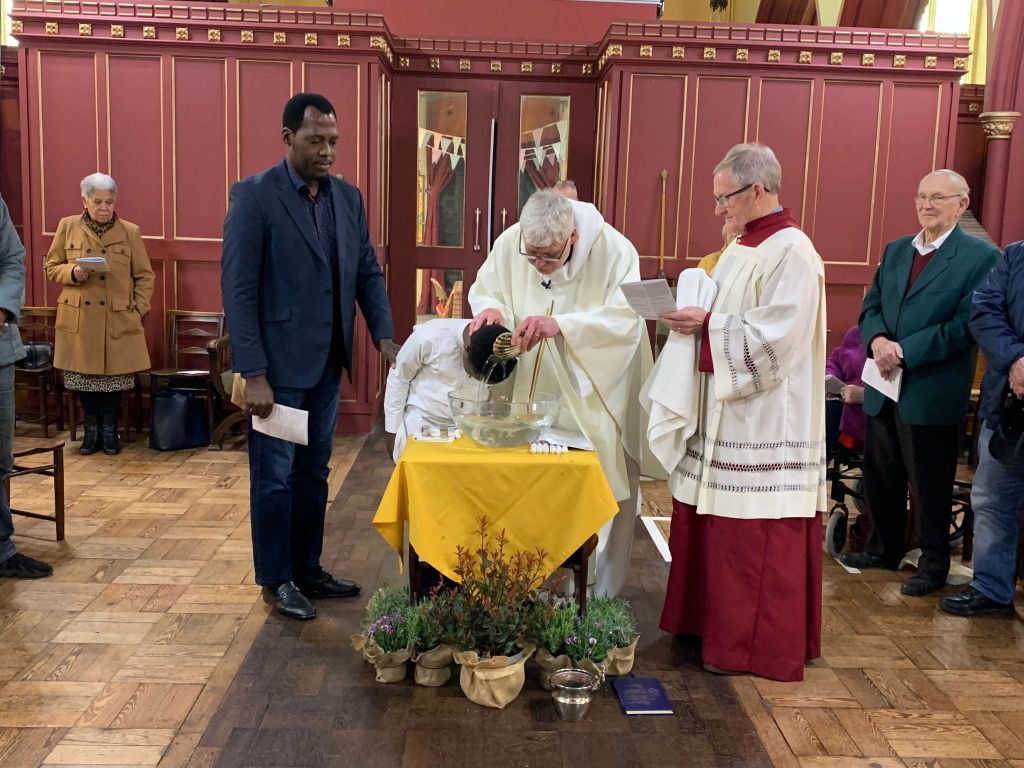
Celebration of Baptism at St Saviour’s Church, Easter Day 2023
Readings: Acts 2:36-41; Psalm 32 (33):4-5,18-20,22; John 20:11-18
‘On the court, I am fierce! I am mean and I am tough,’ said the American tennis player Serena Williams in an interview for Vogue Magazine in 2005. ‘I am completely the opposite off the court,’ she continued. ‘My confidence just isn’t the same. I wish I was more like I am on the court. Nobody would know that I am constantly crying or complaining.”
We often try to hide our tears, conceal our sadness, try to be strong and fierce in the public eye. Today’s gospel reading is filled with tears which freely flow. Mary Magdalene is mentioned twelve times in the gospels, more than most of the apostles and more than any other woman in the gospels. One thing that we significantly remember her for are her tears.
She weeps at the entrance way of Jesus’ tomb and, as she stoops to look in, she continues to weep. Alone and beside herself, her sadness and distress deepen. Angels dwell where Jesus once lay but this does little to comfort her. ‘Woman why are you weeping?’ Her voice cracks through her tears and sobbing. She seeks the body of Jesus, needs to do what she couldn’t do a few days ago when he was buried in haste and left his body to the darkness of a sealed tomb. From behind, out of sight, she hears another voice which echoes the angels’ question. ‘Woman, why are you weeping?’ Her anxiety continues. ‘Sir, if you have taken him away, tell me where you have put him, and I will go and remove him. He speaks her name. ‘Mary.’ In that moment, as she recognises him, he calls for her total attention. She tries to embrace him for she cannot contain her joy.
Mary of Magdala’s tears have defined her, but she is, above all, defined by that message she takes to the Apostles. Her sadness is dissolved by the joy she experiences at meeting her Risen Lord. From there, Jesus sends her off and she makes haste, is fierce and confident, full of faith, unstoppable, as she carries the message of life, and the good news of the Resurrection of Christ. She runs to tell the apostles that she has seen the Lord. We, too, carry the same message which transforms the world. We, too, are called to share this news with others.
MAKING CONNECTIONS
These posts are part of our endeavour each day to provide a short homily or reflection from the celebration of the Mass of the day. Links are posted on Twitter and Facebook, and you can also sign up for daily emails in your inbox.
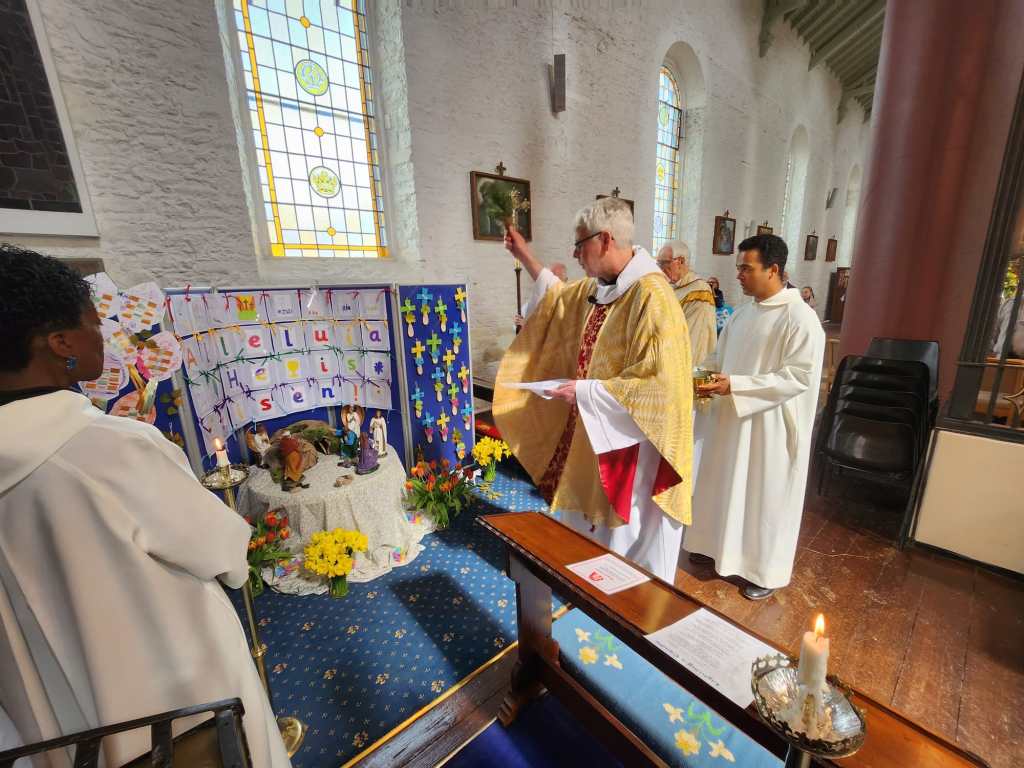
A portrayal of the Easter Garden at St Mary’s 2023
Readings: Acts 2:14,22-33; Psalm 15(16):1-2,5,7-11; Matthew 28:8-15
Apparently, each of us lies at least once or twice a day, although prolific liars will, of course, lie in greater numbers! The lies we often tell may be such seemingly trivial things as providing a false complement to someone, or concealing how we really feel when asked, ‘How are you today?’ And then there are other lies when people or institutions have gone out of their way to cover up something, a lie which has serious consequences for all involved.
When Jesus was on trial, Pontius Pilate asked him, ‘What is truth?’ Jesus gave no answer. As the women who visited the tomb of the first Easter Day return with joy to the others at encountering the Risen Lord, there are backroom deals being done elsewhere. A story is concocted to cover up the most recent happenings and, after an exchange of money and the promise of protection, the soldiers start to circulate the story that the disciples of Jesus have stolen his body under cover of darkness. There is, though, quite a difference between a lie and a perspective.
There are always different perspectives of the same event. News outlets can give varying angles to the same story. Witnesses to a crime can give very different descriptions of what happened. Indeed, each of the four gospels provide a slightly different perspective on the events of Jesus’ life, death and resurrection, each written at a different time, for a different audience, but each seeking to reveal the truth. When Peter spoke to the crowds on Pentecost Sunday, filled with the Holy Spirit, he shared the truth of what he had experienced and witnessed. He talked to them with conviction about Jesus the Nazarene who died and was raised to the heights of Heaven. ‘God raised this man Jesus to life,’ he said, ‘and all of us are witnesses to that.’ Whilst we may not have the eloquence and confidence of Peter, each of us can try to live lives that are authentic, lives which reveal something of the Truth in which we believe – not only with our words but with our actions. We too can be active and living witnesses to the Truth as we rejoice in the Lord in whom we take refuge, and who is our portion, our cup, our prize (Psalm 16:1-2)
MAKING CONNECTIONS
These posts are part of our endeavour each day to provide a short homily or reflection from the celebration of the Mass of the day. Links are posted on Twitter and Facebook, and you can also sign up for daily emails in your inbox.
‘We are called to surrender ourselves to God, so that we can say with St Paul, “It is not I who live but Christ who lives in me.’’ Read the homily from the Easter Vigil at St Mary’s Church.
“The guards were so shaken,
so frightened of [the angel] that they were like dead men.”

They would have experienced the trauma of war,
the battles and blood,
the combat,
the killings,
Seen things we would not want to see,
and braved the enemy,
taken orders,
taken possession,
taken loot,
taken lives.

And now they are frozen,
inanimate,
shocked to the core,
like dead men,
we are told.
Perhaps they’ve seen too much.

These men,
who have enjoyed the camaraderie
and idle talk of a night-time watch
are rendered speechless,
immobile,
like dead men.

They have experienced something different,
something new,
seen things that are beyond their words.
They are dumb and tongue tied.
Perhaps they stare into the middle distance,
or sleep open eyed,
an induced coma.

An angel sits beside them,
passes the time of day,
resting on the very stone
that had sealed the sepulchre,
rolled away in an instant,
in the swoop of an angel’s light.
The angel brings a lightning brightness to the scene.
The place of death is illuminated.

This is beyond their experience,
breaks their expectations of war.
They are rendered useless
in the face of beauty.
There is no white flag to wave.
Just the whites of their eyes, staring.
But they have surrendered now,
They have been overcome by the Divine,
by the power of Love

Turning to the women
who have entered the scene,
the angel quickly speaks,
offers words of comfort,
and reassurance.
He knows the intentions of their hearts,
and whom they seek.
“He is not here,” the angel whispers,
“he has risen,
as he said he would.”

Jesus has moved on,
beyond the grave,
beyond them,
for now.
And so they move on to meet him too.
Armed with the message of salvation,
they carry the news of Resurrection,
following a Divine order
to march on.

And then, from somewhere in the distance,
they see him,
He comes to greet them
across the garden.
They fall down,
clasp his feet,
hold onto him,
feel the warmth of the rising sun
upon their backs,
their face to his wounded feet,
which are the marks of love.

They surrender to him.
They are caught up in sheer love,
their lives turned around,
as they had always been turned
since the moment they knew him,
since the first time they met him
and had that growing awareness
of who he was.


Unlike the soldiers who play dead,
they feel alive,
more alive than they have ever felt before.
And they are ready to move on,
back to the others,
and onwards to Galilee,
to the water’s edge
where once they had walked with Jesus.

For us,
these Easter celebrations
are a fresh encounter with the Risen Lord.
We have been drawn deeper
into the mystery of Christ’s Death
and Resurrection.

Soon, we shall return to the waters of rebirth,
recall that moment when we first walked with Jesus,
when our own lives were changed,
when we drew deep from the wellspring of salvation,
when Christ’s death marked us,
when we were branded with love.

Here in South Cardiff,
we share our lives with so many different kinds of people,
building friendships
which cross religious boundaries,
straddles language and cultures,
working together to build a brighter world for all.
Our Muslim friends are, of course,
celebrating their own holy season of Ramadan,
and we are mindful that the word, ‘Islam’
identifies who and what they are called to be:
‘submissive to God.’

We, too, are called to submit,
to surrender ourselves to God,
so that we can say with St Paul,
‘It is not I who live
but Christ who lives in me.’

'When he died, he died,
once for all, to sin,” wrote St Paul.
“So his life now is life in God.
You too must consider yourselves dead to sin
and alive for God in Christ Jesus.”

Yes, we are ‘alive for God’ in Christ Jesus.
Quite simply, we are Alive - for God.
We have been made by God and for God,
and ‘our hearts are restless until they find their rest in him.’
We are called to surrender to him,
to be submissive to him,
to be enlivened by him
because we too are ‘in Christ Jesus.’

We are not to be like dead men,
immobile and useless,
shaken and afraid.
We are an Easter People,
filled with life,
living in Christ,
armed with the message of his Resurrection,
bearing the good news
that Jesus is risen from the dead.

It’s from Christ that the Apostles get their marching orders
to go out to the whole world.
It is a Divine Commission,
a sending out.

So too we are called to live and be the change,
to speak life into death,
hope into hopelessness,
to walk the way of peace,
to dismantle war,
to scatter hatred,
to untangle the injustices of the world,
so that Love will reign.
We are to stand alongside those who are weak and discouraged,
as a people who want and can and do transform the world,
because we will have known it is possible,
because we will have been transformed ourselves,
and have known what it means to have our lives turned,
again and again,
back to the One
who has Risen from the dead.

St Terese of Liseux said,
“Love consumes us
only in the measure of our self-surrender,’’

And so we must wave the white flag
and surrender to his Love,
to the One who “demands my soul, my life, my all.”
that we may we be consumed by his Love,
and be transformed by the beauty of his Love,
as we cling to Christ,
are moved on by Christ,
marched on with the victory cry of Alleluia!

“The strife is over, the battle done
The victory of life is won
the song of triumph has begun. Alleluia!

The powers of death have done their worst
But Christ their legions has dispersed
Let shouts of holy joy outburst.  Alleulia!

Lord by the stripes which wounded thee,
From death’s dread sting thy servants free
That we may live and sing to thee, Alleluia!
‘The death of Christ leaves its mark upon us, and it is the mark of Love.’ Fr Dean’s reflection at the Liturgy of the Lord’s Passion on Good Friday
He lay there for weeks.

A thin bed sheet, like a death shroud, covered him
even before he had given up the ghost.
The sheet was as thin as his skin
which showed each rib and collarbone.
His hip bones were like whale bones
abandoned on the beach.
His thin legs and cruel knees
would never hold his weight again
even though he was almost weightless now.

As his breath grew finally shallower,
deeper, slower,
he breathed his last,
like a child’s rattle,
playing games.

He was an old man.
He’d always been an old man to me, my grandfather.
Now just skin and bone and hair.
His grey hair,
which still retained a Hollywood wave,
was the only healthy thing about him.
His mind was long gone
as he looked for his mother,
now long dead,
and whom he seemed to see at the foot of his hospital bed.

Being just a teenager,
I had never seen a man die before
but we had waited for this
through the long nights sat in hospital chairs,
our feet raised high
to avoid the scuttle of the cockroaches
which came out at night.


There was nothing unnatural about his death.
He, like all of us, had it coming.
And, since he had always been a ‘miserable bugger’
who longed for the day
when he would be six feet under in Trealaw Cemetery
perhaps he would be happy now,
or at least a little bit happier.

I’m not sure if it was a little before this,
or sometime after,
that my older brother’s girlfriend died at the age of 16 years.
That was a difficult time.
These things leave their mark.

You and I could add countless experiences of death to this,
so personal and so tender,
all of which will have left their mark.

Our lives are full of many dyings and endings,
so many times of letting go and giving up.
Each causes us to grieve in some small way.
Many of these endings are so small and so insignificant.
when compared to the larger dyings,
but each one real,
each one leaves its mark upon us,

Today, we commemorate the ultimate giving up and letting go
as the heart of God aches with grief.
God the Son through whom the world was made
gives up the ghost.
The world is torn in two.
The skies break.
Hearts break.
The earth shakes.
The rocks shatters.
Lives are shattered.
Life will never be the same.


We are told his death changes things
and yet we still feel grief.
There is still sadness,
still madness in the world,
still badness which plays with our minds.

Where is this paradise promised to the repentant thief?
Where is the Kingdom of Love he proclaimed?
Where is the healing,
the wholeness,
the love?

It is there,
in the breaking heart of God.
In the outstretched arms.
In the wounded back.
The pierced side.
The broken, bloody hands and feet.
The thorny crown.
The last breath.
The limp body.
The corpse of God
buried deep into the rock and the earth
in a borrowed grave.

He too is wrapped in cloth.
A thin shroud marks every contour of his body
as he is placed in the tomb,
upon the slab of rock.
On the third day,
they will find the sheet neatly folded,
as he brings order out of chaos,
life out of death,
like that first day of Creation
when God spoke the Word,
‘Let there be light.’
and there was light.

Those who watched him die
were marked for ever.
They were marked, as we are now,
with the mark of the cross.

We are marked with sacrifice and pain,
but, above, all we are marked with love.

The cross stands for us as a sign of God’s love,
and his utter commitment to us
and our little lives.
We, who wrap ourselves in death,
and tie ourselves up in knots
are liberated by this divine act of love.

If you ever doubt that you are loved,
then look at Jesus on the cross.

If you are ever overcome by grief and suffering and pain
then take some comfort from the cross.

If you feel burdened by sin or guilt
then take the cross to heart.

If you are confused or lonely,
scared or worried,
then let the cross of Christ
cut through your strange and mixed-up feelings.

If death has become too much for you
then let the cross be to you a promise of life,
and know that you are loved,
and saved,
and healed
and held.

The death of Christ
is the unusual
and universal mark
of God’s love for us.

So often
we can take love for granted
or confuse it for so many other things.

For even from that place of death
flow love and life,
blood and water flowing from his side,
his eucharistic presence for all time.

He is our hope,
our life, our love,
our salvation.

He is the beating heart of creation,
the one who sets us free,
leading us to Heaven,
leading us to God.

He is the One who has gone before us, risen from the dead,
and the One who is always at our side.

He is the One who is present in the hungry and the homeless.
He is trafficked across borders, sold into slavery,
become a commodity in the human exchange of greed.
He struggles to pay the bills.
He is hit at home and bullied at school.
He is burdened with illusions and mood swings,
struggles to find a vein to take the hit.
Takes the taunt of injustice,
the name calling, the racist slurs,
the sexist comments, the homophobic stripes.
He struggles through poverty’s difficult road to nowhere,
sits with a dying loved one,
cries the tears of a mother
whose child is lost to a single knife wound to the chest.
He lies beneath the bed sheets of a hospital bed,
and hides in a hole from enemy shelling
He is the One who leads us to where he is,
to that skull shaped hill of death,
so that experiencing his suffering and living his risen life
we may also hear and speak his words of light and life,
which brings order to chaos,
the new Creation
whose harvest is love,
and only love.

The Cross of Christ becomes the Tree of Life
whose branches are rich with mercy,
fruitful with forgiveness,
alive with love.

Yes, the death of Christ leaves its mark upon us.
And it is the mark of Love.