As the day’s lengthen and the sun begins to shine, we’re looking forward to the pilgrimage season. For us, a highlight is pilgrimage to the Shrine of Our Lady of Walsingham – and we’re taking bookings NOW! Here, Fr Dean reflects on one particular aspect of pilgrimage, reminding us that it’s not just about the destination.
I don’t know what the staff at the Queen Elizabeth Hospital in Kings Lynn thought that day, when a convoy of six coaches called by. What number of casualties could they expect?
Fortunately, for them, there was just one. She had injured her hand whilst adjusting the skylight of her coach but Fr Graham, our pilgrimage leader, insisted that all pilgrims should stay together! From a practical perspective, it served little purpose, but the image of those coaches, nose to tail trundling towards the hospital doorway has remained with me on every pilgrimage since.
We were on our way to the Shrine of Our Lady of Walsingham. Some years ago, before coaches had comfort, there were often problems along the way. An old coach could break down, or pilgrims bemoaned the unbearable heat, let down by the lack of adequate air conditioning. Some pilgrims, so keen to reach their destination, viewed the journey as an encumbrance, something to prevent them ever going again! They rarely kept their word.
So often, we have our sights so set on the destination, some significant holy place or another, that we forget that pilgrimage is as much about the journey as the arrival.
As we travel, we talk. On the move, we meet others. As we arrive, there is a shared and tangible sense of relief, a breathtaking moment which suddenly snaps us into a new way of being, as we dip in and out of each other’s Divine moments. It is, of course, short lived but it leaves its mark upon us.
After a few days away, the homeward journey becomes another pilgrimage back to the everyday to discover God in the matter of our lives, to seek out the Divine in what we had once dismissed as ordinary.
South Wales Walsingham Pilgrimage
Highlights of the South Wales Pilgrimage 2024
Why not join us for the Pilgrimage from South Wales, from Monday July 22 to Thursday July 25?
If you’d like to be part of the group from South Cardiff Ministry then get in touch, either by email or by speaking to Liz at St Saviour’s Church, Georgina at St Mary’s Church, or any of the clergy.
In the meantime, you can find out more about the pilgrimage, including costs, here:
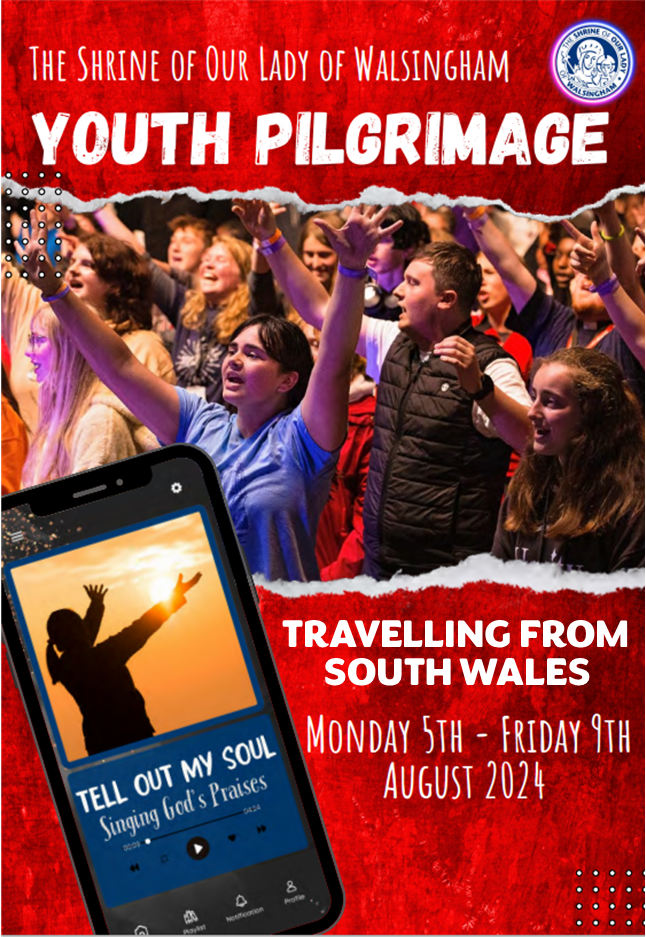
The Youth Pilgrimage is a week of lively worship, teaching, fellowship and fun for 11-18 year olds.
The traditional pilgrimage devotions are presented in an upbeat, lively and enjoyable way which makes them relevant for our young people in today’s world.
Over 500 young people gather in Walsingham for the week from all over the UK and internationally, giving them a chance to meet other Christians and explore their faith in a safe environment. Over the years it has changed the lives of countless young people who have never forgotten their week in Walsingham and many of them have come to love the Shrine and to make the pilgrimage ever since.
We’re now taking bookings for this year’s group travelling from South Wales. The cost is £150 but bursaries are available for anyone who can’t afford this!
To find out more about the Youth Pilgrimage check out the Shrine’s website
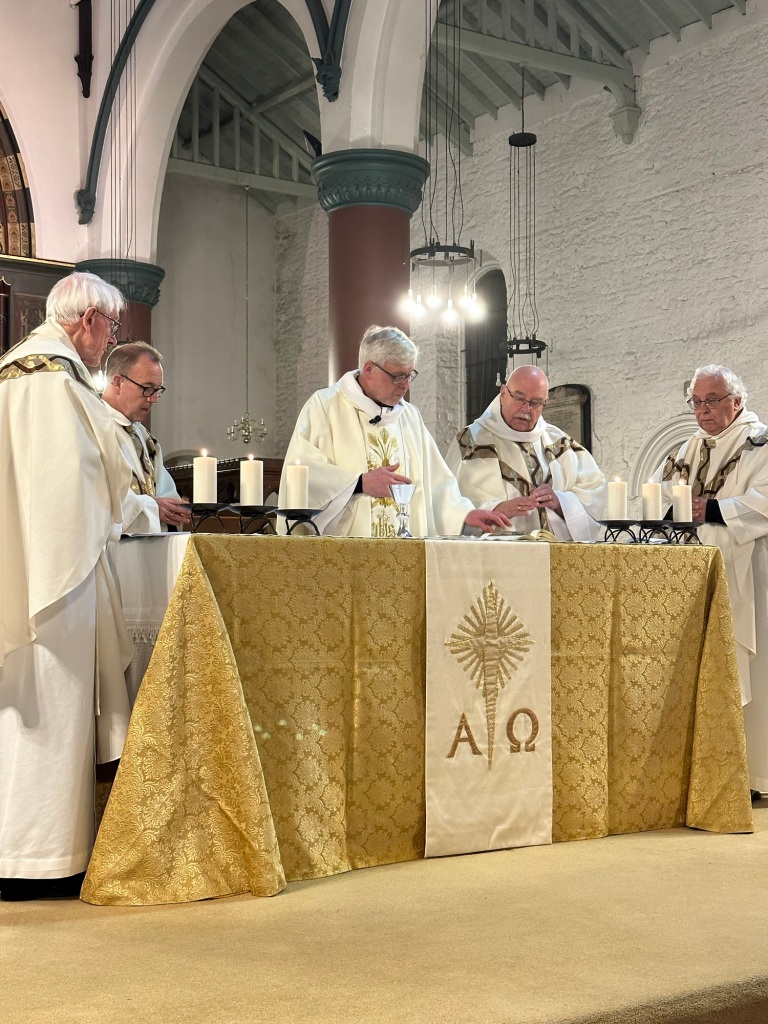
What a week we had! From Palm Sunday to Easter Sunday and everything in between including the great three days of Maundy Thursday, Good Friday and Holy Saturday, Holy Week was a moving experience.
Our Easter celebrations continue with the Octave (eight days) of Easter with Mass celebrated each day, whilst the flame of the Paschal Candle keeps burning.
We also celebrated a number of Baptisms and first Holy Communions. You can check out these and more of our Holy Week and Easter highlights including Maundy Thursday and Good Friday on the ‘Enter the Mystery’ Youtube Channel:
Highlights of the Easter Vigil. You can watch more videos like this at the Enter the Mystery Youtube channel (link above)
Passion for Splott
We were privileged again to join St Alban’s Church on Good Friday for Stations of the Cross.
This year, this included a new initiative: a Passion Play along the streets of Splott
Meanwhile, at St Dyfrig and Samson, children and families gathered for activities and their own Stations of the Cross.
Faithful Giving
The Lenten invitation to review and renew the ways in which we give continues throughout the Easter Season.
On Sunday April 14 at St Mary’s and St Saviour’s, we’re celebrating our Faithful Giving Gift Day, as we give thanks for the generosity of everyone who enables the mission and ministry of our churches to grow and thrive, and to encourage everyone to make a new personal pledge.
Mass is celebrated at least daily across our churches. Heres our pattern of prayer for the week beginning Sunday 7 April
Sunday 7 April 8.00am: Said Mass at St Paul's 9.15am Sung Mass at Ss Dyfrig & Samson 9.30am: Sung Mass at St Saviour’s 10.30am: Sung Mass at St Paul's 11.00am: Solemn Mass at St Mary's
Monday 8 April 6.00pm: Mass at St Mary's 7.00pm: Mass at Ss Dyfrig & Samson
Tuesday 9 April 10.00am: Mass at St Saviour's
Wednesday 10 April 10.00am: Mass at St Paul's 11.00am: Mass at St Mary's
Thursday 11 April 9.30am: Mass at Ss Dyfrig & St Samson 10.00am: NB: no Mass at St Mary's today 5.45pm: Mass at St Saviour's
Friday 12 April 10.00am: Mass at St Mary's
Saturday 13 April 11.00am: Morning Prayer & Rosary at St Mary's 11.30am: Mass at St Mary's
You can discover more about our regular pattern of worship through the week at
Detail of the door of the Tabernacle at St Mary’s depicting the scene of the Annunciation
The Annunciation of the Lord is usually celebrated on March 25th – yes, exactly nine months before Christmas, so that should give you some idea of what we celebrate on this day!
It’s the moment Mary received the angel’s greeting that she had been chosen to be the Mother of God, as the whole of Heaven waits on her response!
This year, because the feast fell in Passiontide, it’s been transferred to Monday 8th April.
We celebrate Mass here at the usual times of 6pm at St Mary’s and 7pm at St Dyfrig and St Samson.
United in Prayer
Join us in prayer for the needs and concerns of the Ministry Area.
In addition to our regular prayer for those who are sick and in need, and for the departed, the following feeds our prayer this week.
We pray for those who work to look after our buildings so that they are welcoming and safe spaces, a sacred sanctuary to all who gather here.
We pray for those who have been recently baptised and who now prepare for Confirmation, and for all who are involved in nurturing new Christians.
We pray for a compassionate response to all who are in need in our communities, and for the work of Cardiff Foodbank, here and across the city.
Building Up
Perhaps, when you think of the churches of our Ministry Area, you may first think of the buildings. Whilst we are more than stones and windows, our church buildings are important to our life together and to our mission and ministry.
However, our church buildings take a great amount of time and money to maintain and develop, and there is always something to maintain or repair.
Visitors to St Mary’s and St Saviour’s in recent months will know of the problems we’ve experienced with both heating systems, and we are busy looking at ways to install new heating systems.
It’s estimated, for example, that a new heating system in St Mary’s will cost in excess of £80,000 which will form part of a wider development of St Mary’s estimated to cost over £300,000.
We’ve established a small working group in each church to set off on our plans, and soon we’ll be rolling out more news and ways in which you can be involved.
Moving On
As the the nights get lighter and the days longer, we’re looking forward to the pilgrimage season, and we have many opportunities for us to move on! Here are just two.
The South Wales Walsingham Pilgrimage takes place between Monday July 22 and Thursday July 25. It’s a wonderful experience, and many pilgrims return year after year!
The Walsingham Youth Pilgrimage for young people aged 11 to 18, takes place from Monday 15 – Friday 19 August.
You can find more details and links for both pilgrimages in the post below:
In the homily at the Evening Mass of the Lord’s Supper, Fr Dean explores the connection between the Eucharist, the crucifixion and our life of service.
Darren McGarvey, also known by the stage name Loki, grew up in Pollock on the south side of Glasgow. Today, he is a writer, columnist and Rap artist. He became the first ever Rapper in residence at Police Scotland’s Violence Reduction Unit.
In his book “Poverty Safari: understanding the anger of Britain’s underclass” he provides moving insights into his own experience of growing up in poverty, a life surrounded by anger and violence, drugs and crime, inequality and difficulties.
In one passage, he shares a moment when he was five years old. His mother was partying downstairs with friends, and so he decided to join them with the plan of being able to stay up a little later and join in the fun. But his plan turned into a distressing moment of anger and violence. His mother ran to the kitchen, grabbed a knife, and chased him as he stumbled up the stairs to his bedroom.
“If only I had the sense to run out of the front door instead,” he writes. “Seconds before, she had appeared to be having so much fun that it had felt safe to wind her up in front of people. Now I was trapped in my room, pinned against the wall, with a knife to my throat. I don’t remember what she said to me but I do remember the hate in her eyes. I remember thinking that I was about to be cut open and that I would probably die. Just as she lifted the knife to my face, she was pulled from behind and thrown to the other side of the room by my dad, who then restrained her while one of the guests picked me up and bundled me into the back of a car.
“I don’t remember my mother, or anyone else, ever talking about that night again. Truth be told, I forgot about it myself until many years later, when it came back to me in the form of a flashback.”
Our memories play tricks on us. Sometimes, for those who have experienced great trauma, their brain tries to protect them from harm, pushes away, into the deep recess of their mind, some painful memory too much to take, too much to process but which somehow emerges later in life. Sometimes, in other extreme cases, humans are even able to create false memories, construct events and experiences that never happened but which seem as clear as day.
Our minds and memories are complex.
For Darren McGarvey, it was only later, as he began to put his life together and address his own power to bring change, that the pain of the past could be seen more clearly.
This evening, we begin to enter sacramentally into the Mystery of Christ’s pain, death and resurrection. We do so with a sense of hindsight. The past is made present, the memories are made clear right in our midst.
In some ritual, liturgical and shared way, we draw closer to the cross of Jesus – to his love, to his life, to his power to save, to the way in which he makes sense of our lives.
This is the night on which Jesus broke bread, the night on which he gave us a new way of remembering and recalling, of sharing in his life, in his death, and in his resurrection.
St Teresa of Calcutta said, “The Eucharist is connected to the Passion (of Jesus). If Jesus had not established the Eucharist we would have forgotten the crucifixion. It would have faded into the past and we would have forgotten that Jesus loved us. To make sure that we do not forget, Jesus gave us the Eucharist, as a memorial of his love.”
This is such a simple thing. The Eucharist recalls, reminds us of the cross. It’s what St Paul meant when he wrote, “Every time we eat this bread and drink this cup, we proclaim the Lord’s death until he comes again.”
Back to Darren McGarvey, whose words we began with. “In ‘deprived’ areas, where resources are scarce, gossip is a form of currency, and if you’re unlucky enough to hail from a visibly troubled family, you are presented with a choice: you can let others people talk about it or you can become the author of your own story – which is exactly what I did.”
Now and over the coming days, through word and action, we tell the story of God’s love for the world. We move through the moments of this Mass tonight until it stands froze, locked in that Gethsemane moment of struggle and prayer.
Tomorrow, we will lean closer to the cross of Christ as we bring our pain to his, and wonder at “Love so amazing, so divine.”
We will wait and watch and gather in darkness on Saturday evening to celebrate the unfolding of God’s Love story which elaborates into a life that doesn’t end, into the remarkable, redeeming presence of Jesus for ever.
In tonight’s gospel story, we hear how the reality of the Eucharist can be expressed and told in our own day, in our own way. As he leaves the table, clothed with a towel, Jesus acts out that life of service. It’s a role-play of divine proportions, a scene filled with love. And the only stage direction is to do for others as he has done for us.
As the Eucharist is connected to the Passion of Jesus, so it’s connected to the pains of everyone. Flowing from the Eucharist is our service of those who are in need. The clean pristine cloth of the altar is never far away from the grime of our feet. The trimmed candles and polished silver are not separate from the dirt of the street.
Everything we do throughout these days is underwritten by the story of God in Christ. We don’t change the story of God’s love for the world. We allow it to change us, and so through changed lives, take part in changing the world and transforming the lives of others.
Much of the world and our society, despite growing in secularism, still know some of the story of Jesus. They are free to take what they want from it. They can place it alongside all the other stories they know or think they know. They can file the stories away as fables or store them alongside other sacred stories.
It’s our calling to share the gospel truth, the story of Jesus’ love with its grim and great reality, with all its outtakes and spin offs, with its sequels and extended material, as we become part of the story, live it out, pass it on.
We are invited to allow God, the author of life, to draw us deeper into the story which is his. To be, as St Teresa said, “a little pencil in the hand of God, who is writing a love letter to the world.”
We can allow others to distort and try to hide the story of God in Christ, or we can take that story, and live it out in our own lives, beginning here at the place where God calls us back to the cross of Jesus, to the love of Jesus.
Without the Eucharist we would forget the cross. Let us never forget the cross. Let us never forget the Eucharist. And let us never forget our calling to be that light in the world, the salt of the earth, the yeast, the leaven, the pencil in the hand of God.
From here, as Christ fulfils our hunger, may we go out and fulfil the hunger of others.
The story is out there.
It’s our calling to fill in the gaps, to stand in those places, to stoop to those feet, to let the memory live, to be faithful to the Eucharist, to be faithful to the Cross, to be faithful to God’s love in action.
“Lord, make me an instrument of Your peace; where there is hatred, let me sow love; where there is injury, pardon; where there is doubt, faith; where there is despair, hope; where there is darkness, light; and where there is sadness, joy.
O Divine Master, grant that I may not so much seek to be consoled as to console; to be understood, as to understand; to be loved, as to love; for it is in giving that we receive, it is in pardoning that we are pardoned, and it is in dying that we are born to Eternal Life.”
Homily by Fr Dean Atkins for the Liturgy of the Lord’s Passion on Good Friday 2024 at St Paul’s Church, Grangetown
Last night, at the Evening Mass of the Lord’s Supper, I shared something of the experiences of Darren McGarvey, also known as Loki, the writer, social commentator, and Rap artist as featured in his book, ‘Poverty Safari.’
Coming from a troubled family, with a mother whose life was turbulent and dependent on drugs, he writes of his own life as a means through which more widespread questions about poverty and inequality can be explored.
“By the age of ten I was well adjusted to the threat of violence,” he writes. In some ways, violence itself was preferable to the threat of violence. When you are being hit – or chased – part of you switches off. You become physically numb as the violent act is carried out. A disassociation occurs. You become detached from the violent act as it is being perpetuated against you. The disassociation can make you physically numb as well as emotionally unresponsive. Your body goes into self-preservation mode until the threat is over.
“In a home where violence, or the threat of violence, is regular, you learn how to negotiate it from a young age. On the one hand, you don’t want the violence to happen. On the other, you know it is inevitable and would rather just get it out the way.”
There is an inevitably to the violence inflicted upon Jesus. After all, it had been predicted by Jesus himself although, for his disciples, that thought was unbearable.
‘I will never let this happen,’ said Peter. ‘I will lay down my life you.”
“Lay down your life for me?’ asks Jesus. And then he pulls the rug from under Peter’s feet, and predicts that his bravado will dissolve. He’ll deny even knowing Jesus, not once or twice but three times.
How do we negotiate our way through a world of pain and suffering? None of us goes out of our way to seek pain, although so many of us, on so many different levels, experience self-harm. It comes in many guises and from so many different places within ourselves. Yes, so much of what we do harms ourselves and harms others.
Perhaps in our ideal world, there would be no pain or suffering, but then that would also appear to be a physically impossible world.
The experience of both physical and emotional pain warns us against certain dangers. Pain causes us to remove ourselves from further harm – to retract our hand from the flame, to run for our lives when our heart is racing, or to indicate that some thing isn’t right with us, so that, hopefully, we can seek some help, allow our wounds to heal.
Negotiating our way through all that inevitable pain can be enough, but what about the gratuitous pain inflicted upon so many people in so many different ways?
The pain of those who experience depravation and poverty, abuse and neglect. The traumas and terrors of war. The violence and aggression which seem to characterise our world and features so deeply in the human story.
The broken relationships caused by greed and selfishness. The walls and barriers we build around ourselves leaving us to peer over and wonder what that ‘enemy’ of ours is up to. The suspicion we cast upon those who seem different from us. The arrogant thought that all people should be ‘just like us.’ How do we negotiate our way through this violence, through this pain?
It’s no mistake that Golgotha lies outside the city walls. After all, we want to push the thought of our own hatred and aggression, our sundry sins and unjust ways, our pain and suffering – and the struggles of others – so far away from us.
We simply keep our heads down, hide our guilt, conceal our culpability. Perhaps we pretend that we are powerless, unable to do anything. That speaking peace, or seeking peace, is for the professional, the politician, the ones we push forward, and finally learn to push away.
It’s into this world that God sends his Son. After dragging his cross through the familiar streets, through the landscape of our lives which we have learned to love and loathe, Jesus arrives at that place of death which we have shunned, and there he dies.
The disciples, who had dispersed and abandoned him, begin to regroup. They try to find some comfort when all around them has been destroyed. As their lives fall apart, they try to create something else out of the remnants of everything they had known. How will they respond to this new life? How will they respond to what has happened to Jesus? How will they negotiate their way through the violence of grief, the pain of loss?
Henri Nouwen tells the story of a close friend of his who was dying of cancer. His friend had been such a great social activist and cared so deeply about people that he saw the value of his life as being able to do things for others. Now that he was unable to be active, he was finding his life impossible. He said, “Henri, help me to think about my not being able to do things anymore so I won’t be driven to despair.”
For someone who had been so active and did so much for others, he now experienced a different reality – having things done for him, having things done to him.
During our lives, whilst we fill them with action and doing, we are mostly ‘done to’. This is particularly the case for those whose lives are dictated by the decisions of others, those prisoners of inequality or greed. Those who live in state funded poverty of well-intentioned schemes that often fail. Those displaced from their homes as a result of a war they did not create.
Throughout his ministry Jesus was busy doing so much. He taught and preached, he helped and healed, he travelled from town to town. But now, in these last days, he has been ‘handed over.’ Things are done to him – he is beaten and scourged, he is crowned with thorns. He is burdened with a weight which brings him tumbling to the ground. He is stripped and nailed to a cross.
He has vinegar pushed to his face to the numb the pain, by those who caused the pain – an image that so encapsulates our perverse human endeavours. We try to live green lives to remedy the harm we’ve done to the planet. We send aid to the places where we’ve played a part in their ruin. We show compassion to those who are poor or homeless, when all we have really done is priced them out of the market.
Yes, Jesus’ work and activity have now culminated in things being done to him. There is a shot of despair, “My God, my God why have you forsaken me?’
We can easily, like Henri Nouwen’s friend, be driven to despair, but in those moments of being done to, in those moments of powerlessness, in those times of waiting are met by God in a new way.
It can be an unfamiliar place, outside the landmarks of our lives, in that place of struggle and pain we know as Golgotha. It’s a place to which we bring our whole lives.
The times we have tried to do so much, the times when we have lost our way. The moments when we tried to redeem our own lives through being busy and preoccupied by such ‘important’ things. The times when we made excuses for ourselves, licked our wounds, sat in self-pity, or just felt bloody awful. The times when we questioned how influential we were or tried to be.
The times when life diagnosed us, when people poked us, cells were scraped from us, when we were dealt blows from out of the blue, and when blue seemed to be the colour of our life at times.
But Golgotha is a place where God waits to see if this thing he has done is enough to win back the world, and not drive him to despair. As we approach the cross today, we take this sense of Divine despair to our lips, as we sing: “My people tell me, what is my offence? What have I done to harm you? Answer me!’
I’ll begin to end as I started – with words from Darren McGarvey as he reflects on an early life of violence and aggression. As he shares an incident of violence he remembers from when he was five years old, he writes:
“After explosive incidents like this, whether they involve physical violence or non-physical aggression, there is always the hope that the perpetrator’s remorse will propel them towards better behaviour. Even when there’s no sense of that happening, there remains a perverse allure in their empty promises.
“In these moments, there is a vulnerability, tenderness and honesty, seen so rarely, that is so affecting that you struggle to resist the twisted logic of your abuser. All you want is for them to love you and this need persists at the expense of your own sanity and safety.”
Here, at the heart of this Passion of Jesus with the inevitable violence and sense of despair, as we seek to negotiate our way through the pain, he asks simply for love.
It was this love which Henri Nouwen’s friend had discovered in his own passion. It was a love which underpinned all the actions he had ever done for others throughout his life, but he had not then realised or experienced the fulness of this love, not now, not until his painful time of waiting.
“More than ever,” wrote a Jesuit priest, Pedro Arrupe, “I find myself in the hands of God. This is what I have wanted all my life from my youth. But now there is a difference; the initiative is entirely with God. It is indeed a profound spiritual experience to know and feel myself so totally in God’s hands.”
‘Father, into your hands I commend my Spirit,” cried Jesus. In this moment of vulnerability, tenderness and honesty, he looks to us for love and, like him, to place ourselves into God’s hands with total abandon.
The cross is a moment of waiting. It’s a place for us to wait and to work out who we are and what we’re for, as we negotiate our way through the pain.
And, there, God also waits for our response, wonders if we will love him, wonders if it’s been worth all the waiting.
It’s a twenty minute walk from where I live in Butetown to St Paul’s Church in Grangetown to where I’m heading. It takes a little longer to reach there today.
Near the door of St Mary’s Church someone has discarded a needle during the night. I return to the house for the sharps box which is getting pretty full now. I dispose the needle safely.
A minute later, and I pass the entranceway to Ty Gobaith. For weeks, during the evening time, numbers of people gather there, and inject there. They have been dispersed by the decisions made elsewhere. The problem passed on, pushed closer to where people live. Closer to schools.
Here, I count five needles. I wonder if I have time to return to the house to collect the sharps box again. I check my watch. I’ll be late.
A street cleaner is collecting rubbish. I point out the needles. He doesn’t collect needles, he tells me, although the company he works for does.
Luckily, I have the Company’s contact details. Send an email with photographs. Hope they will be able to attend soon.
The school run has just finished. I move on.
As I walk on, I see more needles scattered at the side of the pavement on Callaghan Square. I take another photograph, send another email.
This is not uncommon. Sometimes, here, we collect needles on a daily basis. Sometimes, it may be just the one needle. Sometimes, half a dozen.
In a five minute walk from the house I have counted eight.
On my return, the needles outside Ty Gobaith have been collected although one was missed. I return home for the sharps box.
Recently, in Glasgow, a safe drugs consumption facility was opened. (You can read about it here). It would be against the law to initiate one here in Wales, in Cardiff. And yet such facilities have emerged across Europe, North America and Australia. They reduce harm for the user, whose life may be fairly chaotic, and provide a supportive environment which perhaps may eventually lead to them accepting the help they need.
They also reduce drugs litter, and create safer communities, prevent a child stepping over a needle, or walking past someone injecting in broad daylight, or even worse receive an injury from a sharp.
I’m not suggesting that such a facility in Cardiff would solve all the problems. I’m suggesting, that a serious and public conversation around the possibilities of safe drug consumption facilities needs to happen, a conversation which should involve all concerned parties including the community, and be driven by the communities affected.
When the first facility opened in Barcelona, there was a fourfold reduction in drugs litter.
It’s time to start talking in a different way about drugs and homelessness. It’s time to begin to make new decisions, to look compassionately on the needs of all affected (individuals and whole communities) and to move towards making a bold decision.
As the nights draw in, November brings a chill but there are many things that offer a little light and warmth, including the beautiful feast of All Saints, followed by the Commemoration of All the Faithful Departed, or All Souls.
Honouring the saints, with whom we have fellowship as members of Christ’s Body, reassures us that we have been made to live with God for ever, that we have been made for Heaven where the saints pray for us.
We know many of the saints by name, and through stories which have lingered. Their memory is kept alive, their lives are celebrated on their Feast Days. Some of the saints we know well. The details of others have been lost in time, only their name lives on.
Then there are others of whom we know nothing – not even their name of or even their existence. The Feast of All Saints on Wednesday November 1st provides an opportunity to give thanks for all who have allowed God to triumph in their lives.
We’ll be celebrating across the Ministry Area, with a morning Mass at St Paul’s, Grangetown at 10am, and a Sung Mass at St Saviour’s Church, Splott at 7pm
On November 2nd, we celebrate the Commemoration of all the Faithful Departed, (also known as All Souls) those we have known and whose presence we miss, praying that we will be reunited with them one day in Heaven.
Our celebration of Mass on this day takes place at Ss Dyfrig and Samson, Grangetown at 9.30am, St Mary’s Church, Butetown at 10am and St Saviour’s Church, Splott at 5.45 pm.
Also, at St Mary’s each day during the whole of November, you can request a special intention for departed loved ones for the Mass of the day. Please add the intention to the list in church or send us a message.
Are you sitting comfortably? We have something to tell you!
St Saviour’s Church is on a mission. We love to use our space and resources to serve the local Community.
For example, we run two Foodbank sessions each week as we respond to the needs of those in crisis, and we are involved in many community projects across South Cardiff, and have plans to do so much more.
We love to use our space in creative and generous ways whilst also being true to the original purpose of the building and our life together as a worshipping community.
But we have a problem! The chairs at St Saviour’s are over a hundred years old. They have served us well but they’re now on their last legs! But as we move on, with limited resources, it means we have little flexibility to use our building in creative ways for the church and wider community.
We started raising money for new seating a year ago, but at a cost of around £12,000 and with all the other demands involved in the life of St Saviour’s Church, we’re finding it a challenge!
So we’re inviting people to contribute to our most recent development! We need something to sit on! Each chair costs about £160 and we need 70 of them. They will enhance the dignity of the church space, provide comfort and flexibility.
I you’d like to be involved in helping us move on to the next stage of our journey, every pound you give will be so gratefully received.
For many people in Splott, St Saviour’s Church is a constant and valued feature. You may have been baptised or married here, attended a funeral here, or simply have fond memories of the past.
Whatever your connection, we invite you to be part of the ongoing story of St Saviour’s in Splott. So why not consider donating to our SIT DOWN TO MOVE ON campaign?
Why are the chairs so expensive?
As a Grade 2 Listed building and a Church we are restricted to what chairs we are allowed to have. There is a rigorous process of application to the Diocese which is open to external scrutiny (such as the Victorian Society and other interested parties)
If you’d like to donate then follow the link to our GoFundMe page. Thank you.
Each month at St Saviour’s Church, Splott, it’s time for young people! Each OMG! event is different but it always includes a time of prayer and worship, and a chance to eat together.
Last month it was a Barbecue. The month before that it was pizza. In October, it was chippy on the menu!
But most importantly, this month’s event provided a time for us to pray for peace in a world that knows war and conflict, suffering and pain. We were invited to create postcards for prayer which we presented at the altar steps, along with a lighted candle.
Check out our two videos of the event, and where you can also read some of the postcards or peace
The next event will be on Sunday November 26th at 5pm
At St Mary’s, towards the end of Black History Month, we’ll be blessing an icon of St Martin de Porres who, amongst many other things is patron saint of those who seek and work for social justice and racial harmony.
There is, at present, just a small representation of black people in the art work at St Mary’s. This can be found in one of the Stations of the Cross, with Simon of Cyrene and his two sons, Alexander and Rufus.
The icon of St Martin will be a place to pray and light candles, and will also go a little way to better reflect our community and the lives of those who worship here.
Who was St Martin?
St Martin was born in the city of Lima, Peru on 9 December, 1579. He was the illegitimate son of a Spanish nobleman, Don Juan de Porras y de la Peña, and Ana Velázquez, a freed slave of African and Native descent. After the birth of his sister, the father abandoned the family, and his mother supported her children by taking in laundry. He grew up in poverty and was sent to a primary school for two years, and then placed with a barber surgeon as an apprentice.
He spent much time in prayer and was drawn to the Religious Life. However, under Peruvian law, descendants of Africans and Native Americans were barred from becoming full members of religious orders, so he asked the Dominicans of Holy Rosary Priory in Lima to accept him as a volunteer to perform menial tasks in the monastery in return for being able to wear the habit and live with the religious community. He was received at the age of 15, first as a servant boy and then as an almoner. He also took on kitchen work, laundry, and cleaning, as well as continuing his trade of barbering, and performed many miraculous cures.
After eight years at the Priory, the Prior decided to ignore the law, and permitted St Martin to take his vows as a member of the Third Order of Saint Dominic, although he was mocked by some fellow brothers as being illegitimate and descended from slaves. In 1603, when he was 24 years old, he was allowed to profess religious vows as a Dominican lay brother.
St Martin was noted for his work on behalf of the poor, established an orphanage and a children’s hospital, and had a deep devotion to the Blessed Sacrament where he spent many hours in prayer. He is the patron saint of black people, people with a mixed ethnic background, barbers, innkeepers, public health workers, and all those seeking racial harmony and social justice as well as animals, schools and public health.
The icon of St Martin will be blessed at St Mary’s Church, Butetown on Sunday 29 October at the 11am Mass. All are welcome.
St Martin de Porres, born: 9 December, 1579; died: 3 November, 1639; Beatified, 1837 by Pope Gregory XVI; Canonized, 1962 by Pope John XXIII
On Homelessness Sunday (October 8th) the Ministry Area of South Cardiff will adopt a Homelessness Charter.
Some years ago, before the Ministry Area of South Cardiff existed, St Mary’s Church adopted a Homelessness Charter. Its purpose was to set out our commitment and response to those who are homeless in our city.
Now, as part of our life together across the communities of Butetown, Grangetown and Splott, we have reviewed and will adapt this charter for the whole of the Ministry Area.
The charter doesn’t claim to solve problems. It’s simply the beginning of a process which attempts to establish a culture in which we can work together.
Not only does the Homelessness Charter aim to offer a consistent and realistic response to all experiencing homelessness, it also commits us to working with others on issues of Housing Justice, and to respond effectively to some of the related issues.
We will regularly review the charter. So that we can do more and do better!
Photo: Liam Riby, Unsplash
Homelessness Charter
We welcome people who are homeless and will treat you with dignity and respect.
We offer friendship and accept you as you are. We will talk with you and listen to you, and will try to understand your situation. You are welcome to join us for worship but all people regardless of religion, race, gender, sexuality or disability are welcome here. (We may also host external organisations, so please ask about the accessibility of these).
We will guide you to services which can help you with your specific needs.
If necessary and appropriate, we will liaise with them for you. Our pastoral leaders and other individuals in our congregation commit to having an up to date knowledge of Homeless Services across our city and issues which may affect you so that you will receive a consistent, fair and honest response. However, we recognise there are limitations to the help we can give. Our community consists of all kinds of people, some of whom have their own vulnerabilities but we seek to equip our whole congregation so that they will be understanding and supportive.

We aim to offer a safe environment for all.
All staff, volunteers and members of our community of faith and all who visit and use our church premises (including those who are homeless) can expect to be treated with respect and to be safe from harm so that we can offer a welcoming and friendly environment, free from violence, aggression, bullying and fear. We will report aggression, violence, anti-social and criminal behaviour and damage to our property to the police. Drugs are not to be used or dealt on our premises, neither is begging. We work to the Safeguarding Policy of the Church in Wales.
We will support you financially through donations to homeless charities and other projects in our city.
We are unable to give you money or pay for services directly. We value and will promote the work of those charities and organisations, and are committed to supporting them regularly and in appropriate ways.
We have a concern for your physical, spiritual and emotional needs.
Each church has different resources available to them in terms of being able to provide food. However, we recognise that some external projects which offer food also provide parallel services which can help you even further. We can guide you to these services and to the abundance of free food available across Cardiff but we will always attempt to help you at your point of need. We are unable to provide accommodation. On occasions when people are rough sleeping on our premises, we will assess the risk to both you and others, and explore with you the possibilities available by liaising with various services and authorities.
We will be actively involved in Housing Justice and issues which affect those who are homeless.
This also means being informed about the issues which lead to homelessness, and the experiences of those who are homeless.
Homelessness Sunday
Why not join us on Sunday 8th with celebrations across the Ministry Area?
St Paul’s Church, Grangetown at 8am and 1030am
St Dyfrig and St Samson’s Church, Grangetown at 9.15am
St Saviour’s Church, Splott at 9.30am
St Mary’s Church, Butetown at 11am
On Sunday 15th, our Guest Preacher at St Mary’s at 11am is John Stark, chaplain to the Salvation Army’s Ty Gobaith
This charter sets out how, as a whole church community, we will respond to, welcome, care for and support those who are homeless across the churches of South Cardiff Ministry Area, as well as how we will respond to the situation of homelessness and Housing Justice. Adopted on Homelessness Sunday, October 8, 2023. We willcontinue to review and adapt as appropriate.