Gall Duw deimlo’n bell i ffwrdd weithiau ond nid yw byth yn ein gadael. Tad Richard yn myfyrio ar ddarlleniadau heddiw o’r Offeren.
God may sometimes feel far away but he never leaves us. Fr Richard reflects on today’s readings from Mass.
Ydych chi erioed wedi chwilio am rywbeth coll, ac yna sylweddoli ei fod yno trwy’r amser? Aml waith rydw i wedi chwilio am fy sbectol heb sylweddoli ei bod ar fy nghorun drwy’r amser! Weithiau hefyd bydd panic mawr cyn darganfod fy ffôn neu fy allweddi – chwilio gwyllt o gwmpas y tŷ cyn eu gweld yn fy llaw.
Weithiau cawn yr un teimlad o fod ar goll yn ysbrydol a meddwl fod Duw wedi ein gadael yn amddifad. Fodd bynnag, mae ein darlleniadau heddiw yn ein hatgoffa Ei fod Ef yma bob amser, yn ffyddlon bob amser ac wrth ein hochor. Ni sydd ddim yn ei gydnabod.
Yn y darlleniad cyntaf cawn bobl Israel yn teimlo’n amddifad. Dywedant “Mae Duw wedi fy ngadael i, mae Duw wedi fy anghofio fi”. Ond mae Duw yn ateb yn syth gyda’r geiriau gogoneddus: “All gwraig anghofio y plentyn sy’n sugno? Efallai gall y rhain anghofio ond fydda i byth yn eich anghofio chi”. Er ei bod hi’n anodd iddynt weld hyn, ni adawodd Duw erioed mo’i blant. Bydd yn eu hadfer i’w mamwlad yn fuan.
Yn yr Efengyl mae’r Iesu’n amlygu nad yw’r meirw hyd yn oed wedi eu colli i Dduw. “Mae’r awr yn dod, ac mae yma nawr” meddai’r Iesu, “pan fydd y meirw yn clywed llais Mab Duw, a bydd y rhai hynny yn byw”. Mae’r Iesu yn siarad o brofiad achos teimlodd Ef ei fod wedi ei amddifadu ar y Groes. Yno, ymbiliodd ar y Tad i’w gofio. Ond, mae’r Atgyfodiad yn dangos na fu i Dduw adael yr Iesu yn union fel na fydd yn ein gadael ni. Mae hwn yn brif ategiad o’r hyn a ddywed yr Iesu yn yr Efengyl heddiw, “Mae’r Tad yn caru’r Mab ac yn amlygu iddo popeth y mae yn ei wneud”. Ni ellir torri byth yr undod rhwng yr Iesu a’r Tad, beth bynnag all ddigwydd yn y byd. Mae’r un peth yn wir am ein perthynas ni â’r Iesu. Pa beth bynnag a ddaw i’n gofidio, bydd Ef gyda ni bob amser.
Have you ever thought that you have lost something, only to realise it was there all the time? Many times I have gone searching or my glasses, only to realise they are sitting on top of my head! On other occasions, I have not been able to find my phone or keys. With a growing sense of panic I go hunting around the house, and then notice I’m actually holding them in my hand!
Sometimes we can feel lost spiritually, and feel that God has deserted us. Our readings today remind us that he is always there, always faithful, always by our side. It’s just that sometimes we don’t realise it.
In our first reading today, the people of Israel are feeling bereft during their time of Exile in Babylon. “The Lord has forsaken me; my Lord has forgotten me”, they say. But God immediately answers them with wonderful words of reassurance: “Can a woman forget her nursing child? Even these may forget, yet I will never forget you”. Even though it may be hard for them to perceive, God has never abandoned his people, and will soon restore them to their homeland.
In the Gospel, Jesus is clear that even those who have died have not been lost to God. “An hour is coming, and is now here”, Jesus says, “when the dead will hear the voice of the Son of God, and those who hear will live.” Jesus is able to say this because he himself experienced that feeling of loss and abandonment on the Cross, when he cried out to the Father, “why have you forsaken me”. Yet the Resurrection shows that God had never left Jesus, just as he will never leave us. It is the supreme confirmation of what Jesus says earlier in today’s Gospel, “the Father loves the Son and shows him all that he himself is doing”. That unity between Jesus and the Father can never be broken, not even by the worst thing that the world can do. The same is true in respect of Jesus and us. Whatever darkness and loss we may endure, he will always be with us, and will never abandon us.
Yr Offeren heddiw yn St Dyfrig a St Samson am 6.30pm.
Mass today is in St Dyfrig and St Samson at 6.30pm.
Connecting you to the churches of South Cardiff Ministry Area across Butetown, Grangetown and Splott. Our vision is to be a creative and resourceful community which is welcoming, faithful and just!
This Week
Lent continues with our Christian Aid “Act on Poverty Course,” Stations of the Cross and Lent Lunches, as well as the usual daily Mass.
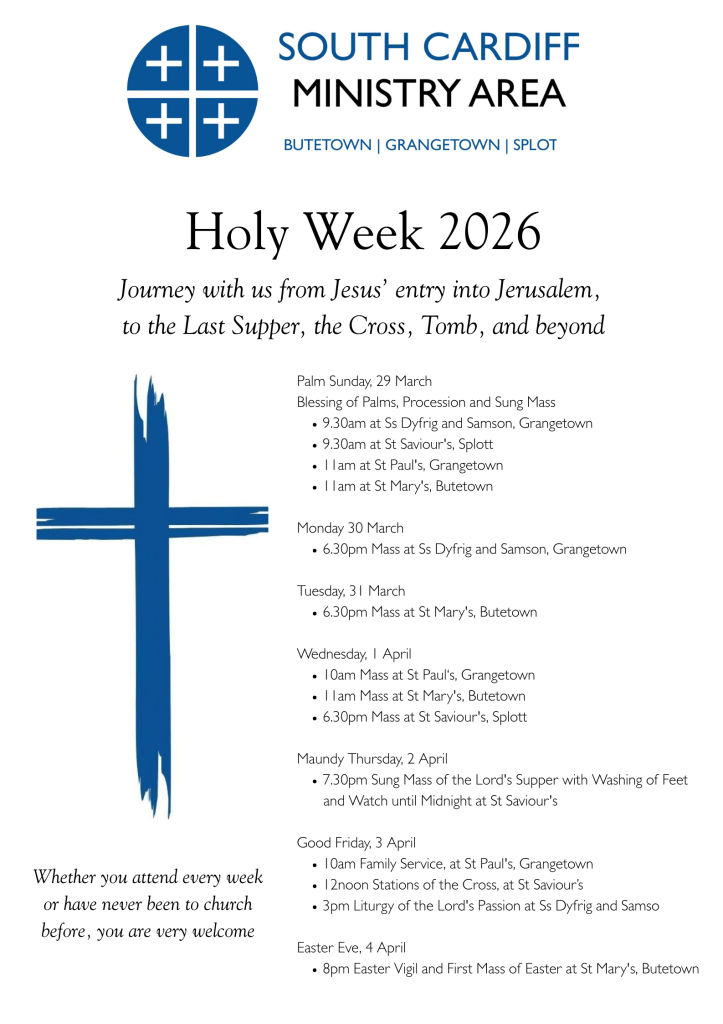
We’re also looking ahead towards Holy Week which is now less than two weeks away. Further ahead there’s information about South Wales Walsingham Pilgrimage in July, and the Walsingham Youth Pilgrimage in August.
We also look ahead to the next coffee morning in St Paul’s in aid of the Motor Neurone Disease Association.
A reminder that our monthly Mass in Welsh takes place today (Wednesday 18th) at 6.30pm in Ss Dyfrig & Samson. The Mass and sermon are fully bilingual, so it’s a great opportunity to practice your Welsh if your are a learner. Tea and coffee is served afterwards.
Keep scrolling to find out more!
Act on Poverty
This Lent, we are taking part in Christian Aid’s Lent course, Act on Poverty – every Tuesday at 7pm in St Mary’s, following the 6.30pm Mass.
Our final session next Tuesday will look at how we can remain hopeful in the midst of so many challenges in our world, and then will encourage us to to develop our own Act on Poverty Plan.
Justice. Righteousness. Mercy. Good News. What would it look like if we shaped our response to poverty as a society around these principles? Come and found out on Tuesday!
Lenten Charity
An important part of Lent is charitable giving and our Lenten charity this year is Christian Aid.
Offertory boxes are available in all our churches.
Stations of the Cross
Join us on a devotional journey each week through Lent as we pray the Stations of the Cross
take place on Monday at 7pm in St Dyfrig and St Samson (following the 6.30pm Mass), and in St Mary’s on Saturday at 11am (before the 11.30am Mass).
We have many resources online that you can use at home. Why not check out this “Just Stations of the Cross” published a few years ago.
This Sunday,the 5th Sunday of Lent, is sometimes also referred to as Passion Sunday.
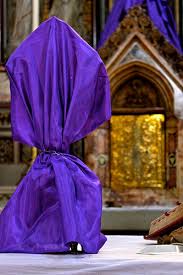
This begin the final two weeks of Lent, sometimes also known as Passiontide. You’ll notice that from this Sunday, all the statues and crosses in our churches are covered with purple veils. This is ancient practice heightens the sense of anticipation as we near the end of Lent, and increases the sense of joy when the crosses and statues are unveiled again at Easter.
The Gospel reading for this Sunday is the raising of Lazarus from the dead in John 11.1-45. As we approach the time of the Lord’s passion, it is a reminder that Jesus has already won the victory over death.
Holy Week
Holy Week is the most important week of the Church year, as we journey with Jesus through the last week of his life on earth.
The week begins with Palm Sunday, and in all our churches we symbolically re-enact Jesus entering Jerusalem by holding a procession at the start of Mass. On Maundy Thursday we commemorate the Last Supper, Jesus instituting the Eucharist and washing the feet of his disciples, so giving us an example of service. Good Friday of course is the most solemn day when we remember his death on the Cross. Holy Saturday is a day of waiting, and our churches are decorated ready for the Easter celebrations. Then in the evening of Holy Saturday we proclaim Easter in a joyful way with the Easter Vigil. It is important for all Christians to attend as much worship as possible during Holy Week – details of our services are given below.
Grangetown Rising!
A new initiative for this year! Join us for a short service at dawn on Easter Day at the summit of Grangemoor Park in Grangetown, which overlooks the city of Cardiff. We will hold a short service to greet Easter Day and offer a blessing over our city. You’re invited to meet at the entrance of Asda in the Cardiff Bay Retail Park at 6am to walk to the summit. Afterwards we will enjoy coffee and pastries.
Coffee Morning
Our next charity coffee morning takes place on Saturday 21 March in St Paul’s Church.
This time we are raising funds for the Motor Neurone Disease Association. As usual there will be plenty of delicious cakes as well as tea, coffee, and a chance to catch up with friends. Everyone is welcome.
Young people aged 11-18 are invited to join us for the Walsingham Youth Pilgrimage from 3-7 August.
Around 500 young people from all over the UK camp in a field just outside the village of Walsingham. Worship takes place in a large marquee led by the excellent worship band CJM. There are also lots of different activities for young people to take part in during the week.
As part of the Welsh camp, all tents are provided and you will be fully catered for. All you need to bring is a sleeping bag, air bed, clothes and toiletries. For more information, please contact Fr Richard and also take a look at the link below to find out more.
We are delighted to announce that St Paul’s Church (meeting in the community hall) has now been licensed for weddings.
This means that our modern, flexible worship space can now be used for your special day! Here’s an idea of what it might look like decorated for your wedding. And then why not have the reception in our well-appointed and spacious hall….. no travelling required!
If you live in Grangetown (or have a qualifying connection to St Paul’s) and would like to get married in St Paul’s, please contact Fr Richard on 0333 301 1850 or RichardGreen@cinw.org.uk
Check out the link below about weddings in our churches:
Mass is celebrated each day across our churches. Here’s our pattern of prayer for the week ahead.
Wednesday 18 March
10.00am: Mass at St Paul's with St Paul's School
11.00am: Mass at St Mary's with St Mary's School
6.30pm: Offeren yn Gymraeg (Mass in Welsh) at Ss Dyfrig & Samson

Thursday 19 March (Solemnity of St Joseph, Husband of the Virgin Mary)
10.00am:  Mass at Ss Dyfrig & Samson

Friday 20 March
10.00am: Mass at St Mary's
Note change of venue for this week only

Saturday 21 March
10.50am: Morning Prayer at St Mary's
11.00am: Stations of the Cross at St Mary's
11.30am Mass at St Mary's
12 noon: Sacrament of Reconciliation

Sunday 22 March | Lent 5 | Passion Sunday
9.30am:  Sung Mass at Ss Dyfrig & Samson
9.30am:  Sung Mass at St Saviour’s
11.00am: Sung Mass at St Paul's
11.00am: Solemn Mass at St Mary's

Monday 23 March
6.30pm:  Mass at Ss Dyfrig & Samson
7.00pm:  Stations of the Cross at Ss Dyfrig & Samson

Tuesday 24 March
6.30pm:  Mass at St Mary’s
You can discover more about our regular pattern of worship through the week at
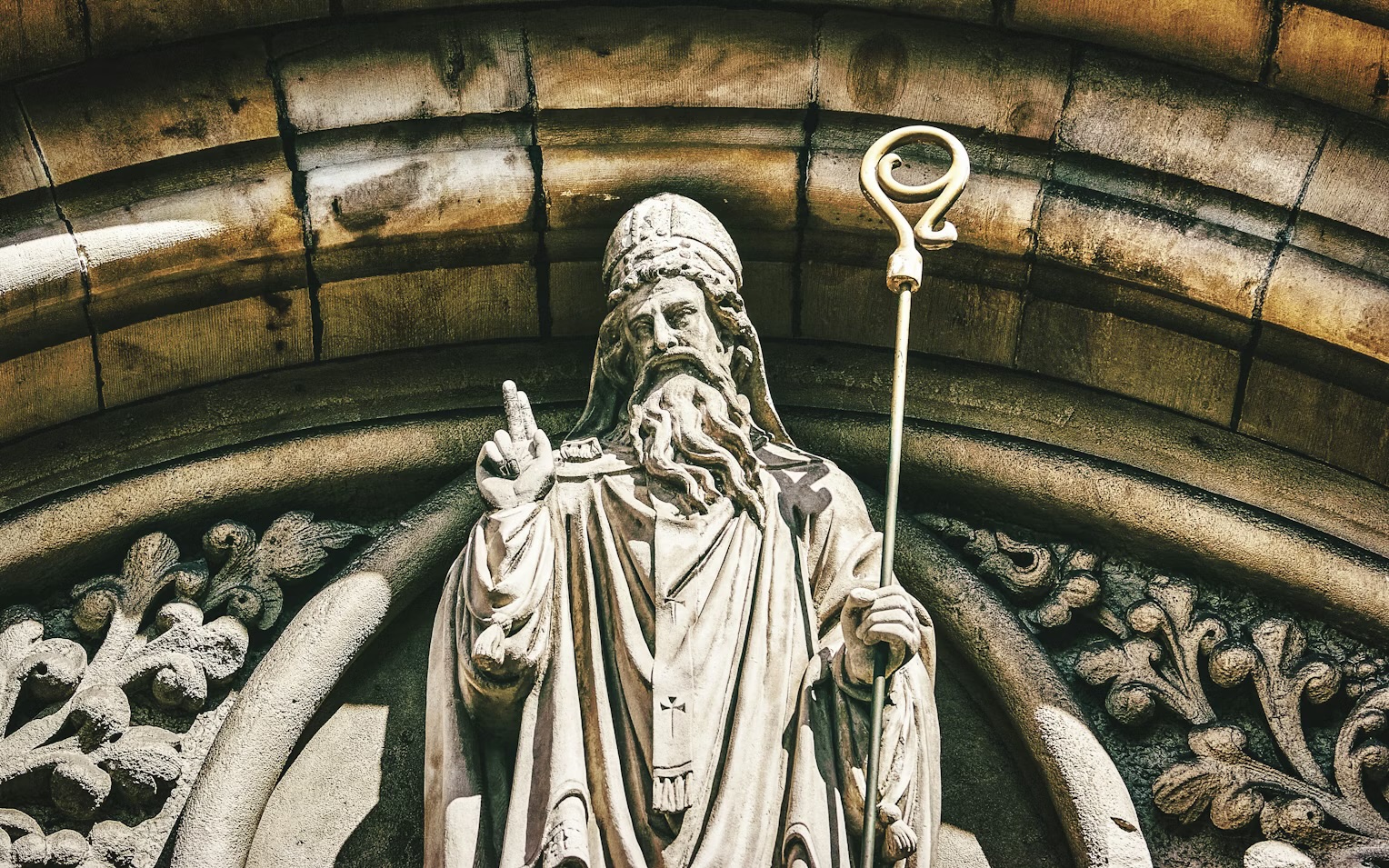
As we celebrate St Patrick, our daily reflection at Mass explores what it’s like to be chosen by God.
BIBLE READINGS: The readingsfor St Patrick, Bishop and Missionary, can be found here
I’m sure we can all remember those times as children when we were chosen by the teacher to perform a special errand.
It made us feel special and responsible. Whilst these days, we may not feel the same kind of joy when asked to do something, there is still a joy if and when we are ever chosen for something particularly special. Some people may earn awards in the workplace. Others may be asked to use their gifts and experience for a special task. Or, we have been chosen or asked to do something in church, appointed to read or lead intercessions, administer the chalice, be elected to the church council, and so many other things.
In the first reading, we have a turning point in the life of the church. Paul and Barnabas explicitly state that they are turning to the Gentiles with the good news of Jesus. And what is the response of the Gentiles according to the Acts of the Apostles? They rejoice and glorify God that they have been chosen. We can easily forget, especially if we have grown up within the life of the church and we are immersed in the faith, how joyful and life changing it is for someone to hear the good news of Jesus and respond.
Whilst St Patrick’s first experience of Ireland may have been a strange one – he is thought to have been kidnapped and taken there as a boy – he later returns and adopts the Irish people as his own, choosing to go there and to remain with them as preacher, pastor and bishop, proclaiming the good news of God’s kingdom and founding communities of faith. In the gospel reading, the seventy-two who have been chosen and sent out by Jesus, return to him with joy after all they had witnessed. May we too be filled with the same joy and happiness. We have been chosen to go out and and proclaim the good news, to share the joy of Christ with others—for the good news of Jesus is good news for all.
Mass today is at S Mary’s Church at 6.30pm
DAY BY DAY
If you’d like more resources for daily prayer then check out our DAY BY DAY pages.
What kind of community, city or world would we create? And what of God’s designs? Here’s today’s reflection from the daily Mass.
BIBLE READINGS: You can find the readings for Monday of the Fourth Week of Lent can be found here
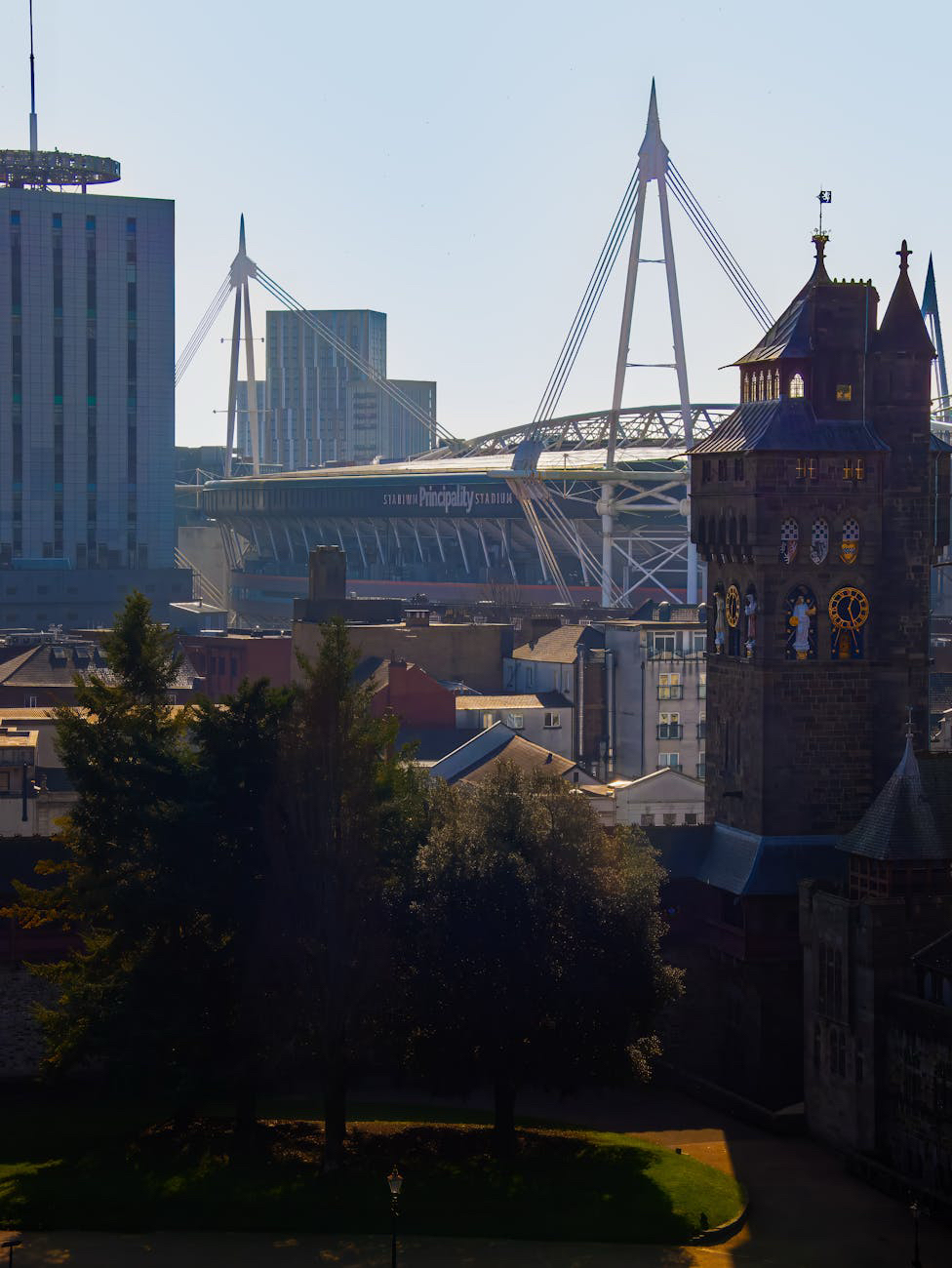
Plans to build Wales’s tallest building were given the go ahead last week.
Standing 110m high, the 50-storey building will be the second tallest building in the UK outside of London, and part of the Central Square development next to Central Station, the BBC studios and the Principality Stadium. Cities never stand still. They are always being redeveloped, rebuilt, growing upwards and outwards.
The prophet Isaiah unveils God’s masterplan for creating a new heaven and a new earth. “Be glad and rejoice for ever in that which I create; for behold, I create Jerusalem to be a joy, and her people to be a gladness.” He talks of a city with no weeping or distress, where there are houses to live in, space for food to be grown, and where vineyards are fruitful. There will be life for all. It is a world transformed from mourning into dancing, when nighttime tears give way to joy at dawn.
If we created our own masterplan for our local communities or city, or wrote our own manifesto for our country, or even our designs and desires for the whole world, what would it contain? How would we start? What vision would we have? And how would it compare to God’s designs? We may think that we are in an impossible situation to achieve any change for the good. But we can begin where we are, working with one another and, as St Paul says, as “co-workers of Christ.” To use more of his imagery, as members of the church, we are part of a building with Christ as the cornerstone, we are God’s household. We are temples of the spirit. We are God’s garden. That may be enough building metaphors to get us started—after all, Christ has already laid the foundations.
Mass today is at S Dyfrig and S Samson Church at 6.30pm
DAY BY DAY
If you’d like more resources for daily prayer then check out our DAY BY DAY pages.
God would much rather that we are honest with him in prayer, even if that honesty reveals aspects of ourselves we would rather keep hidden. Fr Richard reflects on today’s readings from mass.
Readings for Saturday of the third week of Lent can be found here.
There’s a story about a group of schoolboys who manage to steal the foreign-language exam paper the night before a test. Delighted with their success, they gather secretly to look at it. They open the paper and read the first question, which to their consternation says “Translate into French the following proverb: ‘Honesty is the best policy’”. The boys are faced with the absurdity of the sitaution – they are condemned by the very question they have cheated in order to reveal.
Jesus seems to value the brutal honesty of the tax collector’s prayer over the desire to get ahead shown by the Pharisee. Not only is the prayer of the tax collector searingly honest, it is also to the point – he uses just seven words while the Pharisee’s prayer contains 32. Just as with stealing an exam paper, being anything other than honest in prayer is a case of cheating yourself. God already knows the secrets of our hearts, so there’s little point pretending, or trying to impress him with many words or self-justification. An average test result achieved honestly is better than a perfect score attained through cheating; and in the same way, God surely values honesty more than pretence.
A similar theme is present in our first reading from Hosea. The people were fastidious with the outward show of religion, offering sacrifices and burnt offerings. But their faith wasn’t making a difference deep down in the heart, or in the way they treated others. They were trying to cheat their way into God’s favour, not bothering to do the hard work of inner conversion. The externals of our faith such as those mentioned by the Pharisee are not unimportant. Worship is central to the life of the Christian as are the Lent disciplines of fasting and almsgiving. Yet on their own they are not enough. They should draw us into a deeper relationship with God, where we have the courage to lay ourselves bare before him, be truly honest, and so receive his mercy and compassion.
Mass today is in St Mary’s at 11.30am (preceded by Stations of the Cross at 11am).
If you’d like more resources for daily prayer then check out our Day By Day pages.
Sometimes we find it hard to notice what is right in front of us, including God’s word. In today’s reflection on the daily mass readings, Fr Richard considers how we might pay more attention to what God is saying to us.
Readings for Thursday of the third week of Lent can be found here.
The aviation industry is famously safety conscious, meaning that travelling by air is one of the safest forms of transport. Yet occasionally astonishing mistakes can be made. In 1983 Air Canada switched from using imperial units to metric for calculating fuel. Despite warning notices in the cockpit, the pilots forgot this, used pounds instead of kilograms and had to make an emergency landing when they began to run out of fuel. In 2009, two pilots got chatting and overflew their intended airport by 100 miles. When the cockpit recording was played back, it turned out they somehow ignored multiple warning sirens. In both cases ignorance wasn’t the problem – the pilots knew what they should have been doing. Instead they failed to notice of what was right in front of them.
The same thing is happening in our readings today. Jeremiah says that God has given his people the law, shown them the way they should walk, and even sent his prophets to reinforce the message. “Yet they did not listen to me or incline their ear, but stiffened their neck”, says God, and you can almost hear the frustration in his voice. Despite all the messages and all the warnings, the people just will not do the right thing. In the Gospel, people are seeing Jesus’ power in front of their very eyes. He is casting out a demon and so demonstrating that the kingdom of God has broken into this world. Yet the people are somehow unable to accept this, instead suggesting that Jesus is in league with the devil.
We might laugh at the airline pilots who made such basic mistakes, or the people in our readings who ignored God’s clear message right in front of them. Yet we should ask ourselves whether we are sometimes just as guilty. God’s word is always before us; the challenge for us is to be attentive to what he might be saying. As Lent continues, may we listen for his voice, hear what he is saying to us, and then follow where he leads.
Mass today is in St Dyfrig and St Samson, Grangetown, at 10am.
If you’d like more resources for daily prayer, then check out our Day By Day pages.
Connecting you to the churches of South Cardiff Ministry Area across Butetown, Grangetown and Splott. Our vision is to be a creative and resourceful community which is welcoming, faithful and just!
This Week
Lent continues with our Christian Aid “Act on Poverty Course,” Stations of the Cross and Lent Lunches, as well as the usual daily Mass.
We’re also looking forward to Mothering Sunday in a few days time, and also – further ahead – the South Wales Walsingham Pilgrimage in July, and the Walsingham Youth Pilgrimage in August, with lots more in between!
We look back on a great OMG! Event at St Saviours and a wonderful confirmation celebration at St Paul’s.
Keep scrolling to find out more!
Act on Poverty
This Lent, we are taking part in Christian Aid’s Lent course, Act on Poverty – every Tuesday at 7pm in St Mary’s, following the 6.30pm Mass.
Next Tuesdays Session asks “Where do you think Jesus would place himself in your community?”
What happens when an area is labelled ‘deprived’? Or a country is labelled ‘poor’? The way we see our community and the way it is perceived by others matters.
This session will help us think together about where Jesus chose to locate himself and about our experience of place and community.
Lenten Charity
An important part of Lent is charitable giving and our Lenten charity this year is Christian Aid.
Offertory boxes are available in all our churches.
Stations of the Cross
Join us on a devotional journey each week through Lent as we pray the Stations of the Cross
take place on Monday at 7pm in St Dyfrig and St Samson (following the 6.30pm Mass), and in St Mary’s on Saturday at 11am (before the 11.30am Mass).W
We have many resources online that you can use at home. Why not check out this “Just Stations of the Cross” published a few years ago.
This Sunday, as well as being the Fourth Sunday of Lent is also, of course, Mothering Sunday with Mass at the usual times.
We’ll be blessing and distributing flowers and giving thanks for all mothers, living and departed.
Remembering a mother’s love
What’s the best piece of advice your mum ever gave you?
Mothering Sunday can bring back memories of love, care and guidance. It can also be a difficult day for those missing their mum, grandmother or mother figure who helped shape who they are today.
By giving to Christian Aid in memory this Mothering Sunday, you can honour her life through a gift that supports mothers and families living through poverty, conflict and injustice.
Our latest OMG! Event for young people took place on Sunday 1 March in St Saviour’s Church.
As it was St David’s Day, Fr Dean reminded us of St David’s saying about doing the little things in life. Everyone was invited to draw or write little things which give them joy on post-it notes and then stick them on the high altar as a sign of thanksgiving. Afterwards we enjoyed delicious leek and potato soup, Welsh cakes and bara brith. Watch the video below to see more.
OMG! usually takes place on the first Sunday of the month, but since the first Sunday of April is Easter Day, and the first Sunday of May is bank holiday weekend, our next event will be on Sunday 26 April at 5pm in St Saviour’s.
Our next charity coffee morning takes place on Saturday 21 March in St Paul’s Church.
This time we are raising funds for the Motor Neurone Disease Association. As usual there will be plenty of delicious cakes as well as tea, coffee, and a chance to catch up with friends. Everyone is welcome.
Young people aged 11-18 are invited to join us for the Walsingham Youth Pilgrimage from 3-7 August.
Around 500 young people from all over the UK camp in a field just outside the village of Walsingham. Worship takes place in a large marquee led by the excellent worship band CJM. There are also lots of different activities for young people to take part in during the week.
As part of the Welsh camp, all tents are provided and you will be fully catered for. All you need to bring is a sleeping bag, air bed, clothes and toiletries. For more information, please contact Fr Richard and also take a look at the link below to find out more.
We are delighted to announce that St Paul’s Church (meeting in the community hall) has now been licensed for weddings.
This means that our modern, flexible worship space can now be used for your special day! Here’s an idea of what it might look like decorated for your wedding. And then why not have the reception in our well-appointed and spacious hall….. no travelling required!
If you live in Grangetown (or have a qualifying connection to St Paul’s) and would like to get married in St Paul’s, please contact Fr Richard on 0333 301 1850 or RichardGreen@cinw.org.uk
Check out the link below about weddings in our churches:
Mass is celebrated each day across our churches. Here’s our pattern of prayer for the week ahead.
Wednesday 11 March
10.00am: Mass at St Paul's with St Paul's School
11.00am: Mass at St Mary's with St Mary's School

Thursday 12 March
10.00am:  Mass at Ss Dyfrig & St Samson

Friday 13 March
1.30pm: Funeral Mass of Gina Dukes
NB: There is no morning Mass at St Saviour's today

Saturday 14 March
10.50am: Morning Prayer at St Mary's
11.00am: Stations of the Cross at St Mary's
11.30am Mass at St Mary's
12 noon: Sacrament of Reconciliation

Sunday 15 March | Lent 4 | Mothering Sunday
9.30am:  Sung Mass at Ss Dyfrig & Samson
9.30am:  Sung Mass at St Saviour’s
11.00am: Sung Mass at St Paul's
11.00am: Solemn Mass at St Mary's

Monday 16 March
6.30pm:  Mass at Ss Dyfrig & Samson
7.00pm:  Stations of the Cross at Ss Dyfrig & Samson

Tuesday 17 March
6.30pm:  Mass at St Mary’s
You can discover more about our regular pattern of worship through the week at
Sometimes the world seems to be a bleak place. Yet the Gospel, and God’s promise of forgiveness, offers the hope of renewal. Fr Richard reflects on today’s readings from Mass.
Readings for Tuesday of the third week of Lent can be found here.
Recently I was talking to a friend who is the same age as me. We were reflecting on how good it was to have come of age in the 1990s. It seemed like a time full of optimism and hope. The Cold War had ended, the Berlin Wall had come down, the Soviet Union had collapsed and it appeared that Russia was heading towards democracy. Apartheid had ended in South Africa without any bloodshed, peace looked to have come to Northern Ireland, and the economy was booming after years of recession. Since then, however, it feels like things have been falling apart. We’ve had 9/11, wars in Iraq, Afghanistan, Ukraine, Gaza and now Iran; the financial crash, Brexit, Trump, Covid …. Sometimes the world appears to be a bleak place.
Azariah in our first reading is also in a bleak place. For a start he has just been thrown into the fiery furnace, and then describes what has happened to the nation of Israel: “… there is no prince or prophet or leader, no whole burnt offering or sacrifice or oblation or incense, no place to make an offering before you…” The servant in the parable that Jesus tells is also facing a bleak future. Owing 10,000 talents – equivalent to 150,000 years of wages – he and his family are about to be sold as slaves. Yet the servant and his loved ones are saved because of the mercy and compassion of the king, who in this parable of course represents God. It is the boundless love of God, expressed in the Gospel through forgiveness, and in the book of Daniel through God’s mighty power, which brings renewal when all seems lost.
Jesus is clear that we are called to be agents of God’s renewal and hope in what might seem like a bleak world by passing on the forgiveness we ourselves have received. Unlike the servant in the parable, who later refuses to forgive a paltry debt – only 100 days’ wages – we are to forgive like God, without limit. Ultimately, this is the only way in which our world can be lifted from the sorry state it’s in, so that God’s renewal and hope may truly begin to flourish.
Mass tonight is in St Mary’s at 6.30pm, followed by our Lent course at 7pm.
If you’d like more resources for daily prayer, please check out our Day By Day pages.
Humans often put up barriers between different groups, but God breaks them down. Here is today’s reflection on the daily mass readings from Fr Richard.
Readings for Monday of the third week of Lent can be found here.
A few years ago a newspaper ran a light-hearted piece asking people to name the groups they found most annoying. The answers were quite revealing. Car drivers complained about cyclists getting in their way, while cyclists were annoyed by motorists coming too close or cutting them up. Some older people complained about noisy children on public transport, while parents found it irritating when folk pulled faces or tut-tutted about their children. We humans often like to divide up the world into “us” and “them”; and of course, “we” are in the right and “they” are in the wrong. More seriously, we see this tendency played out in our increasingly divisive politics and in the field of international relations.
The world of the Bible was not immune to this, but in our readings today we see how God breaks down barriers and overcomes division. Naaman would normally be regarded with suspicion by Israelites on three levels. First, he is a Gentile; second, he is suffering from leprosy; and third, he was the commander of an enemy army. We’re told he had even kidnapped an Israelite girl in one of the Syrian army’s raids. Yet the girl herself sees beyond these divisions; it is she who suggests that Naaman go to Elisha to seek healing. Elisha too is willing to overcome the differences between him and Naaman, even if he does just send a messenger rather than go himself.
Jesus refers to this story in today’s Gospel. His own people, in his hometown, have rejected him. He tells them that those they regard as inferior – the widow of Zarephath, and Naaman – often respond better to God than his own people. This does not go down well! Let us be aware of the barriers we often construct, or the attitude we form about others. Let us always be on the lookout for God at work in the lives of those who are different to us. We might end up being surprised, and it might help us to build a more tolerant and inclusive world.
Mass today is in St Dyfrig & St Samson, Grangetown, at 6.30pm, followed by Stations of the Cross at 7pm.
If you would like more resources for daily prayer, then check out our Day By Day pages.
Today’s readings at Mass explore a forgiving and loving God, full of mercy, who longs for the lost to return. Here’s today’s reflection from the daily Mass.
BIBLE READINGS: You can find the readings for Saturday of the Second Week of Lent can be found here
It’s impossible to escape commercials, particularly if we use the internet. All the time our data is being collected and used so that paying companies can reach their target audience.
So searching for a new phone or a new car on one page will later conveniently deliver an advert on our our social media timeline for the very thing we’ve shown an interest in.
In the gospel reading today, the religious leaders are disgruntled that Jesus is attracting the wrong kind of audience, that he is spending time and eating with them. What kind of rabbi is he, to allow himself to be tarnished by such people or to given them the time of day? The parable that Jesus then tells, displays a God who is loving and longing for his lost son to return, despite the mistakes he has made. He rejoices when a sinner returns, when the lost is found.
There is a story told of an old man who was praying by the River Ganges when he saw a scorpion struggling for its life, caught in the branches stretched over the water. As the old man reached out to save the scorpion, he was constantly stung. “You stupid old man,” shouted a passer by. “Don’t you know that the scorpion will kill you if you carry on trying to help it?” The old man replied, “Just because it is the nature of the scorpion to sting, why should I give up my nature to save?”
In the first reading, Micah cries out in praise of God, “Who is a God like you,” he says, “pardoning iniquity and passing over transgression?”
Mass today is at S Mary’s Church at 11.30am
DAY BY DAY
If you’d like more resources for daily prayer then check out our DAY BY DAY pages.





















 South Cardiff Ministry Area