Healing our divisions

Divisions in society, among nations, and even within the church seem to be a feature of modern life. Jesus shows us another way, as Fr Richard explores in today’s reflection on the daily mass readings.

Readings for Friday in the fifth week of Ordinary Time can be found here.

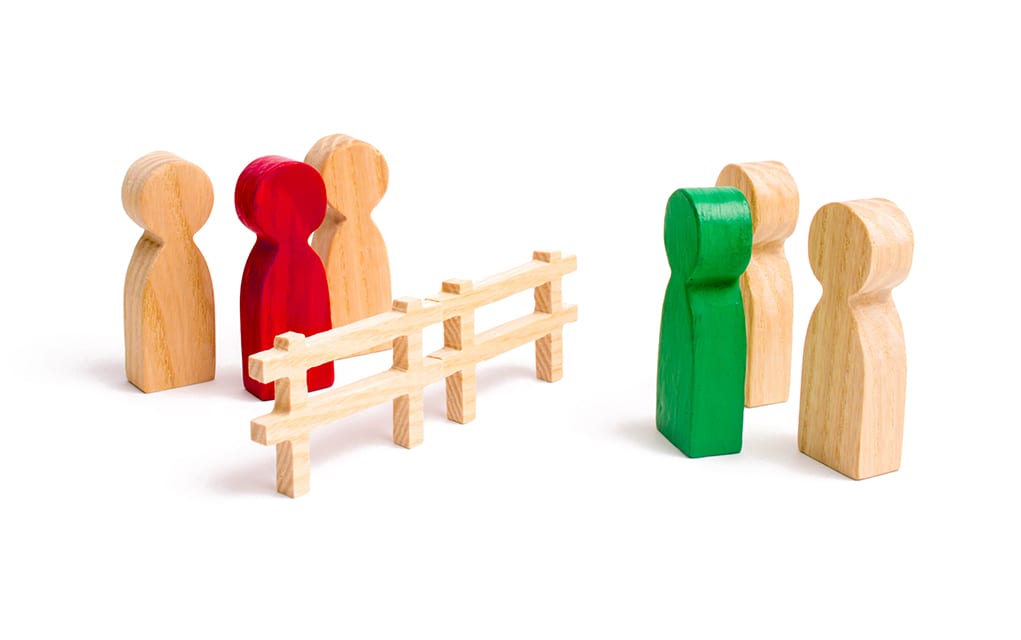
We are all familiar in modern history with nations that have become divided for a variety of reasons. Examples include East and West Germany, North and South Yemen, North and South Korea, and close to home Northern Ireland and the Republic of Ireland. Some have reunited, while others remain apart. There are those in the USA who believe that their nation is so hopelessly divided that the time has come for a “great divorce”, with one country for the Democrats, and a separate one for the Republicans!

Yesterday’s first reading foretold the division of the Kingdom of Israel, established by David, into the northern kingdom of Israel and the southern kingdom of Judah. In today’s passage things move forward. The prophet Ahijah tears his garment into twelve pieces, representing the twelve tribes of Israel. Ten tribes – the northern kingdom – are to be given to Jeroboam, while Solomon and his descendants will retain one tribe, which will become the southern kingdom. In case you’re thinking that only adds up to 11, the tribe of Benjamin is usually counted as one with Judah. 1 Kings is clear that the separation of the kingdom was a result of Solomon’s sin. And surely division is always the result of our sinfulness – our inability to get on with each other, tolerate difference, and reach compromise.

In the Gospels, we see Jesus bringing wholeness and healing as he overcomes the consequence of human sin. In yesterday’s passage he reached out (after a little persuasion on her part) to a Gentile, foreign woman. Today we see him healing the deaf man with a speech impediment, bringing wholeness to his life but also symbolising the in-breaking of his Kingdom. The Church, as a human institution, has had its fair share of divisions over the past 2000 years. As the Body of Christ, however, we should be about overcoming that which separates people from one another, and bringing healing and wholeness to society and to the world, in Jesus’ name.

Mass today is in St Saviour’s at 10am.

If you’d like more resources for daily prayer, then check out our Day By Day pages.

The great reversal

Some people appear to have it all but throw it all away; others who seem to have nothing can achieve great things through persistence and faithfulness. Fr Richard explores these contrasting fortunes in today’s reflection on the daily mass readings.

Readings for Thursday of the fifth week of Ordinary Time can be found here.

The world of film loves a story which centres around a reversal of fortunes, either rags to riches or the other way round. Examples include The Wolf of Wall Street, which tells the true story of Jordan Belfort. He was a successful stockbroker who became very wealthy but was brought down by a mixture of hedonism and greed. On the other hand, Slumdog Millionaire is about a boy from the slums of Mumbai, India, who overcomes many hardships to win big on a TV quiz show thanks to his natural talent.

We see both of these trajectories in our readings today. Solomon was the classic insider who had everything. He was King of Israel, son of David, builder of the great Temple, and the one whom the Queen of Sheba travelled a great distance to see because of his legendary wisdom. And yet today we learn that he threw all of this away by worshipping other gods. As a result, the God of Israel promises that after his reign the kingdom will be divided, which did indeed happen.

Contrast this with the Syrophoenician woman from today’s Gospel. A Gentile, a foreigner, a woman, and one whom even Jesus refers to a dog. Yet unlike Solomon she had a faith which cannot be deterred. She answers back to Jesus, and persuades him to heal her daughter. These readings remind us that in the life of faith, status counts for nothing. It is simple, persistent faithfulness which matters. As Mary puts it in the Magnificat: “He has brought down the mighty from their thrones and lifted up the lowly”. Let us always remember that, and be on the look out for such “great reversals” happening in our world and in our society today. 

Mass today is in St Dyfrig & St Samson, Grangetown, at 10am.

If you’d like more resources for daily prayer then check out our Day By Day pages.

God’s address

God cannot be found at a particular address, nor can he be confined to our rules and customs. How does this belief shape our attitude to the world and other people? Fr Richard reflects on today’s readings from mass.

Readings for Tuesday of the 5th week of Ordinary Time (memorial of St Scholastica) can be found here.

One of the first things any child learns, after perhaps their own name and those of their family, is their address. Throughout our life, we may have moved many times, or always lived in the same house, but our address is something we know instinctively. In this digital age we have become familiar with entering our postcode then selecting our house name or number from the drop-down menu. Even the grandest in the land has an address; many are the people who have written excitedly to the Queen or King at Buckingham Palace, London SW1A 1AA, and then got an answer – even if it is from a lady-in-waiting or secretary.

If someone asked, “what is God’s address”, we might laugh at the silliness of the question. God does not have a house, we might reply; he is everywhere. King Solomon acknowledges this in his prayer at the dedication of the Temple, that mighty house which was seen as God’s dwelling place. “Behold, heaven and the highest heaven cannot contain you; how much less this house that I have built”, he prays. 

We might know this truth deep down, but there has always been a human tendency to try and confine God, to put him in a box or compartment, separated from the world at large. In many ways, this is what the Pharisees in Jesus’ day had done. For them, God’s address was in the many rules and regulations, customs and traditions that they observed. There was a divide between God’s realm – that which was ritually pure, or clean – and the rest of the world, which was unclean. Hence the dispute about Jesus’ disciples washing their hands. It wasn’t about hygiene but washing off the impurities of the world. 

This attitude can affect Christians. Some talk about “bringing God into this community”, as though he wasn’t already there, in the lives of ordinary people who may or may not be religious. If God truly is everywhere, then such distinctions don’t make sense. Far better to adopt Rowan Williams’ attitude to Christian living: find out what God is already doing, and simply join in.

Mass today is in St Mary’s at 6.30pm

If you’d like more resources for daily prayer then check out our Day By Day pages.
Where is God’s presence?

Why do we have favourite places, at home or out in the world, and why do we have physical places of worship? How is God’s presence to be found – in the bricks and mortar or in the people who make up worshipping communities? Today’s reflection on the daily mass readings with Fr Richard.

Readings for Monday on the 5th week of Ordinary Time (memorial of St Teilo) can be found here.

Do you have a favourite place? Perhaps it is a comfy old armchair in your home, where you like to settle down with a cuppa and relax. Maybe it is somewhere outside the home – a park where you feel at peace, or a busy cafe where you can connect with friends and family. The human instinct to adopt favourite places is due to many things. It can be about a feeling of safety and security, or peace and calm, or perhaps a special place is the repository of important memories. 

All of these human needs are surely at work in our tendency to create and maintain places set aside for prayer and worship, such as the church we are gathered in right now. In addition, of course, we hope and pray that here we will encounter God in a special and particular way, through word and sacrament. 

Our first reading today describes the dedication of the Temple in Jerusalem which King Solomon had built. The Ark of the Covenant, containing the tablets of the law, is placed in the Holy of Holies within the Temple. For the people of Israel, the Temple, with the Ark at its centre, was more than just a special and holy place – it represented God’s presence with his people. This is why its destruction at the hands of the Babylonians over 400 hundred years later was such a catastrophe for the nation.

Jesus often spoke of himself as the Temple – God’s presence now revealed not in a building but a person, God’s own Son. Today in the Gospel we see what that presence means when made human – he brings healing to those who are in need. Our church buildings are special and sacred, and we rightly love them and care for them. But they are not museums. They are to be places where God’s presence is shown today, not in bricks and mortar, but through his people carrying on the healing work of Jesus.

Mass today is in St Dyfrig & St Samson, Grangetown, at 6.30pm

If you’d like more resources for daily prayer then check out our Day By Day pages.

Sheep without a shepherd

“St Augustine famously wrote, “You have made us for yourself, O Lord, and our heart is restless until it rests in you.”” In today’s reflection from the Daily Mass, Fr Dean explores the restlessness we may experience on our journey through life.


BIBLE READINGS: You can find the readings for Saturday in the fourth week of the year here


A typical memory from my childhood during the summer months was seeing flocks of sheep wandering through the valley.

Some would make it into people’s gardens. I don’t know if it was the practice of the farmer of the day to let his sheep loose. If it was then, thankfully those days came to an end. The sheep looked out of place, and many got themselves into trouble, stuck by the side of the river or in some other tight spot, like the ram we had a face off with in my neighbour’s garden. On many occasions, we had to phone the farmer to come and rescue them a lost lamb or an injured sheep.

The image of a shepherd for God is a common one in the Old Testament. Psalm 23 comes to mind, of course. Jesus, too, uses the image of himself, and that’s how the gospel writer illustrates the crowd who seek Jesus. They are like sheep without a shepherd. Wandering, lost and out of place. Despite trying to find a place and time to rest, Jesus feels sorry for them and leaves his seclusion to teach them and guide them.

Perhaps, at times, we can relate to that crowd or even to the sheep of my valley’s childhood. We may feel out of place, lost and wandering, with little direction and no means of getting out of a tight spot. We may feel hemmed in by pressures all around us, or feel restless and awkward, unfulfilled or not at ease. St Augustine famously wrote, “You have made us for yourself, O Lord, and our heart is restless until it rests in you.”  Without God, we shall be forever wandering and never ultimately fulfilled. St Augustine had sought meaning and fulfilment in so many different ways and worldly pleasures. The restlessness he and we experience isn’t a bad thing. It is part of the journey, prompting us to discover our need of God, our source and fulfilment, our beginning and our end.


Mass today is at St Mary’s church at 1130am (preceded by Morning Prayer and Rosary from 11am)


DAY BY DAY

If you’d like more resources for daily prayer then check out our DAY BY DAY pages.


Absolute Power

“As we pray for those in positions of leadership and power, so too may we, in whatever role we find ourselves, lead a life of service.” Here’s our reflection from the Daily Mass.


BIBLE READINGS: You can find the readings for Friday in the fourth week of the year here


The famous quote, “Power tends to corrupt, and absolute power corrupts absolutely,” was written by the British historian Lord Acton in a letter to Bishop Mandell Creighton in 1887. It could be applied to many recent incidents reported in the news today. We don’t have to name names to reflect on the results of moral decline or corruption in some who have been given or taken power.

In the gospel reading, Herod has a mad desire to remain in a position of leadership. He doesn’t want anyone who can begin to unravel his power. He has John imprisoned. He fears John and knows that he is a righteous and holy man, but he eventually has him beheaded to impress the whim of his brother’s wife. Then, rumours begin to circulate about Jesus, and Herod is convinced that he is John the Baptist raised from the dead. His previous actions have come back to haunt him.

Whilst the majority of us don’t have such great power, many of us at times will find ourselves in a position of influence and authority—whether we are teachers, parents, priests, employers or managers, supervisors, church wardens or lay workers— they all carry responsibility and care for others. In the book of Sirach, King David is praised for his successes, but even he made mistakes, and turned to God in penitence. “The Lord took away his sins,” we are told.

As we pray for those in positions of leadership and power, so too may we, in whatever role we find ourselves, lead a life of service—taking the example of Jesus who came “not to be served but to serve and give his life as a ransom for many.”


Mass today is at St Saviour’s Church at 10am


DAY BY DAY

If you’d like more resources for daily prayer then check out our DAY BY DAY pages.


How far do you have to go?

There are opportunities on our doorstep to share the peace of God in Christ. Here’s our reflection from the Daily Mass.


BIBLE READINGS: You can find the readings for Thursday in the fourth week of the year here


There will be many sights and attractions in our own city and country that we may have never experienced. Since they’re on our doorstep, we can see them at any time, which often means we never will.

When compared to the journeys many of the apostles will later take around the world, their first few journeys are more local, to all the neighbouring towns and villages, as Jesus sends them out in pairs with specific instructions. They return with joy, filled with stories of deliverance and healing as God’s peace rests on the homes of those who welcome them.

We don’t have to go far or be part of huge projects and initiatives to make a difference in the world. There are opportunities on our doorstep and in our local communities to proclaim through word and action the healing and liberating love of God in Christ. Like those first disciples, we won’t always be welcomed with open arms but sometimes and somewhere we will experience the fruits of God’s peace which is above all understanding.


Mass today is at St Dyfrig and Samson Church at 10am


DAY BY DAY

If you’d like more resources for daily prayer then check out our DAY BY DAY pages.


What’s so important?

“With busy lives and so many demands, it can be difficult to prioritise. In today’s gospel reading, Jesus makes a strange detour from his plans.” Here’s our reflection from the Daily Mass.


BIBLE READINGS: You can find the readings for Tuesday in the fourth week of the year here.


Everyone has such busy lives with so many demands on our time and attention, and we can often find it difficult to prioritise. Do we remain loyal to the first thing that went into our diary, or do we do replace it with something else we prefer? How do we cope when family demands and work commitments collide with one another? Yes, at times, it can be difficult to prioritise what is most important. It is often impossible to please everyone all of the time.

In the gospel reading, Jesus is in great demand. The crowds are pushing around him, each person wanting something. Many come to him for healing. One person manages to get through. An official from the synagogue whose daughter is sick. As Jesus makes his way to Jairus’s house, someone else grabs his attention. An anonymous person has reached out to touch him for healing. Rather than speeding onwards to the sick girl, he reprioritises his time. He lingers with the crowd as his disciples try to identify the woman. Jesus lingers for so long that word comes to them that the little girl has died.

Perhaps, we would have prioritised a young life over an older life. Or thought that Jairus’s daughter was more of an emergency? After all, the woman was already healed it seems. Although, for Jesus, the healing wasn’t complete until a true encounter occurred.

When we seek God’s help and healing in prayer, we can often be disappointed if he doesn’t respond in the way we had anticipated, or in the time we expect. But, as we proclaim at the blessing of the Easter candle, “All time belongs to him, and all eternity.” So next time we are anxious about time and priorities, may it lead us closer not to stress, but to the one who is the Lord of time.


Mass today is at St Mary’s Church at 630pm


DAY BY DAY

If you’d like more resources for daily prayer then check out our DAY BY DAY pages.


Channels of Peace

“The healing touch of Jesus comes in many ways. But in so many ways, we see how he can bring calm to a turbulent situation, peace to where there is conflict, love to where there is hate.” Here’s our reflection from the Daily Mass.


BIBLE READINGS: Mark 5:1-20


In the novel, Wuthering Heights by Emily Brontë, the wild desolate Yorkshire moors with its turbulent weather, reflect the intense, raw emotions of the two main characters, Heathcliff and Catherine. The landscape isn’t just a location where the story happens. The author uses it to reflect the passionate and destructive personalities of the characters at the centre of the story.

Likewise, in the gospel reading, the setting for the character at the centre of the story paints a colourful picture of a wild and uncontrollable person, someone to be feared, living in the tombs among the dead. His life is filled with agony and pain as he gashes himself with stones and cries out throughout the night. The spirit which possesses him confronts Jesus to warn him off. But even confronted by such a frightening scene, Jesus remains calm and in control and instructs the spirit to come out of the man.

There are many things in our own lives and in the world today which we would prefer not to confront. Life is easier if we pretend they don’t exist or that they are someone else’s problem. There are many people too who suffer in silence, far away from the watch of others, keeping their problems and pains locked inside. The healing touch of Jesus comes in many ways. But in so many ways, we see how he can bring calm to a turbulent situation, peace to where there is conflict, love to where there is hate. Reflecting the prayer of St Francis, may we be channels for his peace and love in the world today, and look out for the wounded, the lost and those in pain.


Mass today is at St Dyfrig and St Samson Church at 630pm


DAY BY DAY

If you’d like more resources for daily prayer then check out our DAY BY DAY pages.


In the eye of a storm

In today’s reflection on the daily mass readings, Fr Richard considers the various storms that assail us in life, and hoe God guides us through them.

Readings for Saturday of the third week of Ordinary Time can be found here.

In 2015, the UK’s Met Office began the practice of naming winter storms. The first one, in November of that year, was Abigail. Storms are given names suggested by members of the public which are applied in alphabetical order as the storm season progresses. The most recent, on 26 January, was Storm Chandra, which brought widespread flooding to the south of England.

The disciples of Jesus included experienced fishermen. You would have thought that they had seen storms like the one described in today’s Gospel many times before. Yet sometimes a storm can arise the likes of which have rarely been seen, and even those who have been through a lot are left terrified, wondering if they will survive. 

It can be like this in life. Sometimes we are assailed and battered by circumstances and events that are so frightening we might question whether we will be able to get through it. These storms may be beyond our control, or they might be self-inflicted. In our first reading, David experiences such a storm of his own making when Nathan the prophet confronts him about his affair with Bathsheba and the murder of her husband Uriah. Matters worsen when the child which Bathsheba bore as a result of the affair dies; David lies on the ground, will not get up, and will not eat.

In the boat on the lake, Jesus was with the disciples all the time, albeit asleep. It is he to whom they turned in their hour of need. Likewise, David acknowledges his sin before God, who later blesses him with another child, Solomon. God does not promise that we will never experience the storms of life, but he does promise to be with us, to be there for us, and to help us survive.