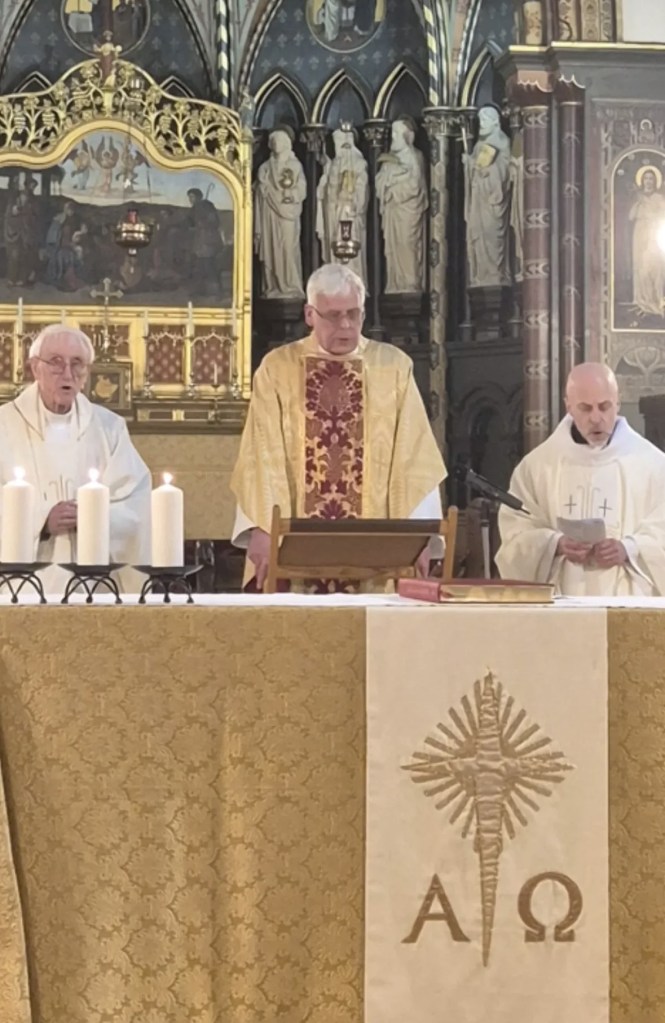
When someone remembers our name we feel loved, valued and empowered. This is is what Jesus does with Mary Magdalene, and all of us. Fr Richard reflects on today’s readings from Mass.
Some people have a knack for remembering names – they are introduced to a person once and the name sticks in their head straight away. Others are quite hopeless; no matter how many times they are told a person’s name, they can never recall it. Remembering names is not just a gift – there are techniques which can help. One is to conjure up a mental picture as soon as you’re told someone’s name. For example, a person called Rose will make you think of the person holding a big bunch of red roses. Next time you meet the person you will recall the image and so their name. When someone remembers our name it makes us feel valued and special; when they forget it, it’s as though our very existence has failed to register.
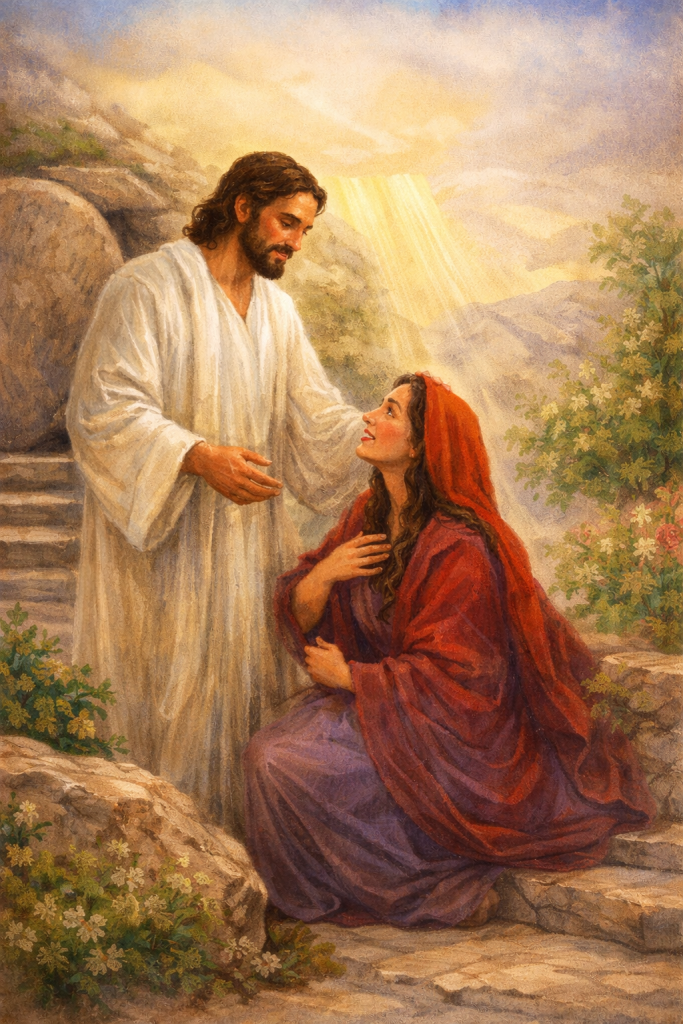
In our Gospel today Mary Magdalene is grief-stricken and fearful as she stands outside the empty tomb. Not only has her Lord been executed, it now appears that the body has been stolen as well. Like with the disciples on the Emmaus Road, Mary fails to recognise the risen Jesus when she encounters him. It is only when he calls her by name that she realises this is the same Lord who knew her, valued her, and loved her during his earthly ministry. The remembrance of her name, and the empowerment which comes with it, transforms Mary. She goes from being sad and afraid to the first witness of the Resurrection. The crowd that Peter is addressing in our reading from Acts is similarly transformed from fear to hope. As soon as he says that the promise of the Holy Spirit is “for everyone the Lord our God calls to himself” – calls by name, in fact – they come forward with joy to be baptised.
There’s a double challenge for us in these readings. First, may we accept that God knows us and calls us by name; may that knowledge transform us to be confident witnesses like Mary. Second, whose name can we remember, treasure in our heart, and then use, so that the person knows they are loved and valued, and empowered for God’s work in the world?
Mass today is in St Mary’s at 6.30pm.
If you’d like more resources for daily prayer then check out our Day By Day pages.
What is the most urgent news you have ever had to deliver? Does it compare to Pheidippides of Ancient Greek legend? After the Greek army defeated the Persians at the Battle of Marathon, he was sent from the battlefield to the city of Athens to deliver the news. He is said to have run roughly 25 miles, burst into the assembly, and exclaimed “Nike!” (Victory) before collapsing and dying from exhaustion. Pheidippides’s journey later gave rise to the marathon race of modern athletics.
There’s a sense of urgency in our readings today. In the Gospel we meet the women on Easter Day just after the discovery of the empty tomb. They depart quickly from the tomb to tell the disciples what has happened. On the way they encounter the risen Jesus. He gives them an urgent message – go and tell the disciples to make haste for Galilee where they will see him. Although Peter isn’t journeying at speed in the first reading, his speech on the day of Pentecost has an urgency about it. He is keen for the people of Jerusalem to understand what has happened in the death and resurrection of Jesus.
The temptation for us is to see Easter Day as marking the completion of a busy liturgical schedule. Easter Monday is the time for a rest. That may be no bad thing, but our readings remind us that Easter is the beginning not the end. Like Peter we are called upon to proclaim the good news that Jesus is risen. The Lord himself gives us the same command as to the women at the tomb: “go and tell”. We may not all have the energy or endurance of Pheidippides, but let us go out from this Mass with an eager urgency to deliver the Easter news to all.
Mass today is in St Dyfrig & St Samson at 10am.
If you’d like more resources for daily prayer then check out our Day By Day pages.
The Cross is the means by which God heals the broken relationship between himself and humanity, borne out of love. Here is Fr Richard’s homily for today’s Good Friday Liturgy.
Have you ever fallen out with someone that you care about? Ever had an argument, a row, a tiff? I’m sure all of us have, at one point or another. Sometimes it might be a minor disagreement; or it might be a major bust-up. A breakdown in a relationship doesn’t just happen. There is usually a cause – something said, something done (or not done) by us, the other party, or maybe both. And if it’s a relationship we care about, then the fact a rift has occurred will cause pain and upset. We will want to patch things up, to heal what has gone wrong, and bring about reconciliation. How do we do this? Well first of all we need to meet with the other person. Then we need to acknowledge what has gone wrong, and address the source of the rift. And then somehow we need to overcome it, to get beyond it, perhaps by being prepared to forgive, or be forgiven. Then, at last, we can hope to move forward in hope.
This is what is happening on Good Friday, as recorded in the great Passion Narrative from John that we have just heard, but on a cosmic scale. It is all about God acting to repair the relationship of love between himself and humanity which has been rent asunder by human wickedness and sin. The extent of this sinfulness is laid in the Passion Narrative as we see an innocent man – the Son of God, no less – arrested, beaten, mocked, and executed in the cruellest and most barbaric fashion. But the evidence of human sin is also all around us. Every time we switch on the news or open the papers we see violence, destruction, pain and suffering in our world. Sometimes folk might question the relevance of our Holy Week ceremonies for the modern world. In answer we just have to say, “look around you”. See the terrible things going on in the world, and we see them all summed up in the suffering of Jesus upon the Cross.
But God in Christ on Good Friday is not simply the victim of the forces of sin and evil in the world. He is acting decisively to bring healing to our broken world. And how does he do this? In any human relationship which needs mending, the cause of the breakdown needs to be addressed, confronted, and then overcome. Now surely the worst consequence of human sin is the taking of another life, especially an innocent life. Again, this is something we see all of the time on our news feeds. Life, the most precious gift God can give, is so often treated as worthless by the actions of others. And so God confronts this. Somehow he must take away its power to separate us from him. He does this in the most amazing way possible by undergoing death himself – experiencing the worst of humanity in order to cancel out its power. He is prepared to go to the darkest corner of this world, and by laying down his life, shining the light of his love even there.
Good Friday says to us there is no place, no situation, no experience, no matter how bleak or desparate or awful, where God is not present. He has experienced the worst of this world, and so he is always there with us and with all those who suffer today. As the author of Hebrews says in our second reading “we do not have a high priest who is unable to sympathise with our weaknesses”. Jesus takes away the power of sin and death by showing us there is nothing to fear, because he is alongside us every step of the way. But of course, he takes away death’s power over us in another way. Here we must look ahead to Easter Day – indeed we cannot make sense of Good Friday without it, just as we cannot make sense of Easter Day without Good Friday. The resurrection of Jesus from the dead shows us that death, that worst thing standing between us and God, has been decisively defeated. The people who wage war in our world, the people who murder, who terrorise and devalue others, do not have the final say. God has the final say, and it looks like the empty tomb.
Why does God do all of this? Why does he go to such lengths to reach out to us, to undergo all that suffering for our sakes, in order to repair the relationship between himself and humanity? The answer, of course is love. As John says earlier in his Gospel, “For God so loved the world, that he gave his only Son, so that all who believe in him may not perish but have eternal life”. God loves all of us so much that he reaches out to us and is prepared to go to any lengths to bring us back to him. As the hymn puts it, “it is a thing most wonderful, almost too wonderful to be, that God’s own Son should come from heaven, and die to save a child like me”. Perhaps today we seek to understand, to make sense of what is going on at Calvary. Yet understanding can take us only so far. Ultimately we just have to accept. Accept his love, shown to us so starkly, so plainly, and so beautifully upon the wood of the Cross.
The Good Friday Liturgy takes place today at 3pm in St Dyfrig & St Samson, Grangetown.
If you’d like more resources for daily prayer then check out our Day By Day pages.
In the gospel reading today, Judas Iscariot pockets a bag of money, what it’s worth to hand Jesus over but the consequences weighs heavily. Here’s today’s reflection from Mass.
BIBLE READINGS: The readingsfor the Wednesday of Holy Week, can be found here
It’s reported that there are around 50 million men, women and children in modern slavery, more than ever before in history. In the UK experts believe that 122,000 people are currently held in slave-like conditions.
It’s estimated that for every person successfully rescued from the clutches of modern slavery and given the opportunity to receive support, at least seven more remain trapped and exploited. Modern slavery can take many different forms, but usually includes tricking, threatening or physically forcing people either into work for little or no pay, committing crimes or sexually exploiting them all to profit the trafficker.
In the gospel reading today, a price is paid for a Jesus, negotiated at thirty pieces of silver. But the burdens of such a betrayal prove too much for Judas and after Jesus is handed over, Judas can no longer live with himself. Whilst Judas is portrayed as a thief and someone who helped himself to the common fund, we can only imagine what his real motives were. Whatever they were, in that moment, even if he later regrets it, he agrees on how much Jesus is worth to him. A bag of silver coins.
As we move closer to the the liturgical celebration of Jesus’ suffering and death, and recall the way in which human beings can inflict such pain on others, we are reminded of the many ways in which the dignity of human life is often neglected, when individuals are treated as simple commodities for someone else’s gain. We can often be blind to injustice or choose to ignore it. The cross reminds us of the reality of suffering but also gives us hope. For it is through Christ’s death and resurrection that we are set free.
Mass today is at S Saviour’s Church at 630pm
DAY BY DAY
If you’d like more resources for daily prayer then check out our DAY BY DAY pages.
Connecting you to the churches of South Cardiff Ministry Area across Butetown, Grangetown and Splott. Our vision is to be a creative and resourceful community which is welcoming, faithful and just!
This Week
Holy Week is now fully underway and we’re looking forward to the Sacred Triduum (Latin for “three days”) of Maundy Thursday, Good Friday and Holy Saturday. These days are the high point of the Christian year and are full of symbolism, power and drama.
Then of course we look forward to the great celebration of Easter, including a new dawn service in Grangetown to welcome Easter Day.
There’s also news about a new young people’s group in Grangetown, a new edition of the South Cardiff Calendar, and information about the various Walsingham Pilgrimages.
Keep scrolling to find out more!
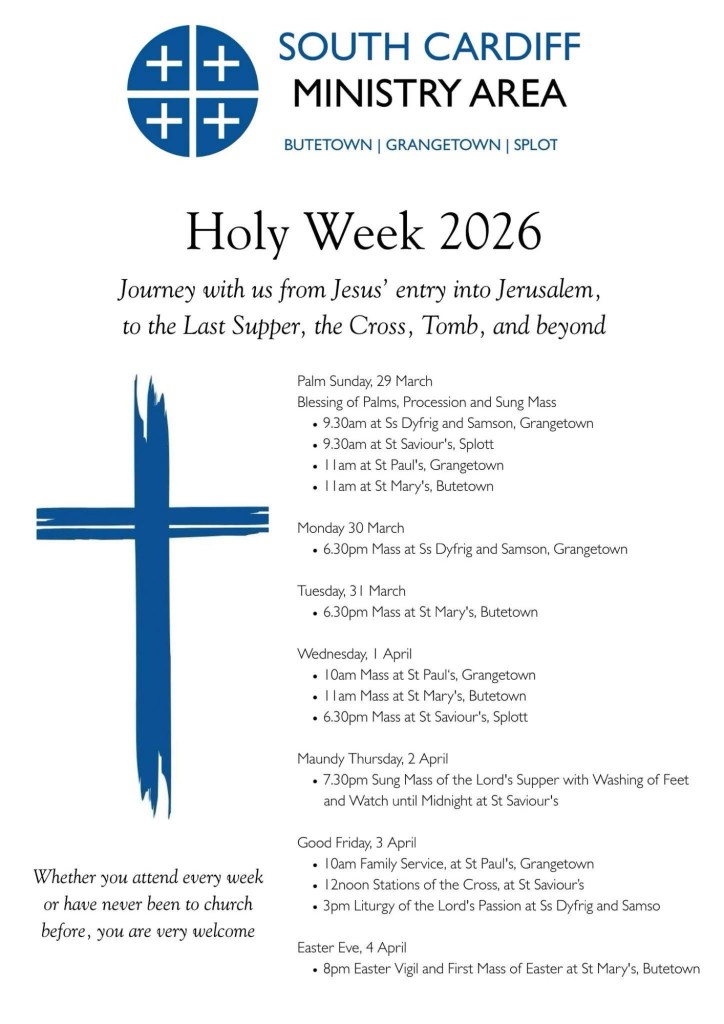
Holy Week
Holy Week is the most important week of the Church year, as we commemorate and celebrate the saving passion, death and resurrection of Jesus.
The week begins with Palm Sunday, and in all our churches we commemorate the entrance of a Jesus into Jerusalem, with the blessing of palms and procession.
Maundy Thursday begins the three great days (The Holy Triduum) with the Evening Mass of the Lord’s Supper with washing of feet, as Jesus did on this night, giving us an example of service, and the mandatum to love one another as he has loved us. The Mass is followed by a watch until midnight.
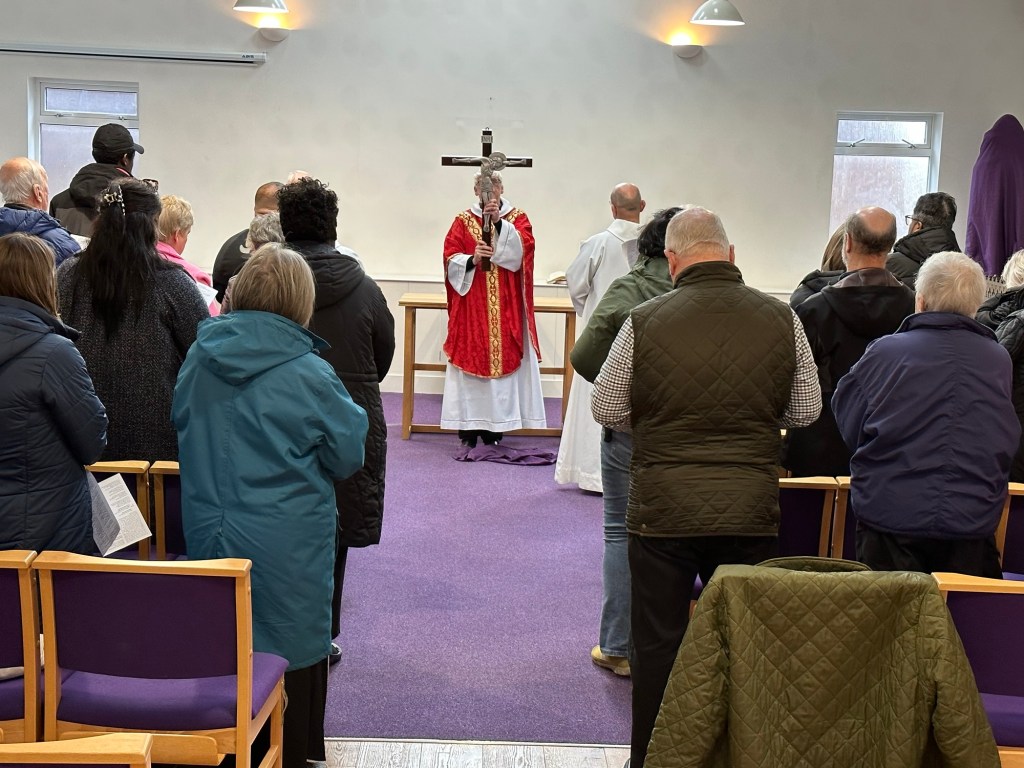
Good Friday is the most solemn day when we commemorate Jesus’ death on the Cross with the Liturgy of the Lord’s Passion at 3pm.
Holy Saturday is a day of waiting, and our churches are decorated ready for the Easter celebrations.
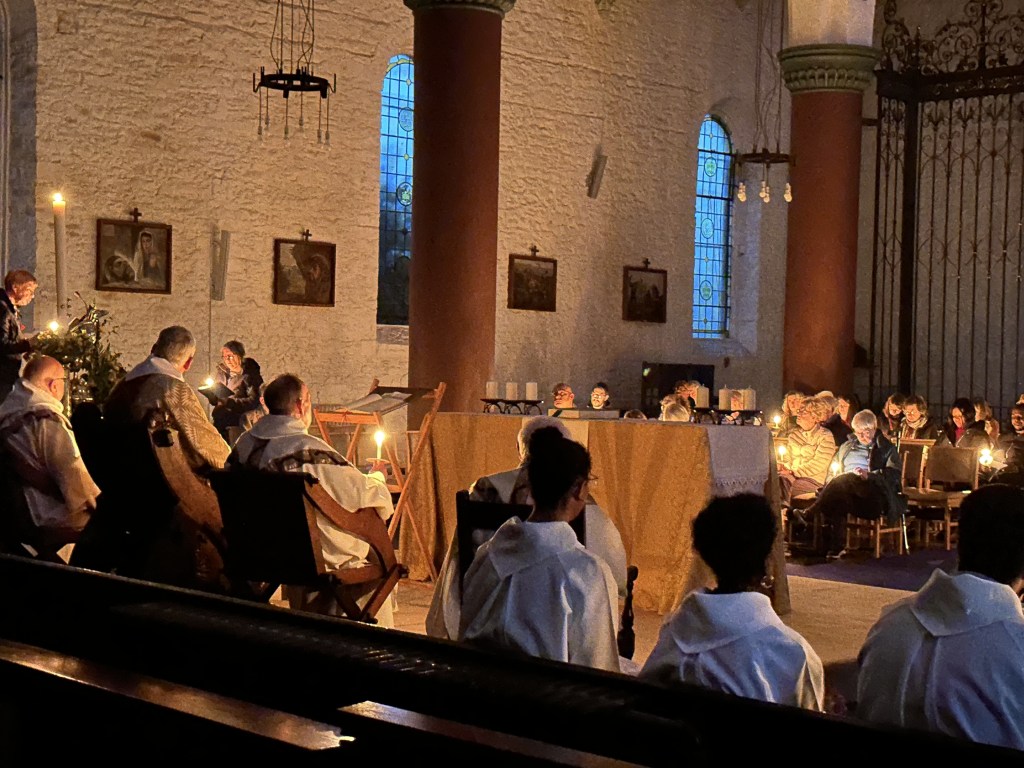
Then in the evening of Holy Saturday we proclaim Easter in a joyful way with the Easter Vigil, the Queen of Festivals.
As Sunday is to our week, so the Easter Vigil is to our year.
We encourage all to participate as much as possible, particularly the three great liturgies of Maundy Thursday, Good Friday and Easter Vigil
Details of all our liturgies are given below:
Lenten Charity
An important part of Lent is charitable giving and our Lenten charity this year is Christian Aid.
We are asking that any offerings be presented at the Maundy Thursday Mass clearly identifying which church congregation you are part of.
St Saviour’s Easter Raffle
Tickets are now available at St Saviours for our Easter raffle which will be drawn on Sunday 12 April. All proceeds to St Saviours Church!
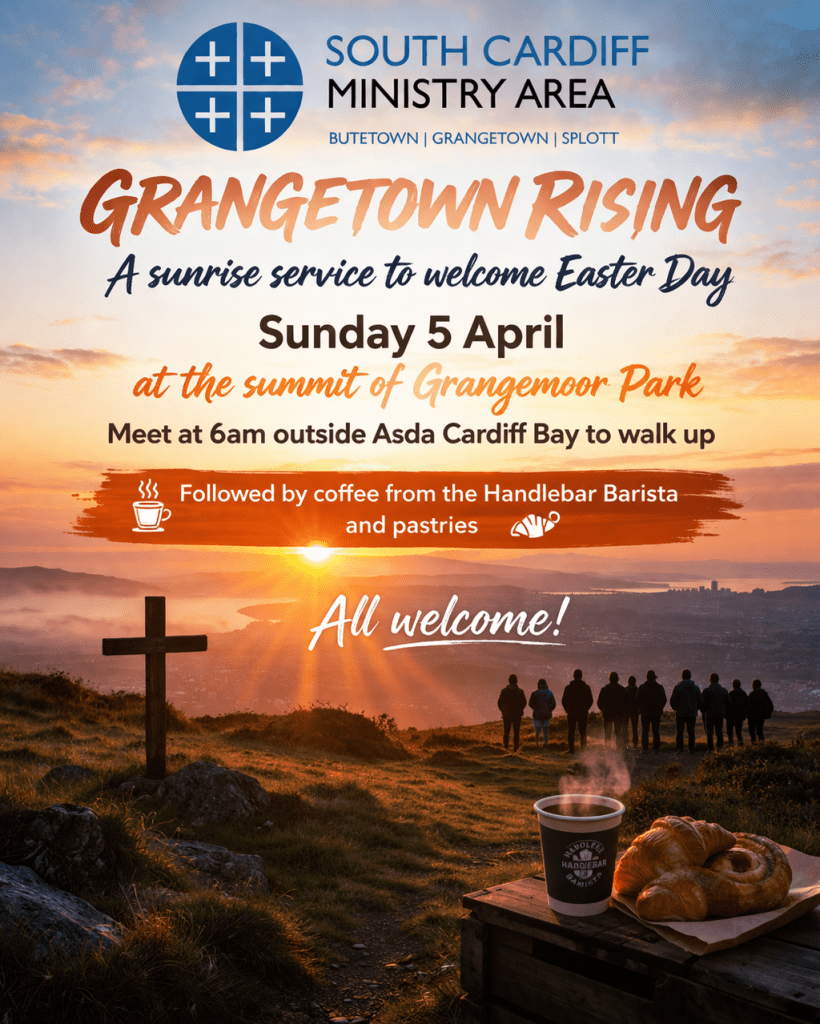
Grangetown Rising!
A new initiative for this year! Join us for a short service at dawn on Easter Day at the summit of Grangemoor Park in Grangetown, which overlooks the city of Cardiff.
We will hold a short service to greet Easter Day and offer a blessing over our city. You’re invited to meet at the entrance of Asda in the Cardiff Bay Retail Park at 6am to walk to the summit. Afterwards we will enjoy coffee and pastries.
Shine Club
Our school holiday activity morning for children and young people – Shine Club – is taking place on Tuesday 7 April in St Dyfrig & St Samson.
We gather at 11am and will be exploring the Easter story through games, songs, and activities. The morning concludes with a free lunch, and all are welcome.
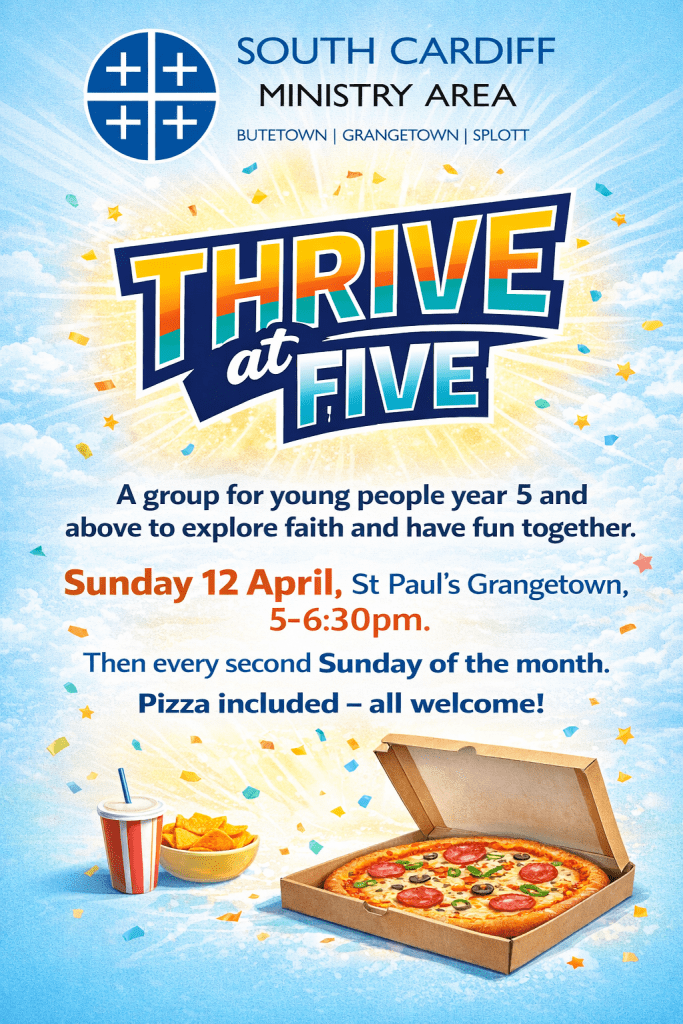
Thrive at Five youth group
A new group for young people is being launched after Easter. Thrive At Five is taking place on Sunday 12 April from 5-6.30pm in St Paul’s Community Hall, and then on the second Sunday of the month going forward.
The group arose out of the recent Confirmation classes that were held, but it is open to any young people in year 5 of school or older. We’ll explore the Christian faith in a fun way and conclude the evening with free pizza. All welcome!
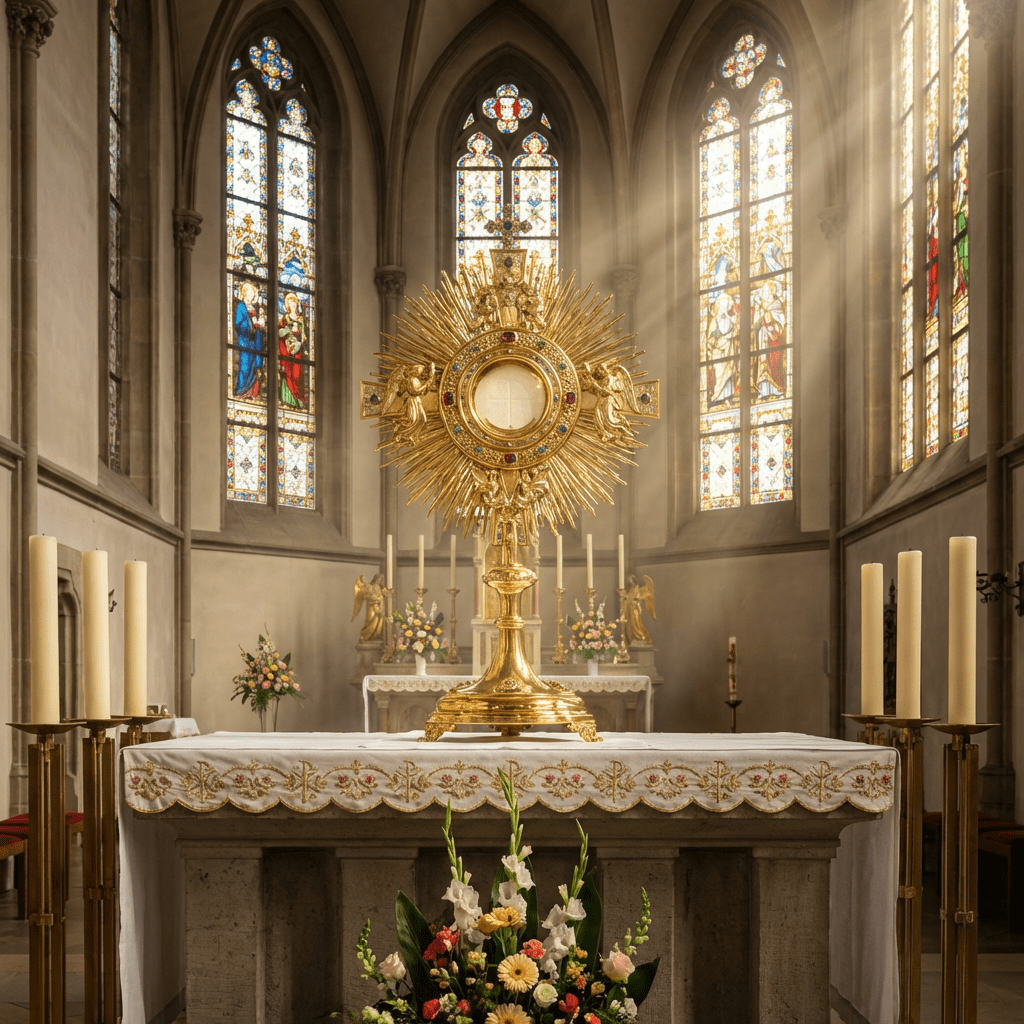
Prayer before the Blessed Sacrament
It’s so important to find space for silent prayer in the midst of our busy lives, but it’s also very hard to find that space! To provide an opportunity for this, a monthly time of prayer before the Blessed Sacrament will begin in April, in St Dyfrig & St Samson’s.
The first occasion will be Monday 13 April, from 5.45pm-6.15pm, followed by the usual 6.30pm mass. It will then take place at this time on the second Monday of every month.
Do come along and join us for some quiet time with Jesus.
Grangetown Consultation
St Paul’s and St Dyfrig & St Samson’s churches in Grangetown are working together to understand what really matters to our community.
A short survey (about 5 minutes) is available and will help us learn how we can serve and support our neighbourhood better.
You can fill in the survey anonymously or leave your details so we can contact you to follow up on your ideas. Your data will not be shared with anyone else and will be deleted after 12 months.
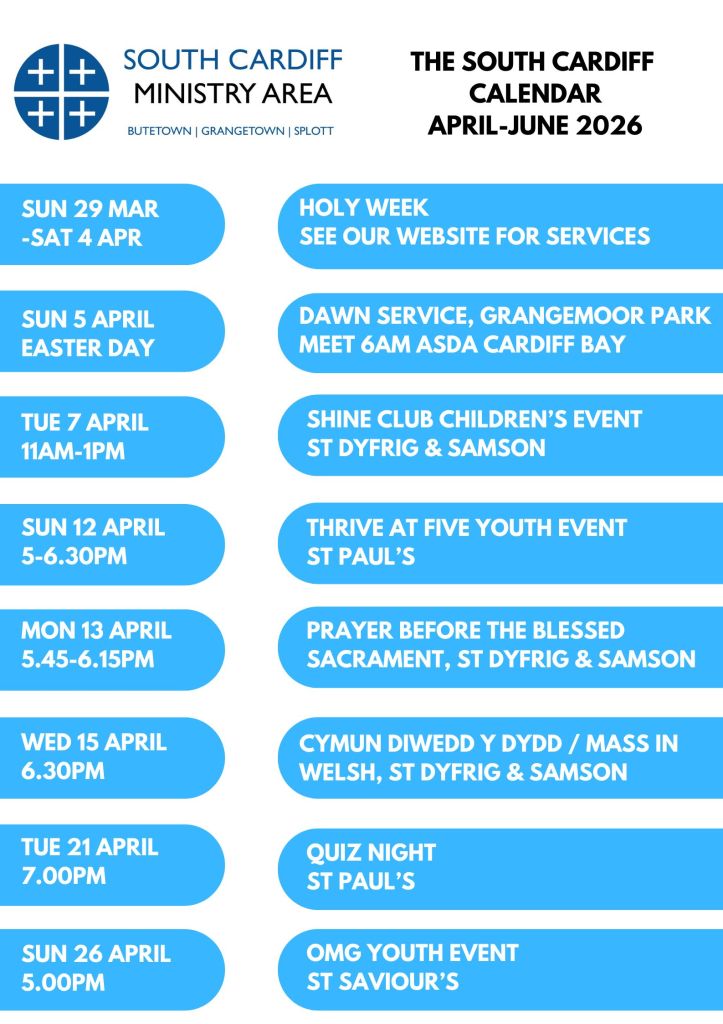
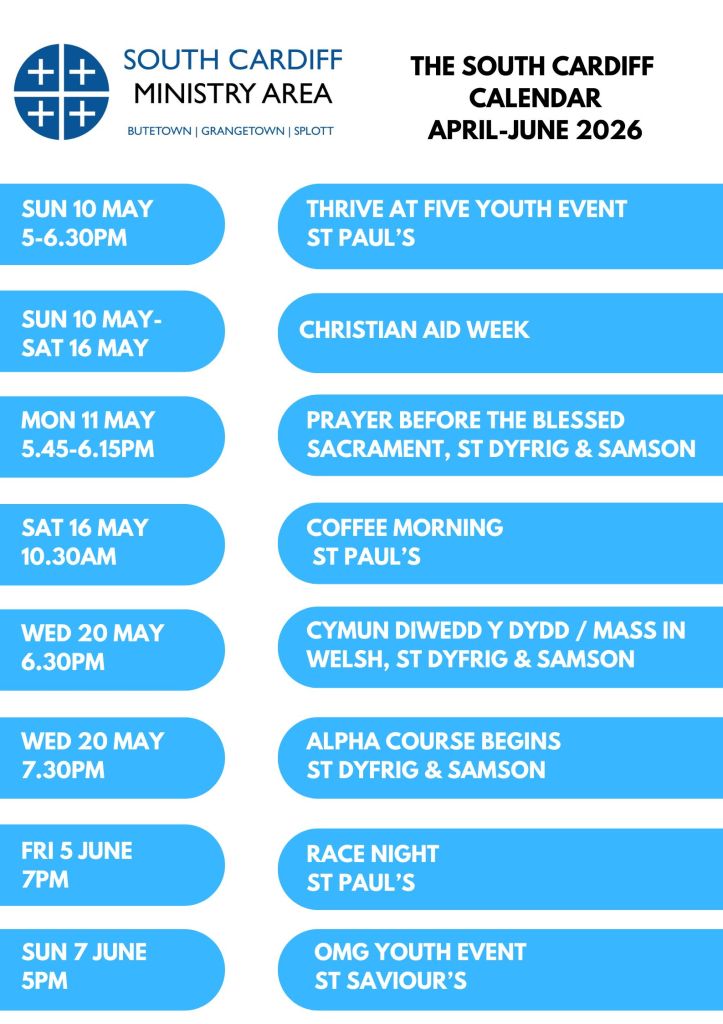
Here is a new-look South Cardiff Calendar, with details of lots of upcoming events and activities across our Ministry Area. Make sure you put everything down in your diary so that you don’t miss anything!
There will be more details about these events in future editions of Connect.
Young people aged 11-18 are invited to join us for the Walsingham Youth Pilgrimage from 3-7 August.
Around 500 young people from all over the UK camp in a field just outside the village of Walsingham. Worship takes place in a large marquee led by the excellent worship band CJM. There are also lots of different activities for young people to take part in during the week.
As part of the Welsh camp, all tents are provided and you will be fully catered for. All you need to bring is a sleeping bag, air bed, clothes and toiletries. For more information, please contact Fr Richard and also take a look at the link below to find out more.
Mass is celebrated each day across our churches. Here’s our pattern of prayer for the week ahead.
Wednesday 1 April | Wednesday of Holy Week
10.00am: Mass at St Paul's
11.00am: Mass at St Mary's
6.30pm: Mass at St Saviour's

Thursday 2 April | Maundy Thursday
7.30pm:  Sung Mass of the Lord's Supper with Washing of Feet, Procession to the Altar of Repose and Watch until Midnight at St Saviour's

Friday 3 April | Good Friday
10.00am: Family Service at St Paul's
3.00pm: Liturgy of the Day at Ss Dyfrig & Samson

Saturday 4 April | Easter Eve
8.00pm: Easter Vigil & First Mass of Easter at St Mary's

Sunday 5 April | Easter Day
9.30am:  Sung Mass at Ss Dyfrig & Samson
9.30am:  Sung Mass at St Saviour’s
11.00am: Sung Mass at St Paul's
11.00am: Solemn Mass at St Mary's

Monday 6 April | Monday in the Octave of Easter
10.00am:  Mass at Ss Dyfrig & Samson

Tuesday 7 April | Tuesday in the Octave of Easter
6.30pm:  Mass at St Mary’s
You can discover more about our regular pattern of worship through the week at
In the gospel reading today, the community of disciples appears to be fractured and fragile. Our dreams for true community begins with living what we hope to change. Here’s today’s reflection from Mass.
BIBLE READINGS: The readingsfor the Tuesday of Holy Week, can be found here.
Dietrich Bonhoeffer, the German theologian and anti-Nazi dissident who was executed at Flossenburg concentration camp in 1945, wrote, “Those who love their dream of a Christian community more than they love the Christian community itself become destroyers of that Christian community.”
We may have a dream for the church and imagine what it could or should be really like, but, if we take Bonhoeffer’s words seriously, then it must begin with a love of the church, whisky acknowledging its sinfulness and weaknesses.
In the gospel reading, at the heart of the celebration from which we receive the sacrament of unity and communion, there is a very real sense of fear and foreboding, self doubt and questioning. Jesus himself is troubled in spirit, and each of his disciples become suspicious of the other. They eye up one another as potential threats and even Peter, who seems so self assured, has the rug pulled from under him. The community of Jesus’ disciples seems fragile.
We live in a society which is so often divided, where we can suspiciously eye up people who are different from us, look for someone to blame for all the problems in society whilst we are distracted from what the real problems might be. How can we, as the Christian community, dismantle the barriers which exist, and model the kind of relationships which bring unity, hope and love? How can we have the kind of conversations which are respectful, choosing our words carefully, listening to others and learning from them? Perhaps it begins with being more self aware and certainly with taking the posture which Jesus adopted— stooping to wash feet, and laying down our lives as servants, loving one another as he has loved us.
Mass today is at S Mary’s Church at 630pm
DAY BY DAY
If you’d like more resources for daily prayer then check out our DAY BY DAY pages.
In the gospel reading today, Judas thinks Mary is wasteful, but their perspectives on life are quite different. Here’s today’s reflection from Mass.
BIBLE READINGS: The readingsfor the Monday of Holy Week, can be found here.
Pablo Picasso, the surrealist painter who died in 1973 is reputed to have said, “I’d like to live as a poor man with plenty of money.” A contradiction if ever there was one.
Incidentally, he died without leaving a will which meant that a feud soon began amongst his family members, including his three illegitimate children. They finally reached an agreement of how his $240 million estate would be divided.
In the gospel reading, Judas Iscariot is eyeing up the value of the expensive ointment in the hands of Mary. We are told that he often dipped his hand into the common fund and had no real concern for the poor, despite saying they it would be better if the ointment had been sold and the money give to the poor. We can only imagine why and how Mary came into possession of the perfume, or what her plans were for it but Mary’s life has been changed by Jesus, and she contradicts what’s Judas thinks is important. She is bold and courageous. She is generous and loving. She holds nothing back from Jesus, and as she anoints his feet, the whole room is filled with the sweet aroma of what she has done.
Our life is often full of contradictions. We say one thing, and do another. We believe one thing, but our belief isn’t always expressed in how we act or respond to others. We may want to live simply and yet litter our lives with so many things we don’t need. We may have a hope or an ambition but do nothing to realise it. Mary’s actions give an example of authentic faith and living, full of love and generosity. Her perspective on life has been changed by Jesus. May we recognise the true value of everything and discover afresh what it means to place Jesus at the heart of our lives, pouring out our love upon him and filling the world with sweetness.
Mass today is at S Dyfrig and S Samson Church at 630pm
DAY BY DAY
If you’d like more resources for daily prayer then check out our DAY BY DAY pages.
Our world loves to erects barriers and boundaries between peoples, nations and groups. God’s vision for the world is far more inclusive – Fr Richard reflects on today’s readings from mass.
Readings for Saturday of the 5th week of Lent can be found here.
Milton Keynes, Harlow, Stevenage, Skelmersdale. These are just a few of the so-called “New Towns” created in Britain in the years following World War Two. The idea was to offer people a place to live designed from scratch, as an escape from overcrowded cities which had developed more haphazardly. One of the concepts of the New Towns was for them to be “open plan” – no walls or fences between properties, to encourage community and neighbourliness. Opinions, of course, vary on the success of the New Towns. But the radical nature of the ideas reminds us how ingrained is the human desire to put up walls and barriers around our little bit of territory – whether it be home, nation, or community.
Our readings today present to us the inclusive vision that God has for his people and his world, where barriers begin to break down. Ezekiel looks forward to a time when God will restore his people from exile in foreign lands to their own nation. The division which existed before, the northern kingdom of Israel and the southern kingdom of Judah, will be no more. “My dwelling place shall be with them, and I will be their God, and they will be my people”, the prophet reports God as saying. This vision goes further in today’s Gospel. Caiaphas makes the unwitting prophecy that Jesus should be sacrificed to save the nation of Israel. But then the Gospel writer says that Jesus’ death would be about more than this – it will also “gather into one the children of God”. Just as the curtain in the Temple was torn in two at the moment of Jesus’ death, so are the divisions between peoples are broken down by his atoning sacrifice.
Our world today, it seems, is becoming increasingly divided. People are keen to retreat behind their self-made borders and boundaries, and pull up the drawbridge. In the midst of this, the Church needs to model what an inclusive community looks like, where God’s love is proclaimed and shared to everyone without distinction.
Mass today is at St Mary’s at 11.30am (with Stations of the Cross at 11am).
If you’d like more resources for daily prayer, then check out our Day By Day pages.
Proclaiming God’s message to the world will not always be popular. What are we to do when we encounter hostility or opposition? Fr Richard reflects on today’s readings from Mass.
Readings for Friday of the 5th week of Lent can be found here.
It’s a truism that politics nowadays is more divisive and angry than ever, fuelled in part by social media. There’s one commentator on YouTube who taps into this phenomenon, but with a twist. He invites those opposed to him to come on his channel and debate with him. They tend to attack him quite viciously, questioning his motives and calling him all sorts of names. Somehow, in the face of all of this, he just sits there, quite calmly, and never responds in kind. Gently, but firmly, he puts his point of view through argument not insult. Occasionally his opponents are won over by this approach and calm down. Often it makes no difference, but he carries on, seemingly undeterred and unflappable.
In our first reading, Jeremiah is feeling harangued and attacked by his opponents, but unlike the YouTuber he has not invited this, nor does he relish it. “‘Denounce him! Let us denounce him!’ say all my close friends, watching for my fall”, says Jeremiah. The reason that Jeremiah is being attacked is quite simply that he is proclaiming God’s message, and the people do not like what they are hearing. Jeremiah challenged their complacency and their sinfulness and tried to lead them back to God. The people and their leaders, however, thought they were doing just fine. In a similar, way, Jesus repeatedly came into conflict with the religious leaders of his day. Today the Jewish leaders try to stone him for whey regard as blasphemy, him claiming to be God. Again, there is a challenge to their ideas, to the status quo, which they cannot accept.
Part of the church’s calling is to be a prophetic voice to society today. We are to challenge conventional wisdom where it conflicts with God’s ways. This can lead to opposition and criticism, which is never easy to take. Both Jeremiah and Jesus continue their mission despite the attacks they face. Jeremiah is convinced that “the Lord is at my side, a mighty hero”; Jesus calmly states his case to the Jewish leaders. May we likewise have that serene trust in God so that we might preach the Word of God whether it is popular or not.
Mass today is in St Saviour’s at 10am.
If you’d like more resources for daily prayer then check out our Day By Day pages.
Names are important in the Bible, often indicating a person’s calling or mission. If we were to adopt a name based on how God wants us to serve him, what would it be? Fr Richard reflects on today’s readings from Mass.
Readings for Thursday of the 5th week of Lent can be found here.
Names are important things – they cement our identity and give us a sense of who we are, either when we introduce ourselves to others or are addressed by them. Nowadays names are given to babies on the basis of what the parents happen to like, but in former times they described an attribute or occupation of the person concerned. It’s often fun to look up the meaning of names to see how well they apply to the ones who bear them. Just to take some random examples, Dean comes from the Latin Decanus, meaning a person in charge of 10 others. Jeffrey is a form of Godfrey, meaning “God’s peace”. Richard means “strong leader” in Old French while Martin comes from Mars, the Roman God of war.
In our first reading God changes Abram’s name as a result of the covenant God makes with him. He is now to be called Abraham, meaning “father of a multitude of nations”. This name is in part related to Abraham’s vocation, but it is mainly about God’s vision for the world. His love and providence is not confined to one family or nation, but extends to all people everywhere. In the Gospel, Jesus claims the divine name of “I Am” which God revealed to Moses in the Book of Exodus. This assertion of divinity, both through the name “I Am” and saying that he existed before Abraham, causes the Jewish leaders to try and stone him for blasphemy. But as with Abraham, this alternate name for Jesus – “I Am” – tells us something about what God is doing in the world. He reveals himself to us in human form, in the man Jesus, whose glory comes not from himself but from the Father.
Whatever our name, and whatever it means, let us reflect on how God’s purposes are being fulfilled through us. What is our particular vocation, the way in which we are being called to serve him in the world? If we were to be given a holy nickname, what would it be, reflecting how we are seeking to make his love known to everyone?
Mass today is in St Dyfrig & St Samson at 10am.
If you’d like more resources for daily prayer, then check out our Day By Bay pages.